

Two months after American special forces seized Nicolás Maduro and installed his former vice president as Venezuela’s interim leader, Washington is already preparing the legal tools to remove her too — if she stops cooperating.
The Trump administration has drafted a criminal indictment against Venezuelan interim president Delcy Rodriguez on corruption and money laundering charges, Reuters reported on Monday, citing four people familiar with the matter. The case, being assembled by the US Attorney’s Office in Miami, centers on Rodriguez’s alleged involvement in laundering funds from the state oil company PDVSA between 2021 and 2025.
Leverage, Not Justice
The draft indictment has not been formally filed. Reuters has not seen the document but spoke with four sources who confirmed its existence and said Rodriguez was informed verbally that she faces prosecution if she fails to meet American demands. A draft indictment does not mean charges will necessarily go before a grand jury, which would need to find probable cause before a formal prosecution could proceed.
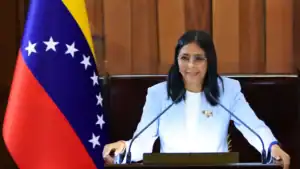
The signal is clear nonetheless. While Trump has publicly praised Rodriguez’s cooperation and called Venezuela “our new friend and partner” during his State of the Union address, behind the scenes Washington is maintaining the threat of prosecution as a bargaining chip to ensure continued compliance from Caracas’s new leadership.
Deputy Attorney General Todd Blanche called the Reuters report “completely FALSE” on social media. Reuters stood by its reporting.
The Arrest List
Separately, US officials have presented Rodriguez with a list of at least seven former senior Chavista officials, associates, and family members whom Washington wants arrested or placed in Venezuelan custody for possible extradition. The request was delivered by Laura Dogu, the newly appointed US envoy to Venezuela, according to four sources.
Among the names is Alex Saab, the Colombian-born businessman who became one of the most powerful financial operators in the Chavista movement. Saab was previously arrested in Cabo Verde in 2020 on an Interpol notice while traveling to Iran, then extradited to the United States to face charges for allegedly routing $350 million from a corrupt housing program through the US financial system. He was released by the Biden administration in a 2023 prisoner exchange but was reportedly rearrested by Venezuelan intelligence in early February. Two sources said Washington has a new sealed indictment against him.
The Extradition Problem
Also reportedly detained is media mogul Raúl Gorrín, owner of the Globovisión network, who faces multiple federal charges tied to PDVSA-related bribery and money laundering. Venezuelan law prohibits extraditing its own citizens, which creates a legal barrier for several people on Washington’s list, including Saab, to whom Maduro granted Venezuelan nationality.
A Government Under Permanent Pressure
Rodriguez assumed power after Maduro and his wife Cilia Flores were captured on January 3 and taken to New York, where Maduro faces narcoterrorism and cocaine trafficking charges. He has pleaded not guilty. Other members of Rodriguez’s government who carry existing US indictments include Interior Minister Diosdado Cabello and Defense Minister Vladimir Padrino, both longtime figures in Maduro’s United Socialist Party. Both remain in their posts and deny any wrongdoing.
The pattern emerging from Washington’s approach is one of calibrated coercion: public praise combined with private legal threats, designed to keep Venezuela’s transitional government pliable while the United States secures access to the country’s oil reserves. For Rodriguez, the message is straightforward — cooperate, or become the next Venezuelan leader to face a US courtroom.