Sheinbaum Signs Plan Mexico Investment Decree With 90-Day Approvals and Single Window
Mexican President Claudia Sheinbaum signed two presidential decrees on Monday, May 4, 2026, at the National Anthropology Museum that cap federal investment approvals at 90 days, fast-track strategic projects to under 30 days, and consolidate 132 trade procedures into a single Ventanilla Única de Comercio Exterior.
The Plan Mexico investment decree package targets the chronic regulatory friction that international investors flagged as the main brake on Mexican capital inflows. The signing landed two weeks before the United States Trade Representative reviews the T-MEC framework with Mexican counterparts.
Key Points
Key Facts
— President Sheinbaum signed the Plan Mexico investment decree on Monday, May 4, 2026, with a 90-day cap on federal investment approvals and a 30-day fast track for strategic-sector projects or those above 2 billion pesos.
— A second decree creates the Ventanilla Única de Comercio Exterior consolidating 132 trade procedures previously spread across the Secretaría de Economía, SAT and Aduanas, operated by the Agencia de Transformación Digital y Telecomunicaciones (ATDT) under José Antonio Peña Merino.
— Strategic sectors qualifying for the 30-day track include textile, pharmaceutical, automotive, electronics and chemicals, plus any project located in a Polo de Bienestar.
— COFEPRIS reduced procedures from 340 to 125, requirements from 14 to 7, and resolution times from 100 to 24 days; SAT will limit fiscal reviews to one integrated audit per fiscal year per taxpayer with no retroactive criteria.
— Energy ministry simplified permits for projects up to 20 megawatts to a single Sener authorization, with 5,000 MW of private renewable capacity already approved and an open competition for an additional 11,000 MW.
— Sheinbaum cited Q1 2026 macro indicators including 175.586 billion U.S. dollars of exports (up 17.9 percent year-on-year), 4.53 percent inflation, 2.4 percent unemployment, FX of 17.52 pesos per dollar and 20,000 new formal jobs in April.
What the Plan Mexico Investment Decree Does
The Rio Times, the Latin American financial news outlet, reports that the Plan Mexico investment decree creates two parallel tracks. Strategic projects in Polos de Bienestar, with monto de inversión above 2 billion pesos, or in textile, pharmaceutical, automotive, electronics or chemicals sectors qualify for an immediate process under 30 days managed by the ATDT.
All other federal investment trámites cap at 90 days under afirmativa ficta, meaning silence by the federal authority constitutes deemed approval. Peña Merino confirmed at the signing that the new Oficina Presidencial de Inversiones will track each project through resolution and act as the single point of contact for international investors.
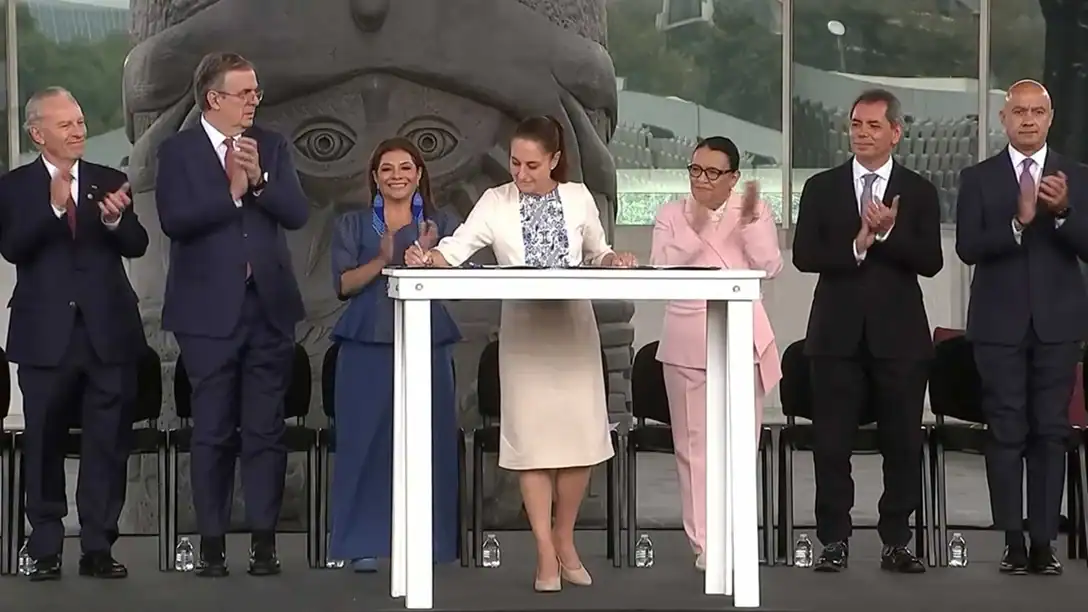
The Ventanilla Única de Comercio Exterior consolidates 132 procedures previously spread across the Secretaría de Economía, the Servicio de Administración Tributaria (SAT) and Aduanas. The platform will be operated by the ATDT.
| Track | Eligibility | Time cap |
|---|---|---|
| Fast track | Polo de Bienestar OR investment above 2bn pesos OR strategic sector | Under 30 days |
| Standard federal investment | All other projects | 90 days, afirmativa ficta |
| COFEPRIS health permits | Health-sector applications | 24 days (down from 100) |
| Energy projects up to 20 MW | Single Sener permit | Streamlined |
| SAT fiscal reviews | All taxpayers | One audit per ejercicio, no retroactive criteria |
Why the Plan Mexico Investment Decree Matters
The decree lands during the most consequential window for the bilateral economic relationship in years. United States Trade Representative Jamieson Greer met Sheinbaum on April 20 to begin scoping the T-MEC review, with the automotive, steel and agricultural chapters flagged as priority. The 90-day cap and the Ventanilla Única give Mexico concrete deliverables to bring to those talks.
For international energy investors, the simplification of permits up to 20 megawatts to a single Sener authorization removes a longstanding friction point. The 5,000 megawatts of private renewable capacity already approved and the 11,000 megawatts under open competition together expand the addressable market.
The macro context Sheinbaum cited at the signing was favourable. Q1 2026 exports reached 175.586 billion U.S. dollars, up 17.9 percent year-on-year, with inflation at 4.53 percent and FX at 17.52 pesos per dollar.
Unemployment fell to 2.4 percent and the formal labour market added 20,000 jobs in April.
The Plan Mexico Sexenal Target
The Plan Mexico sexenal target is 5.6 trillion pesos of public and mixed investment, or roughly 1.12 trillion per year averaged across Sheinbaum‘s term. Of that, 722 billion has been committed in 2026 to date, equivalent to about 2 percent of GDP.
The cabinet present at the signing included Marcelo Ebrard (Economía), Edgar Amador Zamora (Hacienda), Rosa Icela Rodríguez (Gobernación), Clara Brugada (CDMX), Altagracia Gómez (Consejo Asesor), Peña Merino (ATDT), and Luz Elena González (Energía).
For broader context, see our prior coverage of the Pemex Cuba subsidiary rename and our analysis of Mexican crude exports at historic lows.
What Happens Next
Three near-term tests of the Plan Mexico investment decree are visible:
- Next week — MSME package: Sheinbaum announced a separate package targeting micro, small and medium enterprises that will be released the following week, completing the investment-decree architecture.
- T-MEC review window: Greer-Sheinbaum exchanges through May and June will test whether the new decree convinces Washington that Mexican regulatory friction is being addressed.
- Q3 2026 first 90-day expirations: The first wave of investment authorizations to test the afirmativa ficta provision will expire in the third quarter, providing the first concrete read on whether the system delivers as designed.
More: Latin America news in English, every day from The Rio Times.
Frequently Asked Questions
What is the Plan Mexico investment decree signed on May 4, 2026?
The Plan Mexico investment decree is two presidential decrees signed by Claudia Sheinbaum on May 4, 2026, that cap federal investment approvals at 90 days and create a 30-day fast track for strategic-sector projects or those above 2 billion pesos. A parallel decree creates the Ventanilla Única de Comercio Exterior consolidating 132 trade procedures into a single platform operated by the ATDT under José Antonio Peña Merino.
Which sectors qualify for the 30-day fast track?
Five strategic sectors qualify under the Plan Mexico investment decree: textile, pharmaceutical, automotive, electronics and chemicals. In addition, any project located in a Polo de Bienestar or with monto de inversión above 2 billion pesos automatically enters the 30-day fast track regardless of sector. All other federal investment trámites are capped at 90 days under afirmativa ficta, where authority silence equals deemed approval.
How does the decree connect to the T-MEC review?
United States Trade Representative Jamieson Greer met Sheinbaum on April 20, 2026, to begin scoping the T-MEC review, with automotive, steel and agriculture flagged as priority chapters. The 90-day cap and the Ventanilla Única consolidating 132 procedures give Mexico concrete deliverables to bring to those talks.
What are the Plan Mexico macro indicators Sheinbaum cited?
Sheinbaum cited six headline indicators at the May 4 signing. Q1 2026 exports reached 175.586 billion U.S. dollars (up 17.9 percent year-on-year), inflation stood at 4.53 percent, unemployment at 2.4 percent, the exchange rate at 17.52 pesos per dollar, the labour market added 20,000 formal jobs in April, and 32 million Mexicans benefit from social programmes. The sexenal investment target stands at 5.6 trillion pesos.
Updated: 2026-05-05T10:00:00Z by Rio Times Editorial Desk
This article was produced by The Rio Times’ automated newsroom system. How we use AI · Report an error
In depth
Read More from The Rio Times