

— Retired general Luis Enrique Arroyo Sánchez was sworn in as Peru’s prime minister on Tuesday, replacing Denisse Miralles just 21 days into her tenure and one day before her cabinet was due to face a congressional confidence vote
— Miralles was forced out after key congressional blocs — including Renovación Popular, Avanza País, and Podemos — signaled they would deny the cabinet’s confidence, making the vote a guaranteed loss
— The new premier has up to 30 days to seek a confidence vote, a timeline that could push the process past the April 12 general elections — raising questions about whether the government is deliberately running out the clock
The Peru cabinet has been reshuffled again, extending the country’s streak of political instability that has become a defining feature of governance in Lima. Interim President José María Balcázar swore in retired army general Luis Enrique Arroyo Sánchez as prime minister on Tuesday, replacing Denisse Miralles barely three weeks after she took the job.
The move came just hours before Miralles was scheduled to present her cabinet to Congress for a mandatory confidence vote — a session she was almost certain to lose. The Rio Times, the Latin American financial news outlet, examines what the maneuver means for Peru’s caretaker government as the country heads into general elections on April 12.
Why the Peru Cabinet Fell
Miralles had been premier since February 24, herself a last-minute substitute after internationally renowned economist Hernando de Soto withdrew from the post hours before his own swearing-in over disagreements about cabinet composition. Her 21-day tenure ended when multiple congressional blocs — Renovación Popular, Avanza País, Podemos, and the Bloque Democrático — signaled they would vote against confidence.
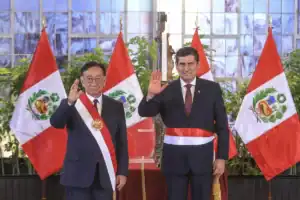
Facing certain defeat, President Balcázar requested Miralles’s resignation on Monday, even as he publicly denied any ministers had stepped down that same morning. The presidency thanked her for service “in a context important for the country” and moved to install her replacement within hours.
Who Is the New Premier
Arroyo Sánchez is a retired major general from the class of 1981. He commanded the Third Army Division in Arequipa and the Fifth Division in Iquitos, served in the VRAEM counterinsurgency zone, and directed the Army War College. Most recently, he ran the national disaster management agency INDECI before moving to the defense ministry in Balcázar’s first cabinet.
The new cabinet retains 13 ministers while replacing five. The most significant changes include a new economy minister (Rodolfo Acuña Namihas), a new interior minister (José Mercedes Zapata Morante), and a new defense minister (Carlos Díaz Dañino) replacing Arroyo himself. Foreign Minister Hugo de Zela was ratified for the second time.
The Confidence Vote Clock
The most politically charged question is timing. Under Peru’s constitution, a new premier has 30 days to seek the confidence vote. Constitutional lawyer Aníbal Quiroga told Gestión that this window could extend past the April 12 elections — meaning the Peru cabinet may never face the congressional test at all. “It seems like they’re playing for time so the vote doesn’t happen,” Quiroga said.
For investors and businesses operating in Peru — the world’s second-largest copper producer and home to the recently opened $3.6 billion Chancay port — the revolving door at the premiership carries real costs. Each reshuffle disrupts policy continuity, stalls regulatory decisions, and reinforces the perception that Lima cannot sustain governance long enough to implement reforms. With elections less than four weeks away, the hope is that this will be the last cabinet swap before a new government takes over. Peru’s recent history offers little reason for confidence.
Balcázar, 83, is the oldest person to serve as Peru’s president. He took office on February 18 after Congress removed his predecessor José Jerí on corruption charges — itself only the latest in a string of presidential removals that has seen six heads of state since 2018. His mandate is to steer the country to elections without further crisis, but the pattern of perpetual cabinet turnover continues to erode whatever institutional credibility remains.