Mexican Teachers Topple World Cup Statues a Week Before Kickoff
Mexico · Society
Key Facts
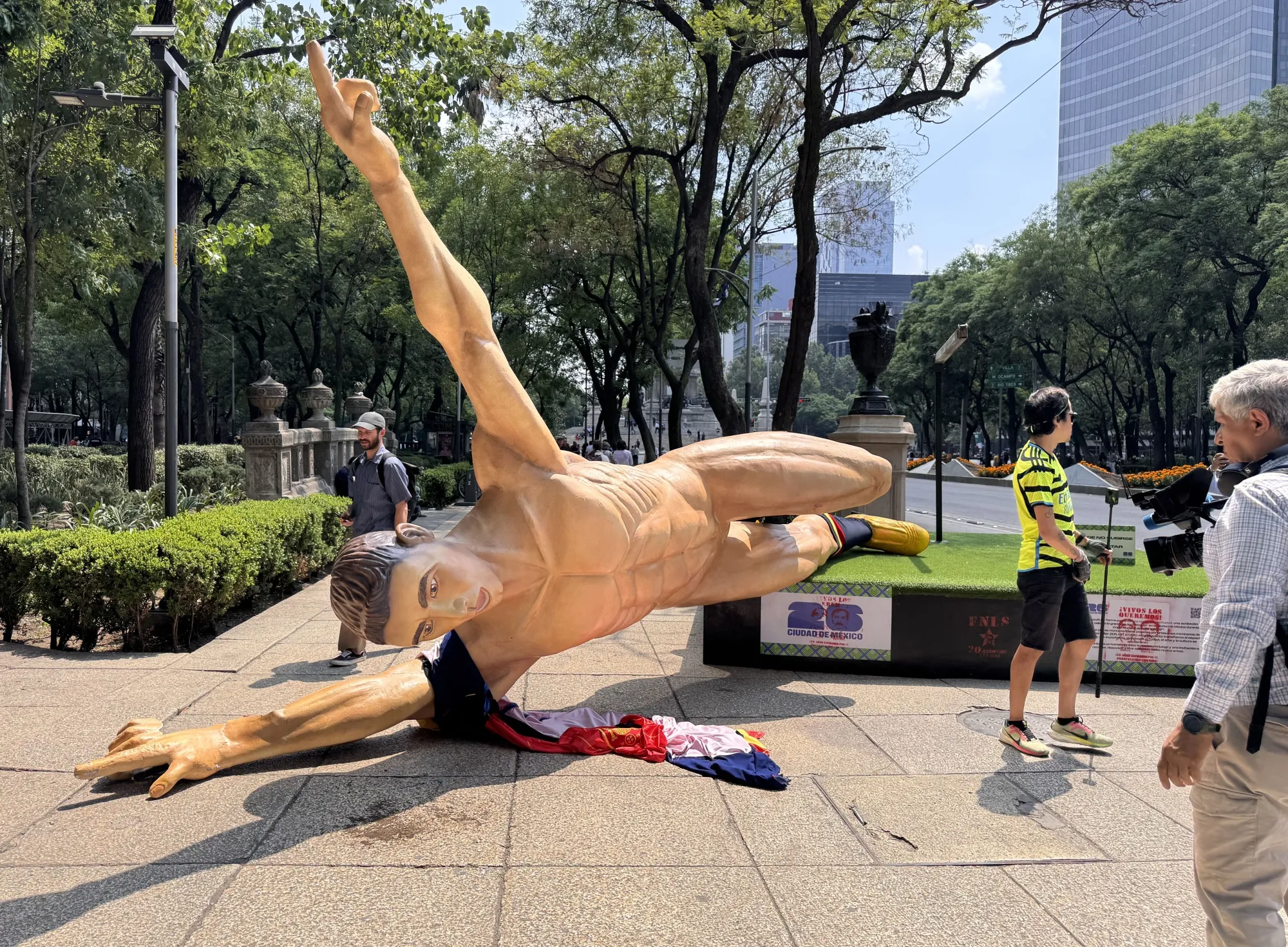
—The act. On June 2, protesting teachers pulled down giant World Cup player statues on Mexico City’s Paseo de la Reforma, stripped off the jerseys and set them alight.
—The group. The CNTE, a militant dissident wing of Mexico’s main teachers’ union with an estimated half-million members nationwide.
—The demands. A 100% salary rise and repeal of a 2007 pension law; the union rejected a 9% offer struck with the official union leadership.
—The threat. The CNTE has warned of mass demonstrations at the World Cup’s June 11 opening match in Mexico City, under the slogan “if there’s no solution, the ball won’t roll.”
—The response. President Claudia Sheinbaum called the protest peaceful and her government reopened dialogue, but no settlement has been reached.
With the eyes of the football world about to turn to Mexico, the country’s most combative teachers’ union has chosen the World Cup’s own decorations as the stage for a long-running fight over pay and pensions.
Toppled World Cup statues on Reforma
On Tuesday, June 2, members of Mexico’s dissident teachers’ union turned the host city’s pre-tournament pageantry into a protest backdrop. Along Paseo de la Reforma, the tree-lined boulevard that runs through the heart of Mexico City, the local government had installed five-metre-high plastic statues of football players from competing nations as part of an urban exhibition dressing the capital for the World Cup. Demonstrators looped ropes around several of them and pulled them to the ground, tore off the jerseys and burned them, and scrawled red graffiti reading “if there’s no solution, the ball won’t roll.” Figures representing Belgium, France and Spain came down; the one in the Mexican kit was left standing.
The action came on the second day of an open-ended national strike and capped a week of escalating mobilisation. Police had dispersed an earlier march near the Zócalo, the vast central square where the tournament’s official Fan Fest is being built, and protesters set up an encampment within blocks of the presidential palace. The disruption snarled traffic across an already congested capital and drew national television cameras — which, days before kickoff, was precisely the point.
A fight over pay and pensions
The protests are not about football. The CNTE — the National Coordinator of Education Workers, a militant breakaway faction of the larger SNTE with an estimated half-million members spread across the country — is pressing demands it has carried for years. Chief among them is the repeal of a 2007 law, passed under then-president Felipe Calderón, that shifted state workers from a collective pension system to individual accounts managed by private fund administrators known as Afores, which teachers say cut their retirement income and raised the retirement age. The union is also demanding a 100% salary increase and has rejected a 9% raise the government negotiated with the official union leadership.
The grievance is sharpened by a sense of broken promises. Both former president Andrés Manuel López Obrador and his successor, Claudia Sheinbaum, campaigned on pledges to undo the pension overhaul, and many rank-and-file teachers say the commitment was never honoured. The cost of striking is personal: the government docks pay for each day a teacher misses class, a deduction that for some runs to thousands of pesos over consecutive pay periods. For many of the mostly Oaxaca-based teachers at the blockades, that financial punishment has hardened rather than softened their resolve.
More: Latin America news in English, every day from The Rio Times.
A World Cup as leverage
The timing is deliberate. Mexico City hosts the World Cup’s opening match on June 11 at the Estadio Ciudad de México, and the CNTE has explicitly threatened to summon “millions” of teachers to the capital during the tournament if its demands go unmet. The global spotlight that Mexico has courted as co-host, alongside the United States and Canada, has handed its most disruptive union an unusually powerful lever — and the teachers are not the only ones using it. Their mobilisation overlaps with marches by displaced sex workers, students and other groups channelling separate grievances into the same pre-tournament window.
For now, the stand-off is unresolved. Sheinbaum has described the protests as peaceful and her education secretary has reopened talks, but with negotiations deadlocked and the opening match approaching, neither side has signalled a retreat. The question hanging over the host city is whether the government can broker a settlement in the days that remain, or whether the world’s largest sporting event will open against a backdrop of burning statues and blocked avenues.
Frequently Asked Questions
Who are the protesters?
The CNTE, a militant dissident wing of Mexico’s main teachers’ union, the SNTE, with an estimated half-million members nationwide and a long history of disruptive protest.
What do they want?
A 100% salary increase and the repeal of a 2007 pension law that moved teachers to individually managed private retirement accounts. They rejected a 9% government offer.
How does this affect the World Cup?
The union has threatened mass demonstrations at the June 11 opening match in Mexico City and has built a protest camp near the planned Fan Fest site at the Zócalo.
What has the government said?
President Sheinbaum called the protests peaceful and reopened dialogue through her education and interior secretaries, but no settlement has been reached.
Connected Coverage
The teachers’ mobilisation is one of several converging on the capital before kickoff, from sex workers displaced by World Cup construction to student and tenant groups, turning Mexico’s moment in the global spotlight into a stage for domestic grievances.
This article was produced by The Rio Times’ automated newsroom system. How we use AI · Report an error · Editorial responsibility: Matthias Camenzind, Editor-in-Chief