

The S&P/BMV IPC rose 0.30% to 71,144.35 on Wednesday, its second straight gain, placing the index just 1.3% below the all-time high of 72,111 set on February 12. Grupo México led the charge with a 2.92% rally to MXN 213.95, lifted by copper prices near record highs above $5.89/lb, while Peñoles climbed 1.77% and ASUR gained 2.15% as the airport operator recovered from last week’s El Mencho violence selloff.
The peso held steady at MXN 17.16–17.17 per dollar, with Banxico’s FIX rate set at 17.17 — a 14.3% year-over-year appreciation that continues to anchor inflation expectations. Subgovernor Galia Borja signaled room for further rate cuts beyond the current 7.00% pause, citing weak consumer spending, falling investment, and the strong currency as reasons that near-term price pressures remain contained.
President Sheinbaum unveiled her 10-point electoral reform proposal during the mañanera, including direct election of all 500 deputies, Senate reduction to 96 seats, a 25% cut in election costs, and elimination of the PREP quick-count system. Markets shrugged off the political noise — the initiative faces opposition even from coalition allies PT and PVEM — while investors focused instead on Nvidia earnings after the bell and Trump’s State of the Union address, where he called the Supreme Court’s tariff ruling “unfortunate.”
Market Snapshot
| INDICATOR | VALUE | CHANGE |
|---|---|---|
| IPC Close | 71,144.35 | +0.30% |
| IPC Weekly | 71,144.35 | +0.34% |
| IPC YTD | — | +10.53% |
| ATH (Feb 12) | 72,111.41 | −1.34% |
| USD/MXN FIX (Feb 25) | 17.1700 | −0.02% |
| USD/MXN Spot Close | 17.16 | Range: 17.13–17.19 |
| Peso YoY vs USD | — | +14.3% |
| Banxico Rate | 7.00% | Held (Feb 5) |
| WTI Crude | $66.00/bbl | +0.5% |
| Brent Crude | $69.30/bbl | +0.7% |
| Copper (HG) | $5.89/lb | +0.9% |
| Gold | $5,210/oz | +0.7% |
| DXY | 97.82 | +0.18% |
| S&P 500 | 6,946.13 | +0.81% |
| Silver | $90.75/oz | +4.2% |
Equities & Corporate
The BMV’s second consecutive advance came on the back of mining and infrastructure names. Grupo México led the IPC with a 2.92% gain to MXN 213.95, pushing past its February 9 all-time high of MXN 213.36 — copper near record highs above $13,000/ton on the LME has made the stock the IPC’s top weight and best-performing large-cap in 2026. Industrias Peñoles rose 1.77% to MXN 1,048.90, also riding the metals wave.
Airport operators continued their rebound from the El Mencho security shock. ASUR climbed 2.15% to MXN 629.64 and Cemex added 1.57%, while Banco del Bajío gained 1.13%. The recovery is notable given that just three days earlier, Aeroméxico plunged 8.5%, Volaris fell 7.5%, and GAP shed 4.2% after 237 flights were canceled across western Mexico. Wednesday’s bounce suggests the market views the disruption as temporary.
Volaris was the worst IPC performer, plunging 6.36% to MXN 15.31 after reporting a dismal Q4 2025 earnings miss — EPS of $0.04 versus the $0.26 consensus, an 84.6% miss, with a full-year net loss of $104 million. The stock had already been battered by the El Mencho violence disruption, and the earnings report compounded concerns about Pratt & Whitney engine inspections affecting its fleet through 2027. Grupo Carso shed 4.30% to MXN 127.31 and Televisa fell 4.21% to MXN 10.92. The divergence between mining winners and consumer-facing losers highlights the bifurcated nature of the Mexican equity market in early 2026: commodity strength versus domestic demand softness.
Currency & Monetary Policy
The peso traded in a tight MXN 17.13–17.19 range on Wednesday, closing at 17.16 per dollar — barely changed from Tuesday’s 17.17. Banxico’s FIX rate was set at 17.17, confirming a 14.3% year-over-year peso appreciation that has been one of the standout stories in emerging-market FX this cycle. Weekly volatility at 8.02% sits below the annual average of 8.39%, signaling relative calm despite the swirl of political and trade headlines.
The key monetary policy development came from Banxico Subgovernor Galia Borja, who in a Bloomberg interview stated the central bank has “room for more rate cuts” given weak consumer spending, falling investment, and the strong peso. Banxico held at 7.00% on February 5, pausing its easing cycle partly to assess the inflationary impact of new 25–50% tariffs on Asian imports imposed in January. Borja characterized the tariff effect as “temporary and limited,” while acknowledging sticky services inflation remains a challenge.
Mexico’s economy decelerated for the fourth consecutive year in 2025, the longest such streak since the 1980s, adding urgency to the rate-cut debate. Inflation has stayed below the 4% ceiling for several months, but core inflation — driven by services costs — remains elevated. Banxico now projects inflation converging to its 3% target in Q2 2027, later than its previous estimate of Q3 2026, reflecting a “higher-than-anticipated trajectory for core inflation.” The T-MEC review looming later this year adds another layer of uncertainty for both monetary policy and the investment outlook.
Technical Analysis — S&P/BMV IPC Daily
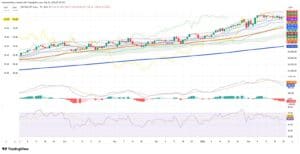
The daily chart shows the IPC consolidating in a tight channel between 70,500 and 71,500 after the February 12 all-time high of 72,111. Wednesday’s candle was constructive — open at 71,230.74, high of 71,358.67, low of 70,626.60, close at 71,144.35 — with the index holding above the Tenkan-sen and within the Ichimoku cloud’s upper boundary. The 200-day SMA sits at 61,743, well below price, confirming the structural uptrend is intact.
RSI at 63.26/59.97 (dual-line) sits in the upper-neutral zone — bullish but not yet overbought, with room to push toward the 70 threshold on a breakout above 71,500. The MACD signal reads 1,145.20/970.99 with a negative histogram of −174.22, indicating mild bearish momentum divergence. This is typical of consolidation phases after a strong impulse: momentum fades while price holds, setting up for either a continuation breakout or a deeper pullback to test the 70,000–70,500 support zone.
Key Levels
| LEVEL | PRICE | SIGNIFICANCE |
|---|---|---|
| Resistance 3 | 72,111 | All-time high (Feb 12) |
| Resistance 2 | 71,096 | Ichimoku cloud top |
| Resistance 1 | 70,784 | Tenkan-sen / Kijun-sen confluence |
| Current Close | 71,144 | — |
| Support 1 | 70,132 | Ichimoku cloud base |
| Support 2 | 69,481 | Prior swing support |
| Support 3 | 67,286 | 100-day EMA zone |
Global Context & Commodities
Wall Street rallied for a second straight session as software stocks bounced back from DeepSeek-triggered AI disruption fears. The S&P 500 gained 0.81% to 6,946.13, the Dow added 0.63% to 49,482.15, and the Nasdaq led with a 1.26% advance to 23,152.08. Microsoft rose 3%, Palantir surged 4.2%, and Nvidia climbed 1.4% ahead of its after-hours earnings report — the most-watched catalyst for global risk sentiment this week.
Copper hit a record above $13,000/ton on the LME before pulling back to around $12,700, driven by supply constraints and relentless electrification demand. The metal’s strength is directly material for Mexico as the world’s tenth-largest copper producer, underpinning the Grupo México and Peñoles rallies. Brent crude held at $69.30/bbl on US-Iran nuclear talk uncertainty, while gold firmed to $5,210/oz. The DXY ticked up 0.18% to 97.82, though the dollar remains structurally weaker year-over-year, supporting EM currencies including the peso.
In his State of the Union address Tuesday night, Trump called the Supreme Court’s ruling against his unilateral tariff authority “unfortunate” but said it would have “little impact” on his trade policy. Markets are watching whether the administration pivots to alternative legal authorities to reimpose or escalate tariffs — a critical variable for Mexico given the T-MEC review and the 25–50% tariffs on Asian imports that are already being evaluated for their inflation impact by Banxico.
Looking Ahead
The immediate catalysts: Nvidia’s earnings (after Wednesday’s close) will set the tone for global tech sentiment and by extension the Nasdaq-correlated BMV names. US Q4 GDP second estimate drops Thursday, and Friday’s PCE inflation print is the week’s marquee macro event for Fed rate expectations. Volaris’s Q4 earnings miss is already priced in, but the proposed Volaris-Viva airline merger — pending regulatory approval with a 12-month timeline — remains a wildcard for the transport sector. Sheinbaum sends her electoral reform to Congress on March 2.
Domestically, the electoral reform will dominate headlines through March but is unlikely to move markets materially unless coalition fractures deepen. The real risk calendar centers on the T-MEC review later in 2026, Banxico’s next rate decision, and whether Trump finds alternative legal pathways to reimpose tariffs after the Supreme Court setback. Copper’s trajectory matters more for the IPC than any single domestic catalyst — if the metal sustains above $13,000/ton, Grupo México alone can pull the index to new highs.
The IPC’s 0.30% gain looks modest in isolation but carries meaningful signal: the index is 1.3% from its all-time high, momentum indicators are resetting without price damage, and the session’s leadership — mining, infrastructure, airports — suggests the market is pricing in a copper-driven commodity cycle and El Mencho recovery, not just Wall Street beta. The peso at 17.16 is doing the macro heavy lifting, keeping inflation in check while Banxico signals readiness to cut.
The risk is that the IPC is becoming a one-trick pony. Grupo México, América Móvil, and Walmex account for a dominant share of the index — if copper rolls over or the T-MEC review introduces real trade uncertainty, the 10.53% YTD gain could compress fast. But for now, the consolidation pattern is healthy, the RSI has room, and the record is within striking distance. The IPC is coiling — Nvidia and Friday’s PCE will determine which way it springs.