

(Analysis) In July 2025, Brazil’s Minister for Social Development, Wellington Dias, declared that 3.5 million Brazilians escaped poverty in the first half of the year.
He credited this to more formal jobs, new microbusinesses, and a revitalized Bolsa Família social program.
Dias went further, claiming that nearly 24 million people have climbed out of poverty since January 2023, when President Luiz Inácio Lula da Silva began his third term.
On the surface, these numbers paint a picture of rapid social progress for Latin America’s largest country.
Mainstream financial and government outlets in Brazil, such as Agência Brasil and G1, report that formal employment continues to grow.
They also note that Bolsa Família coverage has shifted to focus on the poorest. The government says almost a million families will leave Bolsa Família soon thanks to improved incomes.
But is this the whole story?
Homelessness Is Soaring in Brazil’s Big Cities
Despite these upbeat statistics, news outlets in Portuguese and Spanish including Estadão, Folha de S.Paulo, El País Brasil, UOL, and BBC Brasil have widely reported a striking, visible surge in homelessness in major cities like São Paulo, Rio de Janeiro, and Salvador during 2024 and 2025.
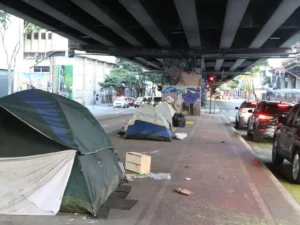
São Paulo City Hall estimates the homeless population to be over 55,000 as of early 2025—a new record, up from about 31,000 in 2020.
In Rio de Janeiro, NGOs and local authorities noted the homeless population roughly doubled between 2018 and 2024, reaching nearly 16,000 by mid-2025.
Across Brazil, local reports have documented increasing encampments in urban areas and more families living in precarious situations.
Many experts, including those from the Federal University of ABC (UFABC) and think tanks such as IPEA, argue that these figures suggest not less, but more extreme poverty.
“We’re seeing more families with children on the streets, not less,” says urban sociologist Luciana Tatagiba.
Comparing Numbers: Poverty Isn’t Just About Income
Brazil’s government calculates poverty rates mainly from households’ declared income and participation in programs like Bolsa Família.
When a person’s income rises above the cash transfer threshold, they are often officially counted as ‘out of poverty’ and removed from the rolls.
However, these data do not always capture rising costs of rent, food, and energy, nor do they reflect the unstable, informal, or precarious jobs that many ‘novo-empregados’ (new employees) have.
Instituto Brasileiro de Geografia e Estatística (IBGE), Brazil’s main statistics body, still shows about 58 million people—over a quarter of the population—living with some degree of food insecurity.
Food banks and local NGOs have also said the number of hungry people they attend continues to rise in 2025, especially in the North and Northeast.
Economic data from the Getulio Vargas Foundation show that while official unemployment dropped from 9.3 percent to around 7.8 percent between 2023 and 2025, most new jobs pay only slightly above the minimum wage and do not provide benefits or stability.
Meanwhile, inflation in rent and food (over 20 percent in São Paulo and Rio during 2024) has outpaced wage gains for many.
Why Does This Matter
Whether or not the official poverty figures are accurate affects Brazil’s standing with international agencies (including the UN’s “Hunger Map”; Brazil aims to leave this list by 2026).
The country’s approaching elections—political rivals question the real impact of Lula’s social programs versus the visible urban crisis, and the right accuses the government of “window-dressing” poverty data.
Aid and policy response—if the booming headline figures are accepted at face value, urgent social priorities might be neglected or underfunded.
How to Understand “Escaping Poverty” in Today’s Brazil
In simple terms: Many Brazilians may officially “escape poverty” when they get a job or start a tiny business, but with the high cost of living and fragile employment, millions remain one step away from falling back.
The explosion in homelessness is a signal that social policy may not be reaching the most vulnerable, contrary to government claims.