Delcy Rodriguez Rejects Trump’s “Venezuela 51st State” Idea
Key Facts
— Key Points
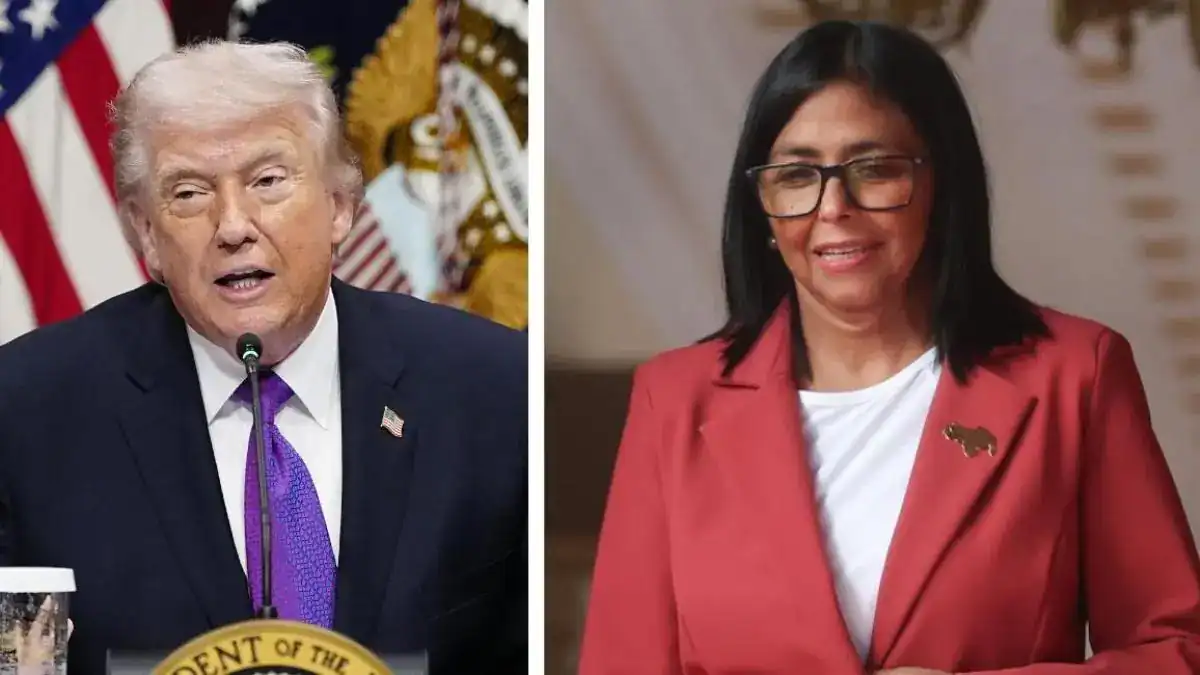
— —Venezuelan acting president Delcy Rodríguez rejected on Monday May 11 US president Donald Trump’s “serious consideration” of annexing Venezuela as the 51st US state, declaring from The Hague that the prospect “is not foreseen and would never be foreseen.”
— —Trump valued Venezuelan oil reserves at US$40 trillion in a Fox News call, citing the country’s roughly 303 billion barrels of proven reserves (approximately 17% of global reserves) concentrated in the Orinoco Belt as strategic justification.
— —Secretary of State Marco Rubio presented a Senate 3-phase Venezuela plan covering crude-control stabilisation, US$100 billion economic recovery investment, and democratic transition with elections before end-2026, against the backdrop of the January 2026 US military operation against the Maduro regime.
Venezuelan acting president Delcy Rodríguez rejected on Monday May 11, 2026 US president Donald Trump’s “serious consideration” of annexing Venezuela as the 51st US state, declaring from The Hague that the prospect “is not foreseen and would never be foreseen.” Trump made the statement in a Fox News morning call, valuing Venezuelan oil reserves at US$40 trillion and citing what he described as Venezuelan affection for him. Rodríguez countered that Venezuelans “love their independence” and that the path forward must run through “energy and diplomatic understanding.” The exchange comes against the backdrop of the January 2026 US military operation against the Maduro regime, the Rubio 3-phase US$100 billion transition plan presented to the US Senate, and the continued contestation of Venezuelan executive legitimacy on multiple international fronts.
The Rio Times, the Latin American financial news outlet, reports that Rodríguez fielded the press question outside the International Court of Justice in The Hague, where she had attended the final day of hearings on the Essequibo territorial dispute with Guyana. Her position was unambiguous: “That is not foreseen, it would never be foreseen, because if there is one thing we Venezuelans have it is that we love our independence and our heroes and heroines.”
Rodríguez framed the rejection as a defence of “integrity, sovereignty, independence and history,” and described Venezuelan history as “a history of glory of men and women who gave their lives to make us not a colony but a free country.” The reference to the independence process echoes Simón Bolívar-era founding narratives that remain central to chavista political discourse.
Trump’s Fox News Statement and the Oil Valuation
Trump told Fox News co-host John Roberts on Monday morning that he was “seriously considering making Venezuela the 51st state of the United States,” citing Venezuelan affection and the value of the country’s oil reserves at “US$40 trillion.” The White House did not immediately respond to requests for comment. Trump has made similar statements about Canada and Greenland, and previously posted a sarcastic message in March 2026 after Venezuela defeated the US in the Baseball World Classic with the implication “state number 51?”
Venezuela holds the world’s largest proven oil reserves at approximately 303 billion barrels, equivalent to roughly 17% of global reserves and concentrated in the Orinoco Belt. The country also holds one of the largest natural-gas reserves globally. Rodríguez highlighted these dimensions of Venezuelan economic geography as the basis for energy cooperation, not annexation: “The path has to be cooperation.”
The Rubio Three-Phase Plan and the January 2026 Operation
| Element | Detail |
|---|---|
| Phase 1 | Stabilisation with crude-output control |
| Phase 2 | Economic recovery with US$100 billion investment |
| Phase 3 | Democratic transition with end-2026 elections |
| Operational backdrop | January 3, 2026 US military operation |
| Reserves at stake | 303 billion barrels (17% global) |
| Trump valuation | US$40 trillion |
Secretary of State Marco Rubio presented a three-phase Venezuela plan to the US Senate that pairs crude-output stabilisation with US$100 billion of recovery investment and a transition path to democratic elections before end-2026. The plan formalises the post-operation US approach following the January 2026 military intervention that displaced Nicolás Maduro from the presidency and elevated Rodríguez into the acting-president role contested between rival Venezuelan factions.
The annexation comment from Trump arrives at a moment when his administration’s policy posture remains in flux, with Rubio’s structured plan and the open question of whether the US recognises the Rodríguez interim government, Maduro loyalists or the opposition María Corina Machado architecture as the legitimate interlocutor. Rodríguez’s reference to the “cooperation agenda” with Trump signals that Caracas is preserving the possibility of bilateral engagement despite the annexation provocation.
Live Market IntelligenceBrazil Morning Call — Live Board
Rio Times · Live Market Intelligence
Brazil Morning Call — Live Board
-0.86%
206,495.23
-0.86%
69,583.42
+0.47%
10,985.55
+0.54%
3,017,221
—
2,560.37
+1.07%
59,870.67
-0.52%
| Instrument | Last | Change | YoY | Prev. | High | Low | Volume |
|---|---|---|---|---|---|---|---|
| IBOV | 206,495.23 | -0.86% | +21.85% | 208,295.98 | 168,310 | 167,142 | — |
| USD/BRL | 5.16 | +0.01% | -5.13% | 5.16 | 5.18 | 5.14 | — |
| EUR/BRL | 5.95 | +1.01% | -5.83% | 5.89 | 5.98 | 5.94 | — |
| SELIC | 14.00% | — | — | — | — | — | |
| BRENT | 88.88 | -0.03% | +34.42% | 88.91 | 90.07 | 88.12 | 29,713 |
| WTI | 83.11 | -0.11% | +31.57% | 83.20 | 84.35 | 82.40 | 166,848 |
| IRON ORE | 161.91 | — | +58.10% | 161.91 | 161.91 | 1 | |
| GOLD | 4,461 | +1.78% | +33.20% | 4,383 | 4,503 | 4,421 | 139,824 |
| SILVER | 65.59 | +1.26% | +73.05% | 64.77 | 66.98 | 64.81 | 46,406 |
| LITHIUM | 75.20 | +1.47% | +62.95% | 74.11 | 75.80 | 75.08 | 89,275 |
| SOY | 1,184 | +3.20% | +17.05% | 1,148 | 1,199 | 1,168 | 163,179 |
| CORN | 480.50 | +10.02% | +29.34% | 436.75 | 480.75 | 459.50 | 341,248 |
| WHEAT | 655.00 | +3.93% | +29.70% | 630.25 | 657.75 | 631.50 | 128,793 |
| COFFEE | 317.25 | -5.51% | +0.67% | 335.75 | 321.20 | 313.55 | 21,747 |
| SUGAR | 16.43 | -1.79% | -3.01% | 16.73 | 17.11 | 16.22 | 171,992 |
| ORANGE JUICE | 138.55 | -0.47% | -45.38% | 139.20 | 141.05 | 137.50 | 703 |
| COTTON | 85.03 | +2.33% | +26.78% | 83.09 | 82.90 | 81.96 | 16,546 |
| BEEF | 223.60 | -3.93% | -5.18% | 232.75 | 226.40 | 223.00 | 16,126 |
| CATTLE | 339.10 | -3.16% | -1.82% | 350.17 | 345.50 | 338.60 | 10,164 |
| COCOA | 5,719 | +3.18% | -34.96% | 5,543 | 5,779 | 5,574 | 26,773 |
| PETR4 | 41.64 | -0.05% | +35.19% | 41.66 | 41.97 | 41.15 | 41,499,400 |
| VALE3 | 72.97 | +0.83% | +30.75% | 72.37 | 73.54 | 72.66 | 17,658,000 |
| SUZB3 | 41.33 | +2.35% | -23.55% | 40.38 | 41.48 | 40.35 | 3,914,900 |
| KLABIN | 17.69 | +0.80% | -2.95% | 17.55 | 17.74 | 17.48 | 2,057,400 |
| SLCE3 | 13.34 | +0.30% | -12.25% | 13.30 | 13.42 | 13.20 | 1,454,200 |
| ABEV3 | 14.89 | -0.80% | +21.91% | 15.01 | 15.07 | 14.81 | 16,453,100 |
| ITUB4 | 38.60 | -1.03% | +4.57% | 39.00 | 39.34 | 38.39 | 29,487,800 |
| BBDC4 | 16.85 | +0.36% | +3.50% | 16.79 | 16.90 | 16.67 | 19,416,900 |
| BBAS3 | 19.37 | +0.47% | +0.73% | 19.28 | 19.44 | 19.16 | 11,069,200 |
| B3SA3 | 14.26 | -0.21% | +12.73% | 14.29 | 14.47 | 14.11 | 33,037,800 |
| WEGE3 | 47.59 | +0.49% | +29.99% | 47.36 | 48.08 | 47.36 | 3,364,600 |
| PRIO3 | 59.14 | -0.19% | +50.67% | 59.25 | 59.81 | 58.74 | 3,325,600 |
| RENT3 | 34.68 | -0.09% | +0.84% | 34.71 | 34.96 | 34.35 | 7,979,100 |
| AZZA3 | 15.89 | -2.63% | -53.76% | 16.32 | 16.42 | 15.82 | 1,330,300 |
| CSNA3 | 4.30 | +0.47% | -42.65% | 4.28 | 4.41 | 4.26 | 10,076,100 |
| GGBR4 | 24.69 | +2.19% | +51.38% | 24.16 | 24.85 | 24.18 | 7,047,600 |
| ENEV3 | 24.21 | -1.38% | +70.49% | 24.55 | 24.64 | 23.99 | 9,297,000 |
| LREN3 | 11.87 | -1.33% | -28.65% | 12.03 | 12.17 | 11.83 | 9,683,300 |
The Geographic and Political Implausibility
No formal US statehood-admission mechanism applies to a foreign sovereign country, and the announcement carries no constitutional procedural weight under either US or Venezuelan law. The framing in the Trump call appears designed to reassert US strategic interest in Venezuelan reserves rather than initiate a formal annexation process. Reactions from Caracas and from regional governments treat it as a rhetorical signal, but one that crystallises the tension between US energy-policy logic and the sovereignty narratives of Latin American governments.
Rodríguez has positioned the cooperation alternative as concrete: Venezuelan crude in exchange for the lifting of remaining sanctions, recognition of the interim government, and a transition path that respects national sovereignty. Whether the Trump administration moves toward formal cooperation, doubles down on the annexation rhetoric, or relies on the Rubio 3-phase plan will determine the next chapter of Caracas-Washington relations.
Connected Coverage
The annexation rejection sits inside the broader Venezuelan transition narrative covered in our Delcy at the ICJ on Essequibo and Machado return analysis.
Energy-geopolitics context is in our Venezuela polls Chevron analysis and our Machado Qatar transition piece.
What to Watch
- White House clarification or follow-up statements on the 51st state remarks and whether the Trump position hardens or softens through May.
- Marco Rubio 3-phase plan Senate progression, particularly the US$100 billion phase-2 investment vehicle structure.
- Rodríguez return from The Hague and any new bilateral engagement signals.
- Machado-faction response to both the Trump annexation idea and the Rodríguez ICJ appearance.
- Chevron, ExxonMobil and ConocoPhillips positioning ahead of any new Venezuelan licensing or sanctions decisions.
More: Latin America news in English, every day from The Rio Times.
Frequently Asked Questions
What did Trump say about Venezuela?
In a Fox News call on Monday May 11, 2026 Trump said he was “seriously considering making Venezuela the 51st state of the United States,” citing Venezuelan affection for him and valuing the country’s oil reserves at US$40 trillion. He has made similar comments about Canada and Greenland and previously joked about “state 51” status in March 2026.
What did Delcy Rodriguez say in response?
The acting president declared on May 11, 2026 from The Hague: “That is not foreseen, it would never be foreseen, because if there is one thing we Venezuelans have it is that we love our independence.” She affirmed Venezuela “is not and will not be a colony of anyone” and called for “energy and diplomatic understanding” rather than annexation. The path forward, she said, must be cooperation.
What are Venezuelan oil reserves?
Venezuela holds the world’s largest proven oil reserves at approximately 303 billion barrels (17% of global reserves), concentrated in the Orinoco Belt. The country also has one of the largest natural-gas reserves globally. Trump’s US$40 trillion valuation reflects the strategic dimension that has shaped US Venezuela policy since the 2017 sanctions framework.
What is the Rubio 3-phase plan?
Secretary of State Marco Rubio presented to the US Senate a 3-phase Venezuela plan covering (1) stabilisation with crude-output control, (2) economic recovery requiring US$100 billion of investment, and (3) democratic transition with elections before end-2026. The plan formalises post-operation US policy following the January 3, 2026 military intervention that displaced Nicolás Maduro.
Updated: 2026-05-12T16:30:00Z
This article was produced by The Rio Times’ automated newsroom system. How we use AI · Report an error · Editorial responsibility: Matthias Camenzind, Editor-in-Chief