

Key Points
One day after Cuban Americans gathered at a memorial in Opa-locka to mark thirty years since Cuba shot down two unarmed planes and killed four pilots, Cuban border guards killed four more people on a boat from Florida — this time in a far murkier confrontation that neither Havana nor Washington can fully explain.
On Wednesday morning, Cuban forces intercepted a speedboat registered in Florida roughly one nautical mile off Cayo Falcones, in Villa Clara province. According to Cuba’s Interior Ministry, when a patrol of five border guards approached for identification, the crew opened fire, wounding the Cuban commander. Four people aboard the speedboat were killed and six wounded.
Armed and Unannounced
Hours later, Havana identified all ten passengers as Cuban nationals living in the United States. The ministry named one of the dead as Michel Ortega Casanova, a truck driver and American citizen who had lived in the U.S. for twenty years. His brother told the Associated Press he had fallen into an “obsessive” quest for Cuba’s freedom.
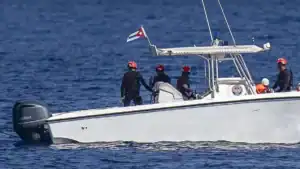
Cuba said the boat carried assault rifles, handguns, bulletproof vests, camouflage uniforms, and Molotov cocktails. Two of the survivors were already wanted by Cuban authorities on terrorism charges. A seventh person was arrested on Cuban soil, accused of coordinating the group’s reception.
Washington Keeps Its Distance
Secretary of State Marco Rubio, visiting Saint Kitts for a Caribbean summit, said the U.S. embassy in Havana was working the case. He confirmed the boat was not on a government operation and declined to speculate on its purpose. The Department of Homeland Security and Coast Guard are running a separate investigation.
Florida’s Attorney General James Uthmeier ordered prosecutors to begin their own inquiry. Congressman Carlos Giménez called the incident a “massacre” and demanded answers on whether victims held U.S. citizenship. The U.S. Attorney’s Office for the Southern District of Florida said it would pursue answers through every available channel.
A Pressure Cooker in the Straits
The shootout lands in the most hostile period in U.S.-Cuba relations in years. Since capturing Maduro in January, the Trump administration has cut off Venezuelan oil that kept Cuba’s economy alive. On January 29, Trump signed an executive order threatening sanctions against any country selling oil to Havana, deepening an energy crisis that has shuttered hospitals and left millions without power.
Nearly a million Cubans have fled to the U.S. in recent years, many by sea. Unlike previous administrations that fast-tracked Cuban arrivals for residency, Trump has deported Cubans in record numbers. Economic strangulation, closed migration paths, and armed exile networks create conditions where incidents like Wednesday’s become less surprising — and more dangerous.
Russia called it a U.S. provocation. Cuba called it a defense of sovereignty. Washington says it does not yet know what happened. In the Florida Straits, the distance between all three versions is roughly ninety miles — and growing.