Colombia Election Security Crisis Sets Up a Restricted May 31 Vote
Colombia’s presidential runoff has since taken place. Abelardo De la Espriella won the vote of 21 June 2026 with about 49.7 percent against Iván Cepeda’s 48.7 percent, a gap of roughly 261,000 votes, and took office on 7 August 2026. The article below describes the situation as it stood at the time of publication. Read the result →
Key Facts
— —Indepaz has confirmed 48 massacres and 249 deaths in the first four months of 2026, the highest pre-electoral count in a decade, with 31 separate attacks in three days across Cauca, Nariño and Valle del Cauca attributed to Iván Mordisco’s FARC dissidents.
— —Armed groups are active in more than 700 municipalities. Former transparency secretary Camilo Enciso called the situation an “absolute collapse of citizen security”, with Cauca, La Guajira and Nariño “captured by organised crime”.
— —The National Electoral Council has accredited 86 US embassy observers under Resolution 2090, the first time the United States observes a Colombian presidential election directly. Iván Cepeda leads polling between 24.8 percent and 44.3 percent depending on the firm.
Four weeks to the vote, three regions captured by organised crime, and 86 US observers about to land. Colombia’s May 31 election is no longer a campaign — it is a security operation.
A Colombia election security crisis four weeks before the May 31 first round has reached its sharpest point of the cycle. The Rio Times, the Latin American financial news outlet, reports that Indepaz has documented 48 massacres in the first four months of 2026, with 249 deaths, the highest pre-electoral toll in ten years and a pattern that already exceeds half of the 54-massacre 2025 total. The violence has spread to 19 departments and 44 municipalities, but the operational concentration sits in Cauca, Nariño and Valle del Cauca — the heart of FARC dissident territory under Néstor Gregorio Vera Fernández, alias Iván Mordisco.
Indepaz’s own chronology of the four days from April 24 to 28 lists 31 separate attacks: vehicle bombs, drone strikes, bridge demolitions, infrastructure incinerations and a public-establishment massacre at El Hobo (Toro, Valle del Cauca) where armed men opened fire indiscriminately on patrons. The use of drones and indiscriminate explosives in rural and urban areas, the institute said, “reveals an absolute moral degradation in which terrorism imposes itself over any principle of humanity”.
Why the Colombia Election Security Crisis Has Reached Cárdenas’s “Restricted Vote”
The political reading is hardening across the spectrum. Camilo Enciso, the former secretary of transparency under President Iván Duque, told Noticias RCN this week the country is witnessing “an absolute collapse of citizen security” with Cauca, La Guajira and Nariño “captured by organised crime”. Former Bucaramanga mayor Juan Carlos Cárdenas added that the vote will be “very restricted” in territories where, as he put it, “the population is essentially captured” — citing personal field reports from La Guajira and Putumayo.
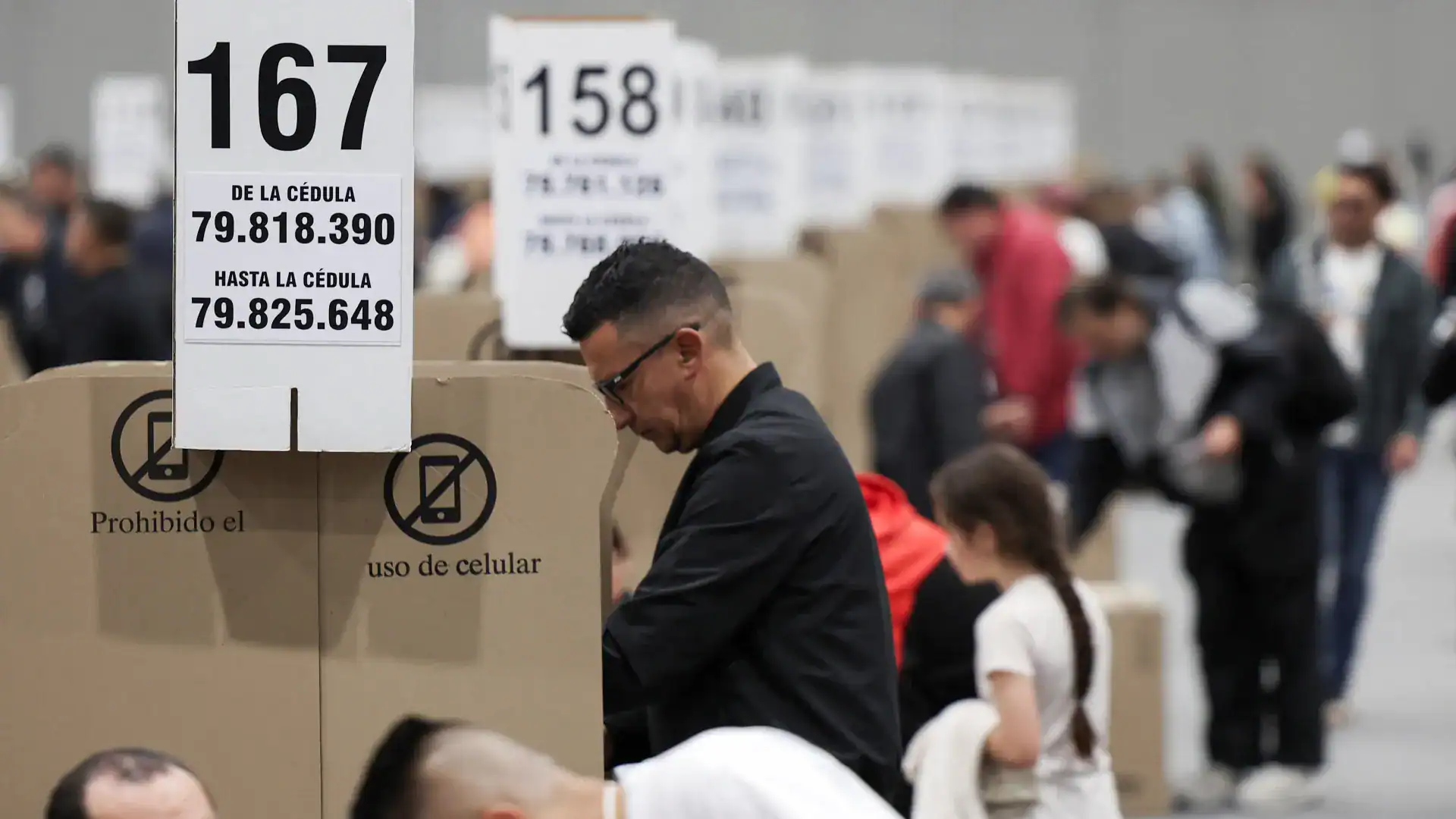
The structural diagnosis is the failure of Paz Total — President Gustavo Petro’s signature negotiated-disarmament policy with eight armed groups, which has produced no significant demobilisations and now coexists with growth in armed-group territorial control. Indepaz researcher Juana Cabezas described the moment as “critical for human rights”, citing systematic killings of social leaders alongside the massacre wave. The UN’s 2025 World Drugs Report noted Colombian coca production rose 53 percent and the country accounts for 67 percent of global coca cultivation, supplying the financial base of the same armed groups.
Petro’s “Drug Trafficking Board” From Dubai
Petro himself has hardened his framing — calling Mordisco’s Cauca fronts “narco-terrorists”, asking for “maximum global pursuit” against them, and announcing he will sign a long-delayed criminal complaint to the International Criminal Court naming individual leaders. Last Monday he linked the violence directly to the electoral process: “It does not surprise me that the Cauca groups are trying to sabotage the elections — that is what the drug-trafficking board wants, that the far right govern.”
Petro’s “drug-trafficking board” (junta del narcotráfico) is, by his own description, a structure of senior leaders operating from Dubai who sit above Mordisco in the hierarchy. The framing is contested — opposition figures argue it shifts blame to a remote actor while the operational violence is local — but it is now central to the executive narrative entering the final four weeks. The April Calarcá rupture in the Paz Total negotiation track sealed the political-process collapse.
The First-Time US Observer Mission
The most novel institutional response is American. The Consejo Nacional Electoral accredited 86 US embassy delegates as international observers under Resolution 2090 of April 16, following a formal request the embassy filed the day before. The delegation will deploy across 16 cities — including Bogotá, Medellín, Cali, Cartagena, Quibdó and Turbo — and will observe both the May 31 first round and any June 21 runoff.
It is the first time the United States serves directly as electoral observer in a Colombian presidential vote, a role traditionally held by the OAS and EU. The accreditation followed US public concern about threats against Paloma Valencia (Centro Democrático) and Abelardo de la Espriella (Firmes por la Patria), as well as Colombian intelligence cooperation with the CIA on threats against Cepeda — and Petro publicly welcomed the deployment, saying Trump can send “as many observers as he wants” while pushing back on framing that only opposition candidates face risk: “All candidates are protected by the government.”
The Polling Spread
The race itself looks different depending on the firm. Invamer (April 15-24, n=3,800, in-home interviews) puts Cepeda at 44.3 percent, De la Espriella at 21.5 percent and Valencia at 19.8 percent — a Cepeda runoff win in every simulation — while CNC for Cambio (April 23-30, n=2,157, 56 municipalities) shows a tighter Cepeda 37.2 percent, De la Espriella 20.4 percent and Valencia 15.6 percent. AtlasIntel for Semana (April 25-29, n=4,037, digital RDR) inverts the picture — De la Espriella 31.2 percent, Valencia 29.6 percent, Cepeda 24.8 percent — and projects Cepeda losing every runoff scenario.
The methodological gap explains most of the divergence: in-home probabilistic samples have historically read higher Cepeda support, while digital reach-based panels capture more of the urban anti-Petro electorate. Both signals are real. What they share is that the Cepeda ceiling and the right-wing fragmentation are now the two variables that decide whether the May 31 vote ends with a clear leader or a runoff that shifts on whichever right-wing candidate consolidates first.
What Investors Should Watch
For the COLCAP and Colombian sovereign curve, the four-week window contains three binary catalysts. First, whether the Mordisco offensive escalates to a Cauca-area voting suppression that materially affects turnout in a department of around 1.5 million eligible voters — the kind of localised disruption that would not change the national winner but would set the legitimacy frame. Second, whether the US observer presence yields a clean post-vote certification or a contested one — directly relevant to capital flows in a year when Q1 FDI fell 9.1 percent year on year.
Third, whether the right consolidates around Valencia or De la Espriella by mid-May. AtlasIntel’s read implies a runoff de-rating risk for Cepeda equity exposure; Invamer’s read implies a continuation premium. Either outcome reshapes the security-policy frame that will define Petro’s successor — and by extension the trajectory of Ecopetrol’s logistics resilience, the Pan-American Highway corridor and the Buenaventura-port supply chain.
Four weeks out, the political question is no longer who wins. It is whether the vote can be held in a way that the loser, the international observers and the markets accept as final. The 48-massacre count is the standing answer to why that question even has to be asked.
More: Colombia news in English, every day from The Rio Times.
This article was produced by The Rio Times’ automated newsroom system. How we use AI · Report an error · Editorial responsibility: Matthias Camenzind, Editor-in-Chief