

The Big Three
COLCAP hemorrhages −2.46%, capping worst week since 2022. The index closed at approximately 2,228 points on Friday, extending the rout triggered by the Invámer poll showing leftist Ivan Cepeda at 37.1% in presidential voting intention. Grupo Cibest (Bancolombia) sank 7.55%, while Grupo Sura cratered 7.10%.
Peso collapses to two-month lows as capital flees. The dollar closed at COP $3,763.47 on Friday, up 1.78% on the session. The TRM for March 2 stands at $3,766.30, the highest since January 6. Colombia’s CDS 5-year spread widened to 218 bps, a level not seen since July 2025.
U.S.–Israel strikes kill Khamenei; Brent surges toward $80. Joint military strikes over the weekend killed Iran’s Supreme Leader, sending Brent crude up over 13% to approximately $80/bbl in early Monday trading. S&P 500 futures are down 1.3% and gold futures have spiked 3.3%, adding a major geopolitical shock to Colombia’s already fragile risk backdrop.
Market Snapshot
| Indicator | Value | Change |
|---|---|---|
| COLCAP Close | 2,222.92 | −2.67% |
| COLCAP Weekly | — | −8.06% |
| COLCAP YTD | — | +7.49% |
| USD/COP Spot Close | $3,763.47 | +1.78% |
| TRM (Mar 2) | $3,766.30 | +$20.52 |
| Brent Crude (Feb 27) | $72.87 | +2.87% |
| WTI Crude (Feb 27) | $66.81 | +2.03% |
| Gold (Feb 27) | $5,247.90 | +1.03% |
| S&P 500 | 6,878.88 | −0.43% |
| DXY | 98.89 | −0.20% |
| CDS 5Y | 218 bps | +26 bps (2 wk) |
| BanRep Rate | 10.25% | +100 bps (Jan 30) |
| Colombia CPI (2025 close) | 5.10% | — |
| Bitcoin (Feb 27) | $65,669 | −1.57% |
| Coffee C (Feb 27) | $286.45 | −0.16% |
Equities — The Cepeda Crash Deepens
The COLCAP suffered its second consecutive session of heavy losses on Friday, closing down 2.46% according to Investing.com (TradingView BVC feed registered −2.67% at 2,222.92 points). This capped the worst week for Colombian equities since the aftermath of the 2022 sovereign downgrade, with the index shedding approximately 8% in five sessions.
The rout was triggered by the Invámer presidential poll released Wednesday, which placed leftist Iván Cepeda of the Pacto Histórico at 37.1% voting intention — more than double his nearest rival, conservative Abelardo de la Espriella at 18.9%. The Thursday session (Feb 26) saw the COLCAP plunge 4.13% to 2,283.91 — its single worst day in years — as Grupo Sura crashed 9.68%, Grupo Éxito fell 8.08%, and Grupo Cibest (Bancolombia) tumbled 7.71%.
Friday’s continuation saw sector-wide capitulation, with financials, services, and industrials all dragging the index lower. Only BVC shares bucked the trend, rising 2.17% to COP 16,000. The market fear is clear: Cepeda has pledged to continue Petro’s statist policies, and with four more years of left-wing governance, the judiciary and the central bank board would likely shift firmly under government influence, erasing institutional counterweights.
Adding fuel to the fire, the government announced its intention to decree the transfer of approximately $6.75 billion in pension assets from private funds to the state-run Colpensiones, amplifying capital flight into dollars and gold as defensive plays ahead of the March 8 congressional elections.
Currency — Peso in Freefall
The peso suffered its worst two-day stretch in months. After Thursday’s dramatic 3.88% crash to COP $3,830 — the largest single-session move of 2026 — Friday saw partial technical recovery but still closed at a weighted average of COP $3,763.47, up 1.78% on the session versus the prior day’s official rate. The TRM for March 2 stands at $3,766.30, up $20.52, the highest level since January 6.
The Banco de Bogotá research team noted that Colombia’s CDS 5-year spread widened from 192 bps on February 9 to 218 bps, the highest since July 2025, reflecting how rapidly sovereign risk perception is deteriorating. Bond yields on TES 2028 surged above 14%, while 2032 and 2033 references breached that threshold as well. Bloomberg reported that Colombia’s 2041 dollar bonds fell almost a cent to 89.9¢, pushing yields from 7.13% to 7.25%.
Analysts now watch the $3,760 level as the new support floor; a sustained break above would target $3,830–$3,850, while the March 8 election will be the next major catalyst. The Cibest Group projects the dollar to average COP $3,878 in 2026, but that forecast may already be conservative given the geopolitical escalation with Iran.
Technical Analysis — COLCAP Daily
The daily chart confirms a decisive bearish breakdown. Friday’s candle (O: 2,255.00, H: 2,278.83, L: 2,222.92, C: 2,222.92) formed a strong red bar that sliced through the Ichimoku cloud and multiple moving averages, closing at the session low — a sign of persistent selling pressure with no intraday recovery attempt.
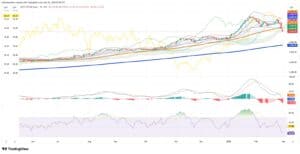
The MACD has turned deeply bearish with the signal line at 19.93 and the MACD line at −1.53, producing a histogram of −21.46 — the largest negative reading since the correction began. RSI has plummeted to 36.43 on the fast line and 51.88 on the slow line, approaching oversold territory but not yet at levels that typically trigger a bounce (30 or below).
Price has fallen below the Ichimoku cloud’s lower boundary and is now testing the 2,222 zone, well below the previous support at 2,303.40. The 200-day SMA at approximately 1,946 remains distant, providing a structural floor but offering limited near-term comfort. The Kijun-sen and Tenkan-sen have both been violated, confirming a bearish trend reversal on the daily timeframe.
Key Levels
| Level | COLCAP | Significance |
|---|---|---|
| Resistance 3 | 2,365.19 | Pre-selloff shelf |
| Resistance 2 | 2,303.40 | Ichimoku cloud base / prior support |
| Resistance 1 | 2,266.89 | Intraday resistance |
| Last Close | 2,222.92 | — |
| Support 1 | 2,170.00 | Valora Analitik technical support |
| Support 2 | 2,068.00 | Jan 2 open / 2025 year-end close |
| Support 3 | 1,946.45 | 200-day SMA |
Global Context
Wall Street closed February in the red. The S&P 500 fell 0.43% to 6,878.88 on Friday, the Dow dropped 1.05% (−521 points to 48,978), and the Nasdaq shed 0.92%. Hotter-than-expected PPI data — headline at +0.5% versus +0.3% expected, core at +0.8% versus +0.3% — cemented fears that tariff pass-through is fueling inflation, complicating the Fed’s path to rate cuts. February ended as a losing month for all three major indices, with AI disruption fears compounding the damage as Block announced mass layoffs and CoreWeave plunged 18.6%.
Brent crude closed Friday at $72.87 (+2.87%) as Iran tensions escalated. Over the weekend, the situation exploded: joint U.S.–Israeli strikes killed Supreme Leader Ayatollah Ali Khamenei, marking the most consequential geopolitical event in the Middle East since 1979. On Monday morning, Brent surged over 13% to approximately $80/bbl, WTI jumped to around $73, and the Strait of Hormuz — through which roughly 20% of global oil transits — faces potential disruption. Gold futures spiked 3.3–3.5%, with spot gold at approximately $5,430.
For Colombia, the oil surge is a double-edged sword. Higher Brent prices support Ecopetrol revenues and government fiscal accounts, but the risk-off environment drives capital out of emerging markets and into dollars and gold, worsening the peso’s trajectory. S&P 500 futures are down 1.3% pre-market Monday, Dow futures are off 627 points, and the VIX has surged. Wells Fargo still targets S&P 7,500 for year-end but acknowledges this as a tail risk scenario. Goldman Sachs warned that only a “severe and sustained oil price disruption” would meaningfully dent global growth, but cyclical sectors and oil-importing nations face outsized pressure.
Looking Ahead
The week ahead is dominated by two seismic catalysts. First, the Iran crisis will dictate global risk appetite minute by minute — any retaliation from Tehran or further U.S. escalation could send oil above $90 and trigger a broader emerging market selloff. Second, Colombia’s March 8 congressional elections and interparty primaries are just six days away; these will narrow the presidential field and either confirm or temper the Cepeda narrative that has terrorized markets.
Domestically, watch BanRep’s next moves — with the rate already at 10.25% after January’s surprise 100 bps hike and inflation projections revised up to 6.3% for 2026, economists at Universidad de los Andes expect further hikes in March and April. The U.S. February jobs report on Friday (consensus: +60,000 vs. January’s 130,000) will also shape Fed expectations and dollar dynamics. Any weakness in the labor data could provide marginal relief for the peso, but the election and Iran risks dwarf everything else.
Verdict
Colombia’s markets face a perfect storm. The Cepeda poll shock erased three weeks of COLCAP gains in just three sessions, and now the Iran crisis threatens to compound the damage with an energy-price spike that simultaneously helps Ecopetrol and hurts the peso. The CDS at 218 bps is a clear warning: sovereign risk perception is deteriorating rapidly as the May 31 presidential election approaches.
Monday’s session will be brutal. Expect the COLCAP to gap down at the open as global risk aversion collides with unresolved domestic election fear. The 2,170 support level is the next meaningful floor — if it holds, the selloff may consolidate ahead of the March 8 vote. If it breaks, the January open near 2,068 and the 200-day SMA at 1,946 become the next targets, and the entire 2026 rally will be at stake.
For the peso, the picture is equally grim. The combination of election risk, a hawkish BanRep, surging oil, and global risk-off creates a toxic mix. The carry trade that had been supporting the peso is now being unwound, and $3,800+ is a realistic near-term target. The only potential relief valve is a decisive centrist showing on March 8 that resets the electoral calculus.