Brazil’s Soul Tested by 50% U.S. Tariffs: Pride, Anger and Unity in the Face of ‘Tarifaço’
(Feature Piece) When news broke on July 9 that the United States would slap 50% tariffs on all products from Brazil, the reaction across Brazil was one of astonishment and affront.
This “tarifaço” (huge tariff) immediately stood out as an unparalleled measure – far higher than the 20–40% tariffs Trump announced for 21 other nations. In effect, Brazil was being singled out with the harshest rate in the world.
“No other conclusion” can be drawn, one Brazilian editorial thundered, “this is mafia stuff”, arguing that Trump was using brute economic threats to force Brazil to “yield to his absurd demands”.
The U.S. justification rang hollow to Brazilians: Trump claimed unfair trade and even cited Brazil’s domestic politics, but in reality the U.S. enjoys a robust trade surplus with Brazil, a fact Brazilian outlets were quick to point out.
The shock of being targeted – “the largest attack on Brazil in peacetime,” as one official put it – cut deep into the Brazilian consciousness.
Brazil’s government convened emergency meetings, treating the tariff announcement like a national crisis. President Luiz Inácio Lula da Silva swiftly issued a defiant response, condemning U.S. interference in Brazil’s sovereignty.
“Brazil is a sovereign country with independent institutions that will not accept tutelage from anyone,” Lula declared, vowing that any unilateral tariff hike “will be met with equivalent measures” under Brazil’s reciprocity laws.
This stance – essentially “we will not be bullied” – struck a chord across the country. By the morning of July 10, the phrase “Respeita o Brasil” (“Respect Brazil”) had exploded across social media as a rallying cry.
A data analysis showed the online hashtag #RespeitaOBrasil surged with nearly 2 million mentions, becoming one of the top trending topics in Brazil, second only to “Trump”. Brazilians from different walks of life coalesced online to demand their country be treated with dignity.
It was a spontaneous outpouring of nationalist sentiment, with users across the political spectrum amplifying messages in defense of Brazil’s sovereignty and economy.
In the face of a perceived humiliation by a foreign power, Brazil’s pride was wounded – but also awakened.
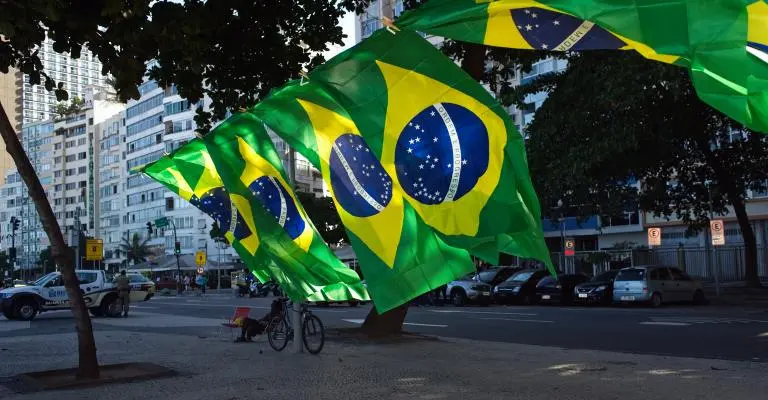
Rallying Around Sovereignty and Dignity
On the streets and in the press, the 50% tariff became a moment of national catharsis. Brazilian media – from straightforward news reports to impassioned opinion columns – portrayed the U.S. move as a direct affront to Brazil’s national pride.
Even outlets often critical of the Brazilian government united in outrage. O Estado de S. Paulo, a major center-right newspaper, ran a scathing editorial titled “Coisa de mafiosos” (“A Thing for Mafiosi”).
It blasted Trump’s tariff as an “outrageous violation of our sovereignty” and “an attempt to interfere in Brazil’s internal affairs” – namely, to halt the judicial process against ex-president Jair Bolsonaro.
The Estadão editorial praised President Lula’s firm response and called for a “soberana e altiva” (sovereign and proud) reaction from all Brazilians.
In words that resonated widely, the paper urged unity above partisan lines, declaring: “Those who are truly Brazilian, whatever their party, must not be lackeys to an American president who shames the ideals of democracy”.
This sentiment – that national dignity must come before politics – reverberated through countless columns and newscasts.
From the government’s side, officials doubled down on the theme of national honor. Lula’s administration framed the tariff not just as an economic assault, but as an insult to Brazil’s status as a sovereign nation.
In a coordinated message on July 10, Communications Minister Sidônio Palmeira circulated a striking social media post splitting the narrative in two: “Lula wants to tax the super-rich; Bolsonaro wants to tax Brazil.”
The implication was clear – while Lula seeks social justice at home, Bolsonaro’s allies invited harm to the entire nation.
Government accounts and supporters flooded social networks with this “rich vs. poor” narrative to place blame squarely on the Bolsonaro camp for provoking Trump’s ire.
They highlighted how Trump’s letter explicitly tied the tariffs to Brazil’s handling of Bolsonaro’s legal troubles, a justification Brasilia deemed “bizarre” and ideologically motivated.
As one prominent journalist, Míriam Leitão, observed, Trump’s announcement that he would “open a trade war to defend Jair Bolsonaro and Big Tech” was “absurd – a shot that will end up hitting Brazil’s right wing itself”.
In her column for O Globo, Leitão warned that if the 50% tariffs take effect, “the Brazilian economy will suffer, and the bolsonarista group will be responsible for the damage”.
The clear message from mainstream voices was that Brazil would stand proud and not capitulate, even as it braces for economic pain.
Patriots vs. ‘Traitors’: Internal Rifts and Fury
Perhaps most revealing was how the tariff crisis exposed deep internal divisions in Brazil’s political psyche. On one side, there was near-universal condemnation of Trump’s move as unfair and punitive.
On the other, a vocal conservative faction – loyal to ex-president Bolsonaro – openly cheered or excused the U.S. action, viewing it as support for their cause.
This stark split prompted an intense bout of national soul-searching: Who in Brazil stands with the motherland, and who aligns with a foreign leader against it?
Members of Bolsonaro’s camp sided with Trump’s tariff and even urged Brazil to concede to U.S. demands.
Within 24 hours, Jair Bolsonaro himself lauded Trump, professing “respect and admiration” for the U.S. government after the tariff was announced.
The former president insisted such punishment “would never have happened under my government,” and said Brazil under Lula was “isolating itself” by attacking freedom – mirroring Trump’s rhetoric.

Bolsonaro portrayed the tariffs as a consequence of Brazil “going against the free world”, implicitly blaming Lula’s policies and the judiciary’s “persecution” of him and his supporters.
Bolsonaro’s son Eduardo took to Trump’s own social network to thank the U.S. president for the decision, pointedly hoping Brazilian authorities would “treat these issues with the seriousness they deserve”.
In essence, prominent figures on Brazil’s right were openly validating a foreign-sanction that harms their own country – a stance that many Brazilians saw as crossing the line.
The backlash to these responses was swift and scathing. “This is the hour when a nation distinguishes patriots from traitors,” declared Gleisi Hoffmann, a minister and president of Lula’s Workers’ Party, in a fiery social media statement on July 10.
She singled out São Paulo Governor Tarcísio de Freitas – a Bolsonaro ally who infamously donned a red “Make America Great Again” cap to celebrate Trump – and “all of Bolsonaro’s accomplices” who applauded Trump’s tariff.
“They only care about the political gain they hope to extract from the U.S. president’s blackmail, because they never truly cared about the country or the people,” Hoffmann wrote.
She denounced Trump’s 50% tariff as “the greatest attack ever perpetrated against Brazil in times of peace…an unprecedented assault on our economy, our national sovereignty and our democracy.”
She and other officials framed Trump’s tariff as essentially “a continuation of the coup attempt Bolsonaro is on trial for – now using a foreign country’s tariffs to impose his will”.
In this narrative, Brazil’s populist right had effectively invited a foreign power to punish Brazil, an act seen as borderline treason.
Hoffmann’s conclusion captured the prevailing mood among pro-government Brazilians: “It’s in a moment like this that we separate the patriots from the traitors.”
This theme – patriotism versus betrayal – dominated discourse in Brazil’s papers and airwaves. First Lady Rosângela “Janja” Lula da Silva even blurted out “ah, esses vira-latas” (“ah, those mongrels”) when overhearing reporters ask Lula about Trump’s statements.
Her hot-mic remark, using a term that evokes the old Brazilian “vira-lata complex” (a sense of inferiority), was later clarified: Janja meant it not for the journalists, but for “the Bolsonarists who are betraying Brazil’s interests and sovereignty.”
The rebuke encapsulated a widespread sentiment – that some Brazilians were behaving like “vira-latas” (stray dogs with no loyalty) toward their own nation, siding with a foreign leader out of ideological subservience.
Senate leaders joined the chorus; even politically neutral figures bristled at the spectacle of Brazilians rooting for Trump’s hard line.
Rodrigo Pacheco, the Senate president, blasted the idea of anyone in Brazil supporting the tariff, calling it “antipatriotic” and urging unity in the face of external aggression.
In effect, the tariff fight became a litmus test of patriotism. As one columnist quipped, “Trump has left Bolsonaro’s supposed patriotism in tatters” – exposing that the self-styled nationalist right was willing to hurt the nation’s economy for the sake of its political agenda.
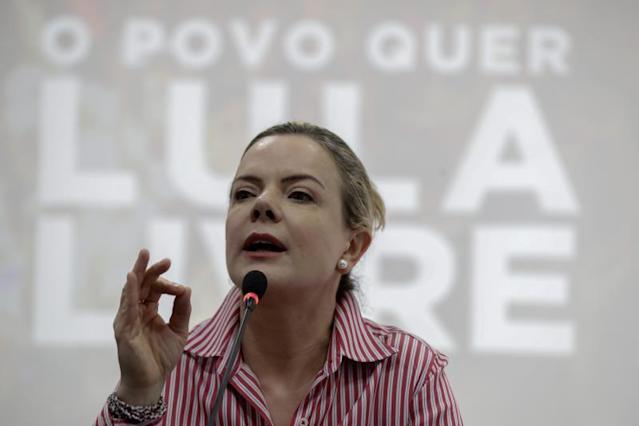
Media Outrage Across the Spectrum
Brazil’s news media – spanning from left-wing outlets to conservative editorial boards – largely rallied to the nation’s side, offering surprisingly aligned reactions colored by patriotism and anger at Trump’s move.
Editorials and columns read like calls to arms, evoking Brazil’s history of resilience and warning against capitulation.
The normally measured Estadão was ferocious: Trump’s gambit “crossed all limits” of diplomatic norms, the paper wrote, accusing him of “lying shamelessly” about trade figures and showing “no respect for the rituals between states.”
It praised Lula for standing firm and, strikingly, called on all Brazilian politicians – regardless of party – to show fidelity to Brazil now.
In an extraordinary admonition clearly aimed at Bolsonaro’s loyalists, Estadão’s editorial thundered that Brazilians must not allow themselves to be “sabujo” (bootlickers) of a U.S. president”, especially one “who disgraces the ideals of democracy.”
Such strong language from a traditionally center-right paper underscored how Trump’s tariff managed to unite opinion-makers who rarely agree.
As Folha de S.Paulo noted, Brazil was now paying the price for the Brazilian populist right’s infatuation with Trump.
Those who “celebrated Trump’s victory” – like Governor Tarcísio donning the MAGA hat and Bolsonaro hailing Trump as a “true warrior” – were now facing the real-world consequences.

Folha’s reports highlighted the irony that Bolsonarista leaders welcomed Trump’s return only to see him target Brazil with punitive tariffs.
The clear subtext across mainstream outlets was a mix of I-told-you-so and rally-round-the-flag: Trump cared little for Brazil, and those in Brazil who tied their fortunes to him had put the nation in peril.
Even commentators known for right-of-center views slammed Trump’s action. Prominent TV journalist William Waack predicted “grave damage to the bolsonarista right” as a result of Trump’s “aggression” – implying that aligning with a hostile act would backfire politically.
And in the business press, there was equal parts alarm and indignation. Agricultural and industry associations, while anxious about export losses, stressed that Trump’s tariffs were clearly political and unjustified by any technical criteria, noting years of U.S. trade surpluses with Brazil.
The Brazilian Orange Juice Exporters Association, beef producers, and other trade groups all expressed shock that a supposed trade partner would undermine international commerce so blatantly.
In financial newspapers and on TV, analysts described the 50% tariff as “inviabilizando” (making unviable) many of Brazil’s exports to the U.S. – effectively a partial blockade of trade.
Yet alongside the grim economic forecasts was a notable tone of steely resolve: an economist told CNN Brasil that Brazil “will have to be creative in retaliating” but must stand up for itself.
Meanwhile, explicitly pro-Lula outlets and columnists framed the standoff in almost existential terms. The left-leaning site Brasil247 wrote, “Either you’re with Lula or with Trump, the aggressor of Brazil. Make your choice.”
Its commentary praised even the conservative Estadão for “reinforcing the need for a broad front in defense of national interest”.
In the pages of Veja, a center-right magazine often critical of Lula, columnists still lambasted Bolsonaro’s camp for “never caring about Brazil” and hitching themselves to Trump’s agenda.
A rare point of consensus emerged: Trump’s tariff was a grievous insult, and Brazilians who cheered it were beyond the pale.
This unanimity in mainstream media – treating the tariff as a national humiliation that must be confronted – fed into the public’s emotional response.
Many Brazilians were left asking themselves: How did we become the one country hit with 50% tariffs? Why us, and what does it say about how the world (and our own leaders) regard Brazil?
These questions cut to the heart of Brazil’s self-image as a respected emerging power.

Anxiety and Defiance Among the People
At the street level, the tariff announcement stirred a mix of anxiety, anger, and defiant patriotism.
As headlines blared about potential price spikes and job losses – Brazil’s coffee, orange juice, steel, beef and other key exports could become prohibitively expensive for Americans – ordinary Brazilians braced for economic turbulence.
Almost immediately, there was a run on currency exchange information: Google reported that searches for “dólar hoje” (“dollar today”) spiked to the top of trending queries in Brazil, reflecting public concern about the real’s value and the broader economic fallout.
Business owners in export-dependent sectors voiced worry in the press that the tariff could “inviabilizar” their U.S. sales overnight, with one cattle producers’ group calculating that the cost of Brazilian beef in the U.S. would jump 50% and “make our product unsellable”.
Such reports fueled fear for jobs in agriculture and manufacturing. Local news interviewed port workers and farmers fretting that “milhões de empregos” (millions of jobs) could be at risk if trade grinds to a halt.
This palpable economic anxiety tested Brazilians’ nerves – but notably did not translate into calls for surrender.
If anything, many Brazilians appeared to channel their unease into a stoic resolve: a determination to weather the storm and not “let Trump win.”
Protests and demonstrations were small but telling. In São Paulo on July 10, a group of activists gathered outside the U.S. consulate with banners, condemning the “tarifaço do Trump” and even linking it to domestic issues (one sign urged taxing the rich in Brazil, effectively echoing Lula’s stance).
The protest was modest, yet social media amplified its imagery as symbolic of Brazil standing up for itself. More dramatic was the online mobilization: thousands changed their profile pictures or added “Respeita o Brasil” filters.
Nationalist memes spread depicting Brazil as a bullied child finally saying “Enough.” By the night of July 10, #RespeitaOBrasil and related patriotic hashtags dominated discussion, vastly outnumbering posts from the rival camp that tried to blame Lula’s diplomacy for the crisis.
In fact, data analysis by the Nexus agency found that pro-Lula, pro-Brazil messages overwhelmed anti-government narratives on social platforms, despite Brazil’s vibrant conservative social media presence.
One reason was that many who normally criticize the government set aside differences to defend the nation’s honor.
“More people joined Lula’s defense than criticized him” online, UOL News observed, noting that even some opposition voices fell silent or softened, not wanting to appear as siding with Trump against Brazil.
The nationalist discourse eclipsed partisan debate, at least temporarily. That said, Bolsonaro’s hardcore base did attempt a counter-narrative, blaming Lula’s foreign policy for the debacle.
In Bolsonaro-friendly corners of the internet, hashtags like “#ChegaDeDitadura” (“Enough with the dictatorship”) trended, accusing Lula of cozying up to anti-U.S. regimes and thus “provoking” Trump.
These users argued that Lula’s alignment with leftist governments and forums like BRICS had “not been good to us,” echoing Trump’s own words that Brazil “has not been good to the U.S.”.
But this narrative gained limited traction beyond the already converted. Mainstream analysts pointed out that Trump had been telegraphing a trade war for weeks, threatening any country in the BRICS bloc with extra tariffs purely out of geopolitical posturing.
Many Brazilians remembered that just days earlier, Lula had publicly criticized Trump’s threats, saying “we don’t want an emperor” and that a U.S. president shouldn’t bully the world via the internet.
In hindsight, Lula’s remark seemed prescient – now that the bullying had arrived, Brazilians weren’t inclined to blame their own government for not kowtowing.
Even some conservative Brazilians who dislike Lula expressed disapproval of Trump’s heavy-handed tactic, agreeing it was “inconceivable to target Brazil like this over internal politics”.
As a result, the pro-Trump, anti-Lula online chorus appeared relatively isolated and “esfarrapado” – tattered, as one commentator put it.
The collective Brazilian psyche was leaning towards unity and defiance, rather than division, in the face of what was widely seen as an external assault on national dignity.

Pride, Self-Confidence, and the U.S. Relationship at a Crossroads
Underlying all these reactions is a profound examination of the Brazilian soul – its pride, its insecurities, and its complex love-hate relationship with the United States.
Historically, Brazilians have had a mix of admiration for American culture and resentment of U.S. interference.
The term “complexo de vira-latas”, coined by writer Nelson Rodrigues, describes a lingering inferiority complex some Brazilians feel, as if Brazil were a “mutt” looking up to foreign pedigrees.
The U.S. slapping an unprecedented 50% tariff on Brazil, and invoking Brazilian domestic affairs to justify it, touched this raw nerve like few events in recent memory. It forced Brazilians to ask: Are we being treated as second-class, as a pawn in someone else’s game?
The overwhelming national response – from the presidency to the press to the people – has been a resounding “Brazil deserves respect”. This is more than a policy dispute; it’s about national self-worth.
As one social media user’s viral post summed it up: “We may be a developing country, but we are not anyone’s backyard. Respect us.” The #RespeitaOBrasil movement encapsulated a surging collective self-esteem, a rejection of the old vira-lata mindset.
Brazilians took pride in their democracy and institutions – flawed as they may be – and bristled at the notion of a foreign leader trying to “tutor” or intimidate their nation.
At the same time, this episode has undoubtedly strained the affection many Brazilians have for the United States, especially for the image of America as a fair and friendly nation.
While Brazilians distinguish between Trump and the U.S. as a whole, seeing Brazil “taxed by the US as nobody else in the world” is felt as a stinging betrayal. It is humiliating to be, as one commentator put it, “the world’s punching bag for a demagogue in Washington.”
There is anger – even among pro-U.S. Brazilians – that their country was chosen as the ultimate scapegoat in Trump’s trade crusade, with flimsy excuses about censorship and trials that Brazilians know are misleading.
Some fear a lasting erosion of goodwill towards America: images of the U.S. flag now accompany news of lost jobs and economic “bombs” on Brazil. Indeed, Brazil’s love for the U.S. has been tested.
Yet, interestingly, many Brazilians channel their anger specifically at Trump (and those in Brazil abetting him) rather than Americans in general.
In Brazilian media, Trump has been personally lambasted – even likened to a “troglodita” by Estadão – but there is also an implicit hope that other American voices will recognize the injustice.
Lula himself penned articles in the international press on July 10 criticizing unilateral tariffs and appealing to global opinion, essentially saying Brazil stands on principle against this bully tactic.
This indicates a lingering desire in the Brazilian psyche to be understood and respected by the world (and by the U.S. in particular), not simply to cut ties.
In terms of self-confidence, the crisis paradoxically seems to have boosted Brazil’s assertiveness. Facing an almost imperial-style economic punishment, Brazilians did not curl up in shame; they stood taller.
The government’s talk of reciprocity measures – even if retaliating in kind could hurt Brazil too – reflects a newfound boldness to assert equality. “If he charges us 50%, we’ll charge him 50%,” Lula said, encapsulating a tit-for-tat resolve.
Such rhetoric, reported widely, gave many Brazilians a sense that “finally we are standing up to the giant.” There’s a current of nationalistic pride in refusing to bow, reminiscent of how Brazil has handled past affronts (such as resisting U.S. pressure on ethanol tariffs in the 2000s, or asserting autonomy in foreign policy under the BRICS framework).
As political scientist Mauricio Santoro noted on a TV panel, “Brazil is saying: we won’t be anybody’s colony in the 21st century.”
That sentiment taps into a long-held aspiration in the Brazilian soul – to be taken seriously as an independent power, neither enemy nor vassal of the U.S. The tariff crisis has, in a sense, catalyzed that assertiveness.
In conclusion, Brazil’s reaction to being hit with 50% U.S. tariffs has been intense and deeply revealing. It has generated anger, yes – a sense of insult that cuts to core questions of respect and sovereignty.
It has also engendered unity and clarity: Brazilians across ideologies closed ranks to defend their country’s honor.
The episode has exposed traitorous leanings in some, igniting a passionate debate about patriotism and the true meaning of loving one’s country.
It has made ordinary Brazilians reflect on their longstanding admiration for the U.S., now tinted with disillusionment. And notably, it has sparked a proud, almost defiant confidence – the notion that Brazil will not be cowed, even by a superpower.
As the dust settles, headlines in Brazil sum it up with a mix of pride and challenge: “Trump taxa o Brasil em 50%; Brasil quer ser respeitado” – Trump taxes Brazil at 50%; Brazil wants to be respected.
In that insistence on respect lies the heart of the “psychogram” of the Brazilian soul emerging from this saga: hurt but unbowed, fearful but fearless, and above all, determined to show the world – and itself – that Brazil’s dignity is not for sale at any price.
More: Brazil news in English, every day from The Rio Times.
Editorial responsibility: Matthias Camenzind, Editor-in-Chief · Editorial standards · Report an error