

What Happened in Kepler Weber Q4 2025
Kepler Weber (KEPL3), Latin America’s leading post-harvest grain solutions provider, reported Q4 2025 net income of R$64.8 million ($12.6M), a 28.5% increase from R$50.4 million ($9.8M) in Q4 2024. The result came despite a 13.3% decline in net revenue to R$398.7 million ($77.4M) and a 17.7% drop in EBITDA to R$67.5 million ($13.1M), reflecting the paradox of a company that grew profits on a shrinking top line.
For the full year, revenue totaled R$1.5 billion ($291M), down 7.3% from R$1.6 billion ($311M) in 2024, as elevated interest rates and tighter rural credit weighed on farmer investment appetite. However, the year marked the third-highest tonnage of equipment shipped in the last decade, signaling that underlying demand remains structurally intact even as financing conditions deteriorate.
The stock trades at R$9.65 ($1.87), carrying a P/E of 12.2x and an 8.4% dividend yield over the trailing twelve months. Shares started 2026 at R$9.88 and have been broadly flat year-to-date, following a 14.8% decline in 2024 that nevertheless outperformed the Small Cap index (−25%) and the Ibovespa (−10.4%).
Key Drivers Behind Kepler Weber Q4 2025 Results
Segment Divergence
The story of Kepler Weber’s 2025 is a tale of two businesses. The Farms segment, which accounted for 31.5% of revenue in 2024, saw annual sales contract 26.4% as indebted producers held back on long-term capital expenditure amid elevated Selic rates and compressed commodity margins. Agroindustry revenue fell 17.8%, and Ports & Terminals collapsed 41%.
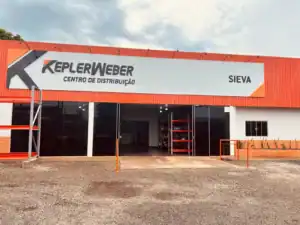
Against this backdrop, the International and Replacement & Services segments delivered structural growth. International revenue reached a record R$237.7 million ($46.2M) for the year, up 19.4%, with Argentina contributing 23% of international sales — a 16-fold increase from the prior year — alongside gains in Bolivia and Paraguay. Replacement & Services grew 10.1% to R$310.9 million ($60.4M), reflecting the pull of recurring aftermarket demand and Procer’s expanding client base.
Profit Resilience
The 28.5% profit gain on a 13.3% revenue decline implies significant margin expansion below the EBITDA line. Part of the explanation lies in Kepler’s Q4 2024 comparison base, which was depressed by the introduction of Law 14.789/23, which materially changed the tax treatment of fiscal incentives starting in 2024 and compressed the prior-year net margin to just 11%.
The company has also been actively restructuring its debt, replacing more expensive instruments with Certificados de Direitos Creditórios do Agronegócio (CDCA), which carry lower interest costs. This financial optimization, combined with a higher mix of higher-margin solutions and services, supported bottom-line growth even as the operating envelope contracted.
Financial Detail for Kepler Weber Q4 2025
Quarterly Earnings Progression
Kepler’s 2025 quarterly trajectory shows a clear recovery arc from the cyclical trough. Q1 was the weakest point, with net income of R$25.6 million ($5.0M), a 51% year-on-year decline driven by Cerrado crop failures and depressed commodity prices. Q3 marked a turning point, with R$51.6 million ($10.0M) in profit and an EBITDA margin of 17.4%, up 5.2 percentage points sequentially. Q4 then delivered the year’s peak profit at R$64.8 million ($12.6M).
The EBITDA margin for Q4 came in at approximately 16.9%, down from Q3’s 17.4% — a modest sequential compression likely reflecting revenue mix and project timing. The full-year EBITDA margin ended below 2024’s 20.8%, consistent with the lower volumes and pricing pressure across the Farms and Agroindustry segments.
Full-Year Segment Performance
For 2024, Kepler generated R$1.6 billion ($311M) in revenue with EBITDA of R$334.8 million ($65.0M) at a 20.8% margin, and adjusted net income of R$200.9 million ($39.0M) at a 12.5% margin. The 2025 full-year revenue of R$1.5 billion ($291M) represents a 7.3% contraction, though the full-year net income figure has not yet been disclosed in detail beyond the quarterly disclosures.
Trailing twelve-month data from Investidor10 shows revenue of R$1.55 billion ($301M) and net income of R$142.0 million ($27.6M). This implies a full-year net margin of approximately 9.2%, down from 2024’s 12.5% adjusted level but still reflecting a business that converts revenue to profit even through a significant downturn in its largest customer segment.
Management Signals from Kepler Weber Q4 2025 Earnings
Management highlighted the effectiveness of the diversification strategy, noting that the gains in International and Replacement & Services — both segments with higher-value-added solutions — are structural, not opportunistic. The record international revenue for 2025, led by Argentina’s 16x growth, signals that the LatAm expansion is moving beyond pilot scale into a durable revenue stream.
For 2026, the company projected a continuation of challenging macro conditions, with tighter credit restricting investment particularly in the Farms segment. Market conditions may shift the revenue mix toward Agroindustry without this constituting a formal performance projection, the company cautioned — a carefully hedged statement that implicitly acknowledges further downside risk in Farms.
Commercial director Bernardo Nogueira told CNN Brasil that producers will likely remain retracted through at least the first half of 2026, citing ongoing difficulty in accessing credit. However, he expressed optimism for the Agroindustry segment, pointing to corn-based ethanol, wheat and sorghum biofuels, and soybean crushing for biodiesel as growth drivers that could partially offset the farm weakness.
What to Watch Next for Kepler Weber
The trajectory of the Selic rate is the single most important macro variable for Kepler Weber. With the Central Bank holding at a historically restrictive 15%, rural credit conditions are unlikely to ease meaningfully in H1 2026. Any signal of a rate-cutting cycle would be a direct catalyst for farm investment and order intake, particularly in the Cerrado and Mato Grosso regions where storage capacity expansion has been deferred for multiple seasons.
Argentina’s agricultural rebound is a structural growth vector for the International segment. The country’s return to orthodox economic policy has unlocked pent-up farm investment, and the 16x revenue growth in 2025 suggests Kepler is capturing a disproportionate share of this recovery. Bolivia and Paraguay are additional expansion markets where Kepler holds market leadership advantages from decades of regional presence.
The biofuels thesis — corn ethanol, sorghum-based fuels, and biodiesel from soybean crushing — is the most compelling medium-term demand driver. These industries require industrial-scale grain storage, handling, and processing infrastructure that sits squarely in Kepler‘s wheelhouse. If Brazil’s biofuels regulatory framework continues to expand, the Agroindustry segment could grow enough to structurally offset secular weakness in Farms.
Kepler Weber Key Figures Q4 2025
| Metric | Q4 2025 | Q3 2025 | Q4 2024 |
|---|---|---|---|
| Net Revenue | R$398.7M ($77M) | R$423.3M ($82M) | R$460.1M ($89M) |
| EBITDA | R$67.5M ($13M) | R$73.6M ($14M) | R$82.1M ($16M) |
| EBITDA Margin | ~16.9% | 17.4% | 17.8% |
| Net Income | R$64.8M ($13M) | R$51.6M ($10M) | R$50.4M ($10M) |
| EPS | R$0.3736 | — | R$0.2855 |
| ROIC (TTM) | — | 21% | 34% |
Kepler Weber Full-Year Segment Revenue 2025 vs 2024
| Segment | FY 2025 | FY 2024 | YoY |
|---|---|---|---|
| International | R$237.7M ($46M) | R$199.0M ($39M) | +19.4% |
| Replacement & Services | R$310.9M ($60M) | R$282.4M ($55M) | +10.1% |
| Farms | — | R$519.9M ($101M) | −26.4% |
| Agroindustry | — | R$492.6M ($96M) | −17.8% |
| Ports & Terminals | — | R$113.4M ($22M) | −41.0% |
Risks Facing Kepler Weber
The Farms segment collapse is the primary risk. At 26.4% annual revenue decline and with management explicitly warning of further weakness in H1 2026, there is no near-term floor for the company’s historically largest customer segment. If the Selic remains at 15% through mid-2026 — as the Central Bank’s current stance implies — farmer investment could remain depressed for another two to three quarters.
Agricultural commodity price risk is asymmetric. While record harvests support equipment demand in tonnage terms, depressed grain prices compress farmer margins and reduce their ability to finance capital expenditures. The combination of high volumes and low prices — Brazil’s current reality — creates a paradox where the need for storage grows but the ability to pay for it declines.
International concentration risk is emerging. Argentina’s 16x growth to 23% of international revenue is impressive but volatile. Argentine agricultural policy has historically been subject to abrupt shifts — export taxes, currency controls, and trade restrictions can reverse investment cycles rapidly. Heavy reliance on a single country for a segment that is central to the diversification narrative introduces a new kind of fragility.
Valuation support rests heavily on the dividend yield. At 8.4% trailing yield and 12.2x earnings, the stock is priced for a business in structural decline rather than a cyclical trough. If the agro cycle turns and Farms recovers, the stock is cheap. If it does not, and trailing earnings contract further, the yield shield could prove insufficient to support the current price level.
Sector Context for Kepler Weber Q4 2025
Brazil’s grain storage deficit remains one of the agro sector’s structural bottlenecks. The country produces roughly 320 million tonnes of grain annually but has static storage capacity of around 200 million tonnes, creating a permanent gap that forces farmers to sell at harvest-time discounts rather than holding inventory for better prices. Kepler Weber, as the leading manufacturer of silos and post-harvest equipment in Latin America, is the primary beneficiary of any government program or private initiative to close this gap.
The biofuels transition is quietly reshaping the demand profile. Brazil’s corn ethanol capacity has grown rapidly in the Midwest, and new mandates for biodiesel blending require expanded soybean crushing infrastructure. These industrial plants need grain receiving, storage, and handling systems that are considerably larger and more complex than farm-level silos — and carry higher margins for Kepler. If the Agroindustry segment can grow enough to offset the Farms decline, the company’s revenue mix will become more industrial and less cyclical.
Founded in 1925 in Panambi, Rio Grande do Sul, Kepler Weber celebrates its centennial this year. The company’s hundredth anniversary arrives at a challenging moment — a cyclical trough in its core market — but also at a point of strategic diversification that is arguably the broadest in its history. With record international revenue, growing service-based recurring income, and a balance sheet that supports an 8.4% dividend yield, the question for investors is whether the current cycle is the new normal or the setup for a recovery that could look very different from past turns.