Brazil’s Job Market: Unemployment Rises but Formal Jobs and Wages Hit Records
Brazil’s job market, as reported by the Brazilian Institute of Geography and Statistics (IBGE), shows a complex picture in early 2025. The unemployment rate reached 7% in March, rising from 6.2% at the end of 2024.
This marks the highest level since May of the previous year and reflects a 13.1% increase in the number of unemployed people, now at 7.7 million. The number of employed people dropped by 1.3% to 102.5 million.
The labor force participation rate fell slightly, with 67 million people now outside the labor force, up 1.2% from the previous quarter. Despite this, real income grew by 1.2%, reaching R$3,410, the highest recorded since 2012.
The number of formal jobs also hit a record: 39.6 million workers now hold formal contracts. The rise in unemployment follows a seasonal pattern. After the holiday season, temporary contracts end and more people look for work.
This trend is not new and does not signal a structural crisis. Compared to the same period in 2024, the unemployment rate is one percentage point lower, and the number of unemployed is 12.5% smaller.
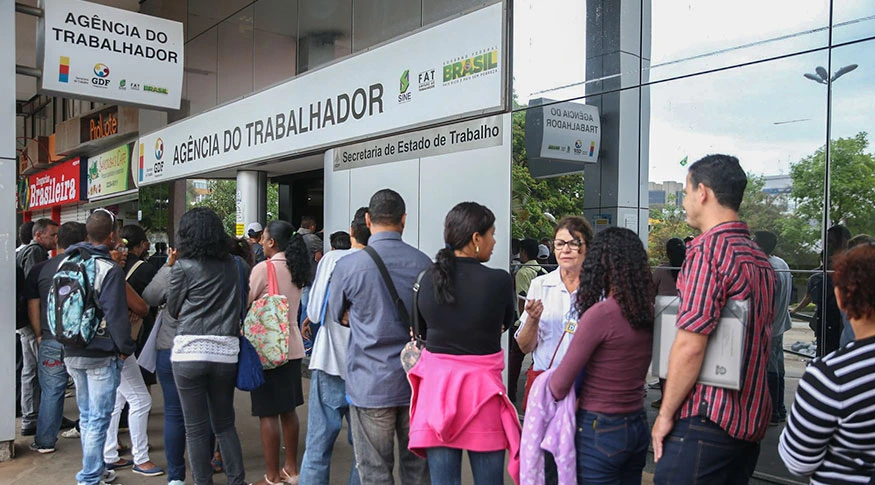
Job losses concentrated in construction, public administration, and domestic services. Despite these sectoral declines, the overall job market remains more formalized and better paid than in previous years.
The government credits recent gains to investment and reindustrialization policies. For businesses, this data signals a labor market in transition.
While unemployment edges up seasonally, formal employment and wages rise, suggesting resilience amid economic adjustments. The figures show a workforce adapting to changing conditions, with formalization and higher earnings providing some stability as the economy shifts.
More: Brazil news in English, every day from The Rio Times.
Live Market IntelligenceBrazil — Live Market Board
Rio Times · Live Market Intelligence
Brazil — Live Market Board
-0.47%
205,526.47
-0.47%
66,790.35
-0.26%
10,912.39
-0.49%
2,857,176
+0.75%
2,591.39
+0.35%
59,543.73
+0.54%
| Instrument | Last | Change | YoY | Prev. | High | Low | Volume |
|---|---|---|---|---|---|---|---|
| IBOV | 205,526.47 | -0.47% | +21.85% | 206,505.98 | 168,310 | 167,142 | — |
| USD/BRL | 5.16 | +0.01% | -5.13% | 5.16 | 5.18 | 5.14 | — |
| SELIC | 14.00% | — | — | — | — | — | |
| PETR4 | 41.64 | -0.05% | +35.19% | 41.66 | 41.97 | 41.15 | 41,499,400 |
| VALE3 | 72.97 | +0.83% | +30.75% | 72.37 | 73.54 | 72.66 | 17,658,000 |
| ITUB4 | 38.60 | -1.03% | +4.57% | 39.00 | 39.34 | 38.39 | 29,487,800 |
| BBDC4 | 16.85 | +0.36% | +3.50% | 16.79 | 16.90 | 16.67 | 19,416,900 |
| BBAS3 | 19.37 | +0.47% | +0.73% | 19.28 | 19.44 | 19.16 | 11,069,200 |
| B3SA3 | 14.26 | -0.21% | +12.73% | 14.29 | 14.47 | 14.11 | 33,037,800 |
| ABEV3 | 14.89 | -0.80% | +21.91% | 15.01 | 15.07 | 14.81 | 16,453,100 |
| WEGE3 | 47.59 | +0.49% | +29.99% | 47.36 | 48.08 | 47.36 | 3,364,600 |
| PRIO3 | 59.14 | -0.19% | +50.67% | 59.25 | 59.81 | 58.74 | 3,325,600 |
| SUZB3 | 41.33 | +2.35% | -23.55% | 40.38 | 41.48 | 40.35 | 3,914,900 |
| RENT3 | 34.68 | -0.09% | +0.84% | 34.71 | 34.96 | 34.35 | 7,979,100 |
| AZZA3 | 15.89 | -2.63% | -53.76% | 16.32 | 16.42 | 15.82 | 1,330,300 |
| CSNA3 | 4.30 | +0.47% | -42.65% | 4.28 | 4.41 | 4.26 | 10,076,100 |
| GGBR4 | 24.69 | +2.19% | +51.38% | 24.16 | 24.85 | 24.18 | 7,047,600 |
| ENEV3 | 24.21 | -1.38% | +70.49% | 24.55 | 24.64 | 23.99 | 9,297,000 |
This article was produced by The Rio Times’ automated newsroom system. How we use AI · Report an error · Editorial responsibility: Matthias Camenzind, Editor-in-Chief
LatAm Markets: Live Signals → — real-time movers, turnover leaders and FX across Latin America.