

Key Points
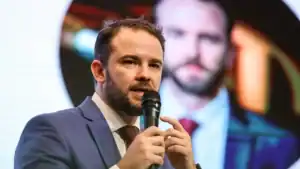
The new Brazil finance minister Durigan held his first formal meeting with President Lula on Tuesday, inheriting a portfolio shaped by $100 oil, rising household debt, and the deepening Banco Master scandal. Dario Durigan, 41, was officially named to the post on March 20 after Fernando Haddad departed to run for governor of São Paulo, The Rio Times, the Latin American financial news outlet, reports.
Who Is Brazil Finance Minister Durigan
Durigan rose through the ministry as Haddad’s executive secretary — effectively the number two — since mid-2023, when he replaced Gabriel Galípolo, who moved to the central bank. His background straddles government and Silicon Valley: he served as a legal adviser in the Casa Civil under President Dilma Rousseff from 2011 to 2015, then spent three years as WhatsApp’s head of public policy for Latin America before returning to government.
To fill the cascade of vacancies, Durigan promoted Treasury Secretary Rogério Ceron to executive secretary and named Daniel Leal, a career Treasury official, to run the national debt office. The reshuffle replaces the entire top tier of Brazil’s fiscal architecture in a single week. Markets view Durigan as a continuity pick who will maintain Haddad’s tax reform agenda and the 0.25%-of-GDP surplus target for 2026.
Banco Master Reaches the Presidential Palace
The Banco Master crisis has become the dominant political risk for Lula’s re-election campaign. The central bank liquidated the institution in November after police investigations uncovered an alleged R$12 billion ($2.2 billion) fraud, triggering more than R$40 billion ($7.3 billion) in payouts from the deposit guarantee fund. Lula publicly called it “a scam of more than R$40 billion” and blamed Bolsonaro and former central bank president Roberto Campos Neto for failing to prevent the collapse.
But the scandal has boomeranged. Reporting revealed that Lula met Master’s controlling shareholder Daniel Vorcaro in a private meeting in December 2024, with Galípolo present, raising questions about the government’s prior knowledge. Former Lula-allied ministers including Ricardo Lewandowski and Guido Mantega sat on Master’s paid advisory boards, deepening the political entanglement.
The Election Calendar Compresses Everything
Durigan takes office at a uniquely compressed moment. Oil above $100 per barrel has forced emergency fuel tax cuts, the Copom reduced rates to 14.75% but signaled caution about the Middle East war’s inflationary impact, and household debt — which Lula has flagged as an electoral vulnerability — remains near record levels. The 2026 budget projects a possible deficit of R$23.3 billion ($4.3 billion) even under the fiscal framework’s formal targets.
Haddad’s departure also removes from government the politician who had the strongest personal rapport with Congress on economic legislation. Durigan’s more technical profile may help in some negotiations but could prove a liability in the horse-trading that Brazilian budget politics demands.
The reform tributária regulation, the selective tax implementation, and the Banco Master investigations all require political management that goes well beyond spreadsheets. Lula praised Haddad’s “near 80% win rate” in Congress, setting a high bar for his successor.
For markets, the key question is whether the Brazil finance minister can maintain fiscal credibility during an election campaign in which Lula will face intense pressure to spend. The 2026 budget projects a possible deficit of R$23.3 billion ($4.3 billion) even under the fiscal framework’s formal targets.
For Lula, the question is whether a less visible finance minister makes it easier or harder to keep the economy out of the campaign crossfire. The Master scandal, the oil crisis, and October’s vote are all converging at once.