

The S&P Merval fell 0.45% to 2,799,876 on Wednesday, extending the post-ATH correction to roughly 15% from the January 28 record of 3,296,502. MercadoLibre was the session’s main drag, plunging 8–9% on the BYMA after its Q4 2025 earnings missed profit expectations despite a 45% revenue surge to $8.76 billion. The Merval has posted multiple negative sessions in a row — TradingView data shows six consecutive closes in the red — yet it remains up 18% year-to-date.
The peso continued its extraordinary 2026 rally — the dollar blue closed at ARS 1,435, official BNA at 1,405, and the MEP at 1,412, with the brecha cambiaria compressed to just 2–3%. Analyst Salvador Di Stefano argues the final lifting of corporate currency restrictions is imminent, which would collapse the remaining spread entirely. The dollar has lost roughly 7% in 2026, turning the “súper peso” into one of the year’s top EM FX stories.
Riesgo país ticked up 3 basis points to 545 bps as sovereign bonds (Bonares and Globales) edged down 0.1% on average, reflecting mild profit-taking after the recent rally. The Treasury auctioned Boncer, dollar-linked bonds, and a new Bonar 2027 (USD 150M initial offer, up to USD 250M), needing a high rollover against ARS 7.2 trillion in maturities against only ARS 4.9 trillion in BCRA deposits.
Market Snapshot
| INDICATOR | VALUE | CHANGE |
|---|---|---|
| Merval Close | 2,799,876 | −0.45% |
| Merval Weekly | 2,799,876 | −3.11% |
| Merval YTD | — | +18.13% |
| ATH (Jan 28) | 3,296,502 | −15.1% |
| Dólar Blue (sell) | ARS 1,435 | +0.35% |
| Dólar Oficial BNA (sell) | ARS 1,405 | +0.36% |
| Dólar MEP | ARS 1,412 | +0.52% |
| Dólar CCL | ARS 1,448 | — |
| Brecha Blue/Oficial | ~2.1% | Compressed |
| Riesgo País | 545 bps | +3 bps |
| Brent Crude | $69.30/bbl | +0.7% |
| Soybean (CBOT) | $1,140/bu | +0.5% |
| Gold | $5,210/oz | +0.7% |
| S&P 500 | 6,946.13 | +0.81% |
| DXY | 97.82 | +0.18% |
Equities & Corporate
MercadoLibre dominated the session narrative. The stock plunged 8–9% on the BYMA after reporting Q4 2025 earnings that beat on revenue ($8.76 billion, +45% YoY) but missed on profitability: EPS of $11.03 versus consensus estimates of $11.44–$12.09, a miss of roughly 4–9% depending on the source. Operating margin compressed to 10.1% as the company invested aggressively in free shipping, cross-border logistics, and Mercado Pago credit expansion — the credit portfolio surged 90% to $12.5 billion. Barclays cut its price target from $2,900 to $2,600 while maintaining overweight.
The MELI selloff dragged the broader index, masking a mixed session elsewhere. YPF, Galicia (GGAL), and Banco Macro (BMA) — the Merval’s three largest weights — traded with mild declines as oil-linked names tracked Brent’s hold above $69 and banking names consolidated after recent strength. The index opened at 2,813,758, hit an intraday high of 2,828,558, and sold off to a low of 2,759,863 before a modest recovery into the close.
The broader correction from the January 28 ATH now stands at approximately 15%, driven by global tech de-risking, the Kevin Warsh Fed nomination shock, profit-taking after the Milei midterm rally, and the MercadoLibre earnings disappointment. Despite the pullback, the Merval remains up 18% YTD and 21% year-over-year, reflecting the ongoing structural re-rating of Argentine assets under Milei’s fiscal consolidation program.
Currency & Monetary Policy
Argentina’s multi-exchange rate system continued to converge. The blue dollar closed at ARS 1,435 (sell), official BNA at 1,405, MEP at 1,412, and CCL at 1,448 — a brecha of just 2–3% between official and parallel rates. The dollar has lost roughly 7% against the peso in 2026 alone, defying conventional expectations for a depreciating EM currency and turning the “súper peso” into a market consensus trade.
Analyst Salvador Di Stefano argues the final step — lifting corporate FX restrictions (the last remnant of the cepo) — is imminent, backed by strong BCRA dollar purchases, rising Oil & Gas exports, and an agricultural campaign projected near the record of $40.4 billion in grain liquidation. Di Stefano forecasts the brecha would collapse to near zero on full cepo removal, potentially triggering a credit rating upgrade and fresh foreign investment inflows.
The Treasury’s Wednesday auction highlighted the rollover challenge: with ARS 7.2 trillion in maturities against only ARS 4.9 trillion in BCRA deposits, the government offered five Boncer (CER-linked), two dollar-linked instruments, and the new Bonar 2027 (USD 150M, expandable to USD 250M). Achieving a high rollover ratio remains critical for maintaining fiscal credibility — the cornerstone of Milei’s economic program and the foundation of the peso’s rally.
Technical Analysis — S&P Merval Daily
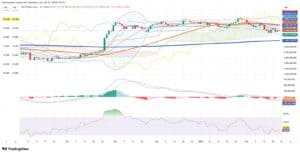
The daily chart shows the Merval deep in a corrective phase after the January 28 ATH of 3,296,502. Price has broken below the Ichimoku cloud, the Tenkan-sen, and the Kijun-sen, now trading at 2,799,876 — below the cloud’s lower boundary. The 200-day SMA at 2,440,748 remains well below, providing a structural floor. Wednesday’s session formed a modest doji-like candle (O: 2,813,758, H: 2,828,558, L: 2,759,863, C: 2,799,876), suggesting some indecision after the extended decline.
The RSI at 41.04/40.50 is approaching oversold territory without reaching the 30 threshold, leaving room for further downside. The MACD is deeply negative at −20,447/−48,716 with a histogram of −69,163, confirming strong bearish momentum. Volume has been declining on the selloff, however, which is modestly constructive — it suggests the correction is more about exhaustion of buying interest than aggressive institutional selling. A re-entry into the Ichimoku cloud above 2,833,000 would be the first technical sign of stabilization.
Key Levels
| LEVEL | PRICE | SIGNIFICANCE |
|---|---|---|
| Resistance 3 | 3,296,502 | All-time high (Jan 28) |
| Resistance 2 | 2,945,000 | Ichimoku cloud / prior support |
| Resistance 1 | 2,833,000 | Ichimoku cloud base |
| Current Close | 2,799,876 | — |
| Support 1 | 2,654,276 | Prior swing low |
| Support 2 | 2,500,000 | Midterm election breakout zone |
| Support 3 | 2,440,748 | 200-day SMA |
Global Context & Commodities
Wall Street rallied for a second straight session — S&P 500 +0.81% to 6,946, Nasdaq +1.26% — but the positive risk sentiment failed to lift Buenos Aires, where the MELI-driven selloff overpowered global tailwinds. Nvidia’s after-hours earnings were the most-watched catalyst, while Trump’s State of the Union address added noise around tariff policy after the Supreme Court struck down his unilateral authority.
Brent crude held at $69.30/bbl on US-Iran nuclear talk uncertainty, supporting YPF and the broader Vaca Muerta narrative. Gold climbed to $5,210/oz (+0.7%), benefiting from dollar weakness and trade uncertainty. Soybeans traded near $11.40/bushel, a critical input for Argentina’s grain export receipts. The DXY ticked up to 97.82 but remains structurally weaker year-over-year, which continues to benefit EM currencies including the peso.
Looking Ahead
The key catalysts this week: Nvidia’s earnings reaction on Thursday will set global tech sentiment and determine whether the MELI selloff was company-specific or part of a broader de-rating. US Q4 GDP second estimate on Thursday and PCE inflation on Friday are the macro events that will shape Fed rate expectations and dollar dynamics. The Merval’s RSI near 40 suggests it could stabilize here if external shocks don’t materialize.
Domestically, the Treasury’s rollover success will be the near-term fiscal signal. The potential lifting of the last corporate cepo restrictions remains the market’s most anticipated catalyst — if it comes alongside the bumper agro liquidation starting with Expoagro, the peso could extend its gains and compress riesgo país further toward the 500 bps level.
Oil & Gas export growth continues to underpin the structural bull case, with Vaca Muerta production expansion providing a floor for reserves and fiscal receipts regardless of global sentiment shifts. The midterm election mandate — Milei’s coalition captured roughly 41% of votes in the October 26 elections — improved the legislative path for privatizations, deregulation, and the broader fiscal consolidation that underpins the peso’s strength and the Merval’s re-rating.
The Merval’s 15% correction from ATH is textbook profit-taking after an extraordinary 2025–2026 run, amplified by the MELI earnings disappointment and global tech de-risking. The RSI near 40 is approaching levels that have historically marked buying opportunities in the Milei-era bull market, but the MACD’s deep negative reading warns that momentum hasn’t turned yet. The index needs to reclaim the Ichimoku cloud above 2,833,000 to signal stabilization.
The bull case remains intact: the peso rally is compressing brecha to near zero, fiscal consolidation continues, riesgo país at 545 is well below crisis levels, and the cepo endgame is approaching. But markets are testing whether Argentina’s structural re-rating can survive a bad MELI quarter and a global tech wobble. The answer likely hinges on the Treasury rollover, the agro liquidation cycle, and whether Milei’s team can deliver the final cepo removal without disrupting the equilibrium. At 2.80M, the Merval is pricing in doubt — if the macro holds, this is a dip; if it doesn’t, 2.65M is the next test.