

The C-130 Hercules was on final approach to El Alto International Airport, eight miles from downtown La Paz and sitting at 4,061 meters above sea level, when a hailstorm swallowed the runway. Witnesses described heavy hail and lightning as the aircraft touched down on the evening of February 27. It never stopped.
The plane, registration FAB-81, overran the runway, smashed through the airport‘s western perimeter fence, and plowed onto Costanera Avenue, a principal thoroughfare packed with evening traffic. It struck more than a dozen vehicles before breaking apart across the road.
Twenty-Two Dead, Most on the Ground
At least 22 people were killed and 37 injured. Of the eight crew members aboard, one died. The remaining casualties were civilians, including four children, who had the misfortune of being on Costanera Avenue at the wrong moment. Seven crew members survived with serious injuries. One remains missing.
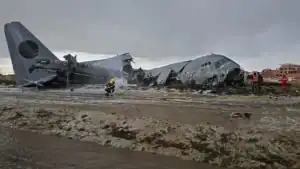
The aircraft had departed from Viru Viru International Airport in Santa Cruz carrying eight tons of newly printed banknotes for the Central Bank of Bolivia. The notes had not yet been serialized for circulation, a detail that would take on unexpected significance in the minutes after impact.
Banknotes, Bodies, and Tear Gas
When the fuselage tore open, bundles of bills worth an estimated $62 million scattered across the crash site. What followed captured international attention. Crowds surged toward the wreckage, stepping past victims and burning debris to grab fistfuls of banknotes. The chaos actively hindered rescue operations.
Police deployed tear gas and water hoses to push the crowds back. Journalists covering the scene were also targeted. Bolivia’s National Association of Journalists condemned attacks on reporters, saying a mobile television unit had been hit with stones. More than a dozen people were arrested for stealing notes.
Authorities burned the remaining banknotes at the scene in the presence of Central Bank President David Espinoza, who declared the bills had no legal value. The Central Bank subsequently suspended the legal tender status of certain 10, 20, and 50-boliviano denominations of the 2018 series, publishing serial numbers of affected notes.
The Investigation Begins at Altitude
Bolivia’s Aeronautical Accident Investigation Board has classified the event as a runway excursion on landing. The cockpit voice recorder has been recovered, but the country lacks certified facilities to extract the data. The device will be sent abroad for analysis, a process investigators say could take weeks.
Why El Alto Is Uniquely Dangerous
Two factors will be central to the inquiry. The first is weather. February marks the peak of the Andean wet season, when afternoon thunderstorms and hailstorms are routine at El Alto. The second is altitude. At over 4,000 meters, thin air reduces engine performance, increases landing speeds, and degrades braking efficiency. Hail or ice on the runway compounds the problem severely.
The aircraft itself raises questions. FAB-81 was a 49-year-old Lockheed C-130H manufactured in 1977. It spent much of its career under Transporte Aereo Boliviano, the military’s cargo subsidiary. While C-130s are built to last and many fly past 40 years worldwide, continued safe operation depends on rigorous maintenance that Bolivia’s military budget has long struggled to sustain.
Days after the crash, when rescue teams left the site, looters returned to dig through wreckage for burned money and airplane parts. It was a grim coda to a disaster that revealed as much about crumbling infrastructure as it did about the desperation that poverty breeds at 4,000 meters above sea level.