

Mexico’s largest ultra-low-cost carrier is caught between a balance sheet under pressure and a security environment that keeps rattling investors. Volaris shares have fallen more than 16% since the start of 2026 on the Bolsa Mexicana de Valores, heading into their fourth consecutive session of losses as two separate shocks compound one another.
The first blow came on February 24, when the airline released fourth-quarter results that missed market expectations. Shares dropped roughly 6% in a single session. The second hit arrived the same weekend, when the killing of Nemesio Oseguera Cervantes — the cartel boss known as “El Mencho” — triggered a wave of retaliatory violence across Jalisco and at least 20 other Mexican states, forcing flight cancellations in Guadalajara and Puerto Vallarta and wiping 28 billion pesos off the aviation and airport sector on the BMV.
A Difficult Year on the Books
Volaris reported a net loss of $104 million for full-year 2025, a sharp reversal from the $126 million profit recorded in 2024. Total operating revenue fell 3.3% to $3.04 billion, dragged down by an 18.4% drop in average fares to $42 per passenger. Unit revenue, measured as total revenue per available seat mile, declined 9% for the year. The airline managed a modest $4 million net profit in the fourth quarter alone, but that was not enough to reassure the market.
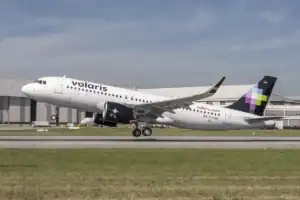
The EBITDAR margin for 2025 came in at 32.5%, down 3.8 percentage points from the prior year, while annual EBITDAR fell 13.4% to $988 million. A significant contributor to the pressure was the ongoing grounding of aircraft for Pratt & Whitney GTF engine inspections, which left 41 planes out of service as of January 2026 — more than a quarter of Volaris‘s 155-aircraft fleet. The company expects to reduce that number to 25 by year-end.
Jalisco Violence Hits the Sector
The timing could not have been worse. On the same weekend investors were digesting the earnings report, the death of El Mencho in a military operation in Tapalpa, Jalisco, unleashed cartel blockades, arson attacks, and road closures across western and central Mexico. Aeroméxico, Volaris, and Viva Aerobus all cancelled flights to and from Guadalajara and Puerto Vallarta.
The aviation sector bore the brunt of the sell-off. GAP shares fell around 6%, losing roughly 15.7 billion pesos in market capitalization. Aeroméxico dropped more than 10%, and Volaris fell about 7%, shedding 1.4 billion pesos in value. Jalisco is a critical logistics and tourism node for all three carriers, and prolonged insecurity there poses a direct threat to passenger volumes.
World Cup Security Under the Spotlight
The violence has intensified scrutiny of Mexico’s readiness for the 2026 FIFA World Cup, with Guadalajara among the three host cities alongside Mexico City and Monterrey. The power vacuum left by El Mencho’s death raises the prospect of further territorial disputes among criminal organizations, a concern that weighs on the broader tourism and transport outlook.
A Merger That Could Change the Math
Amid the turbulence, Volaris has one strategic card in play. In December, the airline announced a merger of equals with Viva Aerobus to form a new Mexican airline group, with each side holding 50%. Together, the two carriers account for roughly 70% of domestic passenger traffic. The deal requires approval from Mexico’s new Comisión Nacional Antimonopolio and is expected to close in 2026.
But regulatory clearance is far from certain, and the stock market is focused on what is happening now: margins under pressure, planes on the ground, and gunfire echoing through one of Mexico’s most important aviation corridors.