

The United States and Venezuela formally restored diplomatic and consular relations on Thursday, closing a chapter of mutual estrangement that began in January 2019 and opening one defined by oil deals, gold shipments and a political arrangement that would have seemed inconceivable three months ago. The announcement was made simultaneously in Washington and Caracas at the conclusion of Interior Secretary Doug Burgum’s two-day visit to the Venezuelan capital, where he arrived with executives from more than 20 mining and commodities firms ready to invest.
The State Department said the step would facilitate joint efforts to promote stability, support economic recovery and advance political reconciliation. Crucially, Washington described its engagement as focused on creating conditions for a “peaceful transition to a democratically elected government.” Venezuela’s statement struck a different tone, emphasizing mutual respect, sovereign equality and the pursuit of social and economic well-being for its people — but made no reference to elections or transition.
The Road From Rupture
Diplomatic relations collapsed in 2019 after then-President Nicolás Maduro severed ties in response to the Trump administration’s recognition of opposition lawmaker Juan Guaidó as interim president. Both countries withdrew staff and closed embassies. Guaidó’s representatives administered Venezuelan diplomatic facilities in the US until his political movement lost power in 2023, after which they shut entirely.
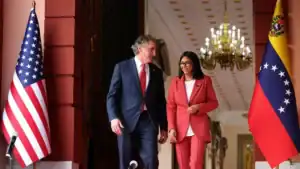
The landscape shifted dramatically on January 3, 2026, when a US military operation captured Maduro and his wife, flying them to New York to face narcoterrorism charges. The Trump administration chose to work with acting President Delcy Rodríguez, Maduro’s former vice president, rather than the opposition — a decision that stunned Venezuelans across the political spectrum. Since then, the relationship has accelerated at a pace driven almost entirely by resource access.
Oil, Gold and Red Tape
Burgum’s visit was the fourth by a senior US official since the January operation, following trips by SOUTHCOM commander Francis Donovan, CIA Director John Ratcliffe and Energy Secretary Chris Wright. Each visit has expanded the scope of American economic involvement. Rodríguez overhauled oil-sector regulations in late January to allow private investment, and PDVSA has since shipped over 80 million barrels of crude to the US. On Wednesday, Venezuela’s state mining company Minerven signed a deal to supply 650 to 1,000 kilograms of gold doré bars to commodities trader Trafigura for refining at US facilities — the third extraction contract under Washington’s supervision.
Burgum told executives that Venezuela’s mineral wealth — gold, diamonds, bauxite, coltan, copper and potential rare earths — could reduce American dependence on Chinese supply chains. Rodríguez announced she would submit a mining law reform to the National Assembly within days, replacing a statute from 1999.
The Unresolved Question
Behind the public displays of cooperation, leverage runs in one direction. Reuters reported this week that US officials have drafted criminal charges against Rodríguez herself, including corruption and money laundering allegations, which could be deployed if she resists Washington’s demands. Deputy Attorney General Todd Blanche denied the report. Meanwhile, the government approved an amnesty law acknowledging it had held hundreds of political prisoners, and opposition leader María Corina Machado — the 2025 Nobel Peace Prize laureate — said Sunday she would return to Venezuela in the coming weeks and that elections would be held.
No timeline for those elections has been announced. The US embassy in Caracas, shuttered since 2019, has already quietly reopened, and additional diplomatic staff from the Bogotá mission are expected to transfer soon. What the restored relationship will produce beyond oil shipments and mining contracts remains the central question. For now, the flags are going back up — and the tankers are already moving.