

A 150-Person Bet on Beijing
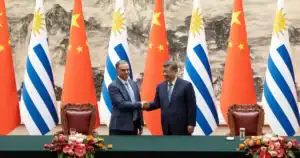
When Yamandú Orsi walked into the Great Hall of the People on February 3, he brought along not just a foreign minister but an entourage of 150 officials, business leaders, and union representatives — a delegation size that sent its own diplomatic signal. The weeklong visit produced 30 signed agreements covering investment, trade, science, technology, agriculture, culture, and emergency management. Uruguay China trade ties, already the backbone of the country’s export economy, were formally elevated under a deepened Comprehensive Strategic Partnership. This is part of The Rio Times’ comprehensive coverage of Latin American financial markets and economic developments.
Orsi was the first Latin American head of state received by Xi Jinping in 2026 — and only the fifth world leader to meet the Chinese president that year, following the prime ministers of the UK, Finland, Canada, and Ireland. The symbolism was not lost on analysts. Beijing backed Uruguay’s upcoming presidency of both the G77+China group and CELAC, the regional bloc encompassing all of Latin America and the Caribbean.
The Uruguay China Trade Numbers
The economic gravity pulling Montevideo toward Beijing is substantial. According to Uruguay XXI, the country’s investment promotion agency, China purchased $3.49 billion in Uruguayan exports in 2025 — 26% of the total — a 12% increase over the prior year. China bought 86% of Uruguay’s soy exports, with shipments rising 31% in value and 45% in volume. It also absorbed $1.055 billion in cellulose, representing 46% of all cellulose imports. Uruguay’s purchases from China totaled $2.98 billion, also around 26% of total imports.
New market openings agreed during the visit included poultry meat, pecan nuts, and bovine gallstones. China also expressed interest in establishing an agroindustrial processing laboratory in Uruguay. Industry Minister Fernanda Cardona described the trip as a turning point for the country’s international positioning.
Cooling Relations With Washington
The pivot toward China has unfolded against a deteriorating relationship with Washington. In January, the Trump administration froze immigrant visa processing for nationals of 75 countries including Uruguay, citing concerns over public benefits dependency. The suspension, which remains in effect, blocks Uruguayans from obtaining permanent residency visas while tourist and student visas remain unaffected. Uruguay’s ambassador to Washington, Daniel Castillos, confirmed the measure is under review but has not been lifted.
The diplomatic friction runs deeper than immigration. Orsi’s left-leaning Frente Amplio government publicly condemned the U.S. military operation that captured Venezuelan president Nicolás Maduro in January, calling it an unacceptable intervention. More recently, Uruguay’s foreign ministry expressed alarm over U.S. and Israeli military strikes on Iran, urging de-escalation and respect for international law. These positions represent a sharp departure from predecessor Luis Lacalle Pou, whose center-right government maintained closer alignment with Washington.
Balancing Act or Strategic Shift
Whether Uruguay‘s trajectory constitutes a genuine geopolitical realignment or pragmatic economic hedging depends on whom you ask. From Montevideo’s perspective, China has been the country’s top trading partner for over a decade, and deepening the relationship simply follows commercial logic. From Washington’s vantage point, a 150-person delegation to Beijing — arriving weeks after the Venezuela standoff — signals defiance at a moment when the Trump administration is explicitly pressuring Latin American nations to limit Chinese engagement.
For a country of 3.5 million people whose economy depends overwhelmingly on agricultural exports, the calculus may be simpler than the geopolitics suggest. China buys the beef, the soy, and the cellulose. As Orsi told 170 Chinese business executives during a trade seminar in Beijing, Uruguay is a reliable and profitable destination for investment. The question is whether Washington will view that pitch as neutral commerce or as choosing sides.