

(Analysis) Togo, a small West African nation with a coastline along the Gulf of Guinea, is quietly emerging as a key player in regional and global geopolitics, thanks largely to its Port of Lomé.
This deep-water facility, located in the capital city of Lomé, stands out as one of the few natural deep-water ports in West Africa, allowing it to dock massive container ships that other regional ports cannot handle.
Its strategic position makes it an essential gateway for landlocked neighbors such as Mali, Niger, and Burkina Faso, which rely on it for importing goods and exporting resources like minerals and agricultural products.
In recent years, the port has handled increasing volumes of cargo, reaching 30.64 million tonnes in 2024, a rise from 30.09 million tonnes the previous year.
This growth underscores its role in driving about 70% of Togo’s economic activity and contributing over 75% of the country’s tax revenue. Historically, Togo has leveraged its stability and infrastructure to build economic ties in a volatile region.
Under the long-standing leadership of the Gnassingbé family—President Faure Gnassingbé has been in power since 2005—the country has maintained relative peace compared to its Sahel neighbors, which have faced coups and instability.
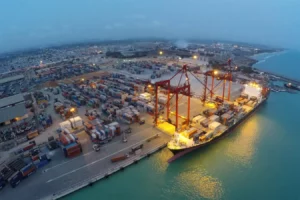
The port’s development began in earnest during colonial times, but post-independence investments, including partnerships with private operators, have modernized it.
Today, it ranks as Africa’s fourth-largest container port and one of the top 100 globally, with ongoing expansions like a new dry port and industrial zone enhancing its capacity.
These upgrades include advanced equipment for faster cargo handling and better logistics, making it a hub for transshipment—where goods are transferred between ships for redistribution across West and Central Africa.
The port’s allure has drawn intense interest from major powers, particularly the United States and Russia, as they vie for influence in Africa amid shifting alliances. For the U.S., the focus is on economic and commercial diplomacy.
In July 2025, U.S. Chargé d’Affaires Richard C. Michaels visited the port and nearby facilities, highlighting opportunities for American businesses in logistics and infrastructure.
He described the port as a “win-win” for bilateral trade, emphasizing its deep-water capabilities and access to African markets. The U.S. Embassy has actively promoted sustainable trade, such as in the cashew sector, and invited firms to explore investments.
This outreach aligns with broader U.S. efforts to counterbalance other influences in Africa, including through cultural events like attending the Evala wrestling festival, where Michaels held talks with Togolese officials.
Russia, on the other hand, is pursuing a security-oriented approach. In June 2025, Togo and Russia signed a bilateral military cooperation agreement, covering joint training, equipment supplies, and emergency medical support.
Russian officials, including Vladimir Gruzdev from the Association of Lawyers of Russia, praised Togo as “the most organized and equipped country in Tropical Africa” and its port as the busiest in West Africa.
This deal builds on Russia’s expanding footprint in the Sahel, where it has supported military-led governments in Mali, Niger, and Burkina Faso through arms and training, often via groups like Wagner (now rebranded).
Observers note that the agreement could grant Russia unfettered access to the Port of Lomé, providing a strategic Atlantic outlet in the Gulf of Guinea.
This is part of Moscow’s broader push to displace traditional Western powers, especially France, in Francophone Africa. Togo’s balancing act between these powers reflects a pragmatic foreign policy.
In late July 2025, Togolese officials engaged with both sides within days, signing the Russian military pact while welcoming U.S. economic overtures.
The country is also positioning the port as a lifeline for the Alliance of Sahel States (AES)—Mali, Niger, and Burkina Faso—which formed after coups and faced ECOWAS sanctions.
Togo has negotiated corridors from Lomé to these nations, facilitating trade and aid amid their isolation. For instance, in February 2024, Togo granted Niger access to the port to bypass sanctions, and similar talks continue for broader AES integration.
This has led to shifts in regional trade, with powers like the U.S. and Russia reportedly diverting from Nigerian ports to Lomé due to its efficiency and stability.
Other actors are involved too. China has invested in African ports elsewhere, but Togo’s focus remains on U.S. and Russian engagements.
Turkey, the UAE, and India show interest in similar hubs like Mombasa in Kenya or Walvis Bay in Namibia, highlighting a continent-wide scramble for maritime control.
Why does this matter, and why should you know about it? In simple terms, ports like Lomé are like giant doors for trade—they let goods in and out, creating jobs, money, and connections.
For landlocked countries, it’s their only way to the sea, so who controls the port decides what gets shipped, at what cost, and who profits.
This is huge for Africa’s future because the continent is building a big free trade area called AfCFTA, which could make intra-African business boom.
But if foreign powers dominate these “doors,” they might take the biggest slice of the pie, leaving locals with less control over their own resources and economy.
Knowing this helps you see how global rivalries play out in everyday life: it affects food prices, job opportunities, and even security in your region.
African leaders, like Kenyan economist Jael Otondi, warn that countries must drive their own deals to ensure partnerships build long-term value, not just access for outsiders.
In summary, Togo’s Port of Lomé isn’t just a dock—it’s a symbol of Africa’s growing leverage in a multipolar world.
By adding military pacts, economic outreach, and regional corridors to its arsenal, Togo is flexing its maritime muscle, but the challenge is turning foreign interest into true African empowerment.