

Five days into a war the president launched without congressional approval, the US Senate voted Wednesday to let him keep going. A bipartisan war powers resolution that would have required the withdrawal of American forces from hostilities in Iran failed 47–53, falling short of the simple majority needed to advance. The vote split almost precisely along party lines, with the Republican majority closing ranks behind Trump despite constitutional concerns that have echoed across the political spectrum.
The resolution, co-sponsored by Democrat Tim Kaine of Virginia and Republican Rand Paul of Kentucky, invoked the 1973 War Powers Act to demand the removal of US forces from any operations against Iran not explicitly authorized by Congress. Paul was the only Republican to vote in favor. Democrat John Fetterman of Pennsylvania, one of Congress’s most vocal supporters of Israel, was the sole member of his party to oppose it.
A Congress Without Conviction
Paul was blunt in his assessment of his colleagues. He said James Madison “never imagined a Congress without ambition” and accused the chamber of acting as “a rubber stamp for whatever the president orders.” Kaine, a member of the Armed Services and Foreign Relations committees, said the administration had produced no evidence of an imminent Iranian threat even in classified briefings. He vowed to continue forcing votes as the conflict evolves, noting that some Republicans who initially opposed a similar resolution on Venezuela eventually flipped.
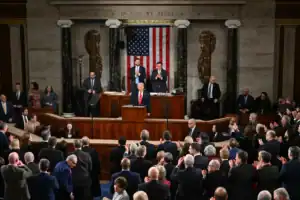
The resolution had been introduced in January, when the military buildup in the Middle East was already well advanced. The US-Israeli strikes that began Saturday — killing Supreme Leader Ayatollah Ali Khamenei and targeting Iran’s navy, missile sites, and air defenses in what the Pentagon calls Operation Epic Fury — transformed the legislation from a preventive measure into a live test of congressional war authority.
An Escalating Operation
Defense Secretary Pete Hegseth said Wednesday that the operation is “just getting started” and that the US and Israel expect to achieve “complete control of Iranian skies” within days. He described an accelerating campaign with additional bombers and fighters arriving daily. Trump himself has projected the conflict could last four to five weeks, but Democrats left classified briefings this week saying officials described an open-ended mission that had not yet begun in earnest.
Six American servicemembers have died since Saturday. Neither Trump nor Pentagon officials have ruled out a ground invasion, though most Republican senators said they would oppose such a step. Senator Josh Hawley of Missouri, who supported the president’s authority to continue airstrikes, said deploying ground troops would cross his “red line.”
The House Votes Next
A companion resolution in the House of Representatives, introduced by Republican Thomas Massie of Kentucky and Democrat Ro Khanna of California, is expected to be voted on Thursday. Speaker Mike Johnson said he was confident Republicans would defeat it, calling passage “a terrible, dangerous idea” that would “empower our enemies.” But the House majority is razor-thin, and a handful of conservative defections — from members who view the Iran campaign as a betrayal of Trump’s “America First” anti-war promises — could make the outcome closer than in the Senate.
A Constitutional Question Deferred
Article I of the Constitution grants Congress alone the power to declare war, a prerogative the United States has not formally exercised since World War II. Trump justified the strikes citing Iran’s terrorism sponsorship and nuclear ambitions. Critics argue none of those rationales meet the standard of an imminent threat required to bypass legislative authorization. The Senate has answered the constitutional question not with a legal ruling but with a political one: the president’s party will not stop him.