

Gustavo Petro wanted to be first. When Labor Minister Antonio Sanguino produced the official petition forms during a cabinet session broadcast live on the presidency’s social media channels on Tuesday, Colombia’s left-wing president reached for the pen. “I want to put the first signature,” he said. Within minutes, the finance, commerce, culture, mining, education and housing ministers had signed as well. The presidency posted photos. The message was unmistakable.
A Symbolic Act With Political Weight
In formal terms, the signing means almost nothing. A citizens’ committee led by Sanguino obtained authorization from the Registraduría Nacional on January 30, through Resolution 1117, to begin collecting signatures for a National Constituent Assembly. The committee has six months to gather over 2,050,000 valid signatures — 5% of the electoral roll — so the initiative can be submitted as a legislative bill to the next Congress. Petro’s signature is one among millions that are needed.
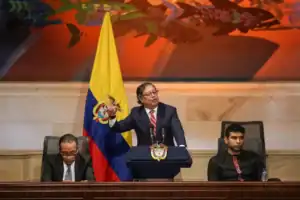
But the political symbolism is hard to miss. The signing took place 12 days before Colombians vote in legislative elections on March 8, in a year that will also feature a presidential first round on May 31. Petro has openly linked the two: his supporters must win a congressional majority, he argues, because the newly elected legislature will decide whether the constituent assembly advances or dies.
Breaking the ‘Blockade’
Petro has framed the assembly as a response to what he calls an institutional blockade by a Congress controlled by traditional parties. His flagship health reform remains stalled in committee after more than three years. His pension reform is tied up in the Constitutional Court. A tax reform was voted down in December, prompting Petro to call lawmakers “parasites” and urge his base to “unleash constituent power.” He has said he wants to “deepen” the 1991 Constitution, not replace it, and that filing the constituent assembly bill before the incoming Congress will be his final act as president — performed in a public square, with Bolívar’s sword.
Under Colombia’s Constitution, a constituent assembly requires congressional approval. Articles 374 and 376 stipulate that the initiative can originate from the president, Congress or citizens, but Congress must authorize the convocation before voters can approve it in a referendum. If the legislature blocks the process, the assembly cannot proceed through legal channels.
The Opposition’s View
Critics see the constituent assembly drive as a political strategy, not a legal necessity. Senate President Efraín Cepeda has insisted that any assembly process must follow constitutional procedures strictly and cannot bypass Congress. Opposition politicians argue that legislative disagreements do not constitute a “blockade” — they constitute democracy. Legal scholars have warned that modifying the 1991 Constitution, widely regarded as the most important political and juridical project in Colombia’s modern history, without broad consensus carries serious risks.
Sanguino’s Role
The labor minister has become the most visible face of the constituent assembly campaign, a role that extends his reputation as a combative figure in Petro’s cabinet. Sanguino led the controversial decree that raised Colombia’s minimum wage by nearly 24% for 2026 — the largest increase since 1960 — a decision the Council of State temporarily suspended before Petro signed a replacement decree at a mass rally in Bogotá’s Plaza de Bolívar. Now he is steering the signature drive, calling it a response to “the exhaustion of a people facing institutional blockade.” A cabinet member described Tuesday’s signing as “a spontaneous gesture” by Sanguino during a nearly three-hour meeting. Spontaneous or not, the presidency made sure the cameras caught it.