

On a single weekend in early March, Peru’s government issued emergency decrees for drug trafficking, catastrophic flooding, and organised crime — all at the same time, in different parts of the country. If you are trying to find a corner of Peru that is not under some form of state of emergency right now, you will have to look hard.
The latest declaration, published March 8, places 17 districts across the southern regions of Ayacucho and Cusco and the central region of Junín under a 60-day emergency to combat drug trafficking. Police will lead operations with military backup, constitutional rights including freedom of movement and the inviolability of homes will be suspended, and intelligence-driven raids will target what prosecutors describe as networks trafficking subsidised fuel and cocaine through the Andes.
The VRAEM: A Permanent War Zone
The districts covered by the latest drug-trafficking decree sit in and around the VRAEM — the Valley of the Apurímac, Ene, and Mantaro Rivers — a sprawling territory that has been under continuous emergency since 2003. That is 23 years of suspended constitutional rights in a region the size of a small European country, home to roughly 650,000 people, most of them indigenous Asháninka, Matsigenka, and Nomatsigenga communities.
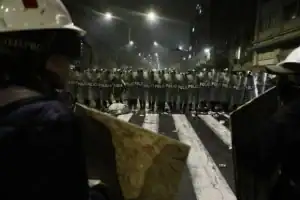
The VRAEM produces over half of Peru‘s coca leaf and remains the operational base for remnants of the Shining Path guerrillas, now functioning primarily as narco-trafficking armed groups. It is also the corridor for the Camisea gas pipeline, one of Peru’s most strategic energy assets. The government has treated this region as a security problem for two decades, cycling through emergency decrees every 60 days without interruption.
Floods, Crime, and Cascading Emergencies
But the drug-trafficking emergency is only one layer. Days earlier, the government extended a separate 60-day emergency in 298 districts across 19 regions for catastrophic flooding tied to El Niño conditions. Since January alone, Peru has issued multiple overlapping flood-related emergency decrees covering well over 700 districts, with regions like Arequipa (80 districts), Ayacucho (48), and Amazonas (41) among the hardest hit.
On top of that, Lima and the port of Callao — home to roughly 11 million people, or a third of the national population — were placed under their own emergency in late February to combat a surge in homicides, extortion, and sicariato (contract killings). The decree authorised military support for police operations and the suspension of civil liberties including freedom of assembly and the right to privacy of the home.
A Country in Permanent Exception
Add these together — drug trafficking in the highlands, floods across 19 regions, urban crime in the capital, plus the standing VRAEM security emergency — and well over 1,000 of Peru’s roughly 1,880 districts are currently operating under some form of emergency decree. Constitutional rights are formally suspended in more than half the country’s administrative territory.
Critics on the left argue the emergencies have become a governance crutch, allowing the state to deploy military force without investing in long-term development, judicial reform, or anti-poverty programs. Critics on the right counter that Peru’s security crisis is real — homicide rates in Lima have spiked, extortion has become a national epidemic, and the VRAEM remains ungovernable — and that emergency powers are the only tools that produce results on the ground.
Why the World Should Pay Attention
Peru is the world‘s largest producer of cocaine and a critical link in global supply chains for minerals, natural gas, and agricultural exports. The fact that its government cannot maintain basic public order without permanently suspending constitutional rights across most of its territory is not just a domestic concern — it is a signal about institutional fragility in one of Latin America’s most resource-rich nations.
For a country heading into general elections later this year, the normalisation of emergency as the default mode of government raises uncomfortable questions about what Peruvian democracy actually looks like on the ground — and how long a state of exception can last before it stops being exceptional at all.