

The Big Three
IPC edges up +0.02% to 71,405.77, capping a stellar February. The Mexican benchmark posted a monthly gain of 5.63% — its strongest since September — linking four consecutive months of advances. At the session level, Peñoles surged 5.21% on metals strength while Televisa crashed 6.75%.
Super-peso holds firm at MXN 17.21 despite PPI shock. The peso closed Friday at 17.21 per dollar, barely changed, capping a monthly appreciation of 1.09%. Banxico’s Galia Borja signaled the central bank has room for rate cuts given weak domestic demand and the strong currency.
U.S.–Israel strikes on Iran reshape Monday’s risk landscape. Joint military strikes over the weekend killed Iran’s Supreme Leader Khamenei. Brent crude surged 13% toward $80/bbl in early Monday trading, S&P 500 futures dropped 1.3%, and gold spiked 3.3%. For Mexico, the oil surge supports Pemex revenues but global risk-off threatens the peso.
Market Snapshot
| Indicator | Value | Change |
|---|---|---|
| S&P/BMV IPC Close | 71,405.77 | +0.02% |
| IPC Monthly (Feb) | — | +5.63% |
| IPC 52-Week Range | 49,799–72,111 | Near highs |
| USD/MXN Spot Close | 17.21 | +0.06% |
| USD/MXN Monthly (Feb) | — | −1.09% (peso gains) |
| Brent Crude (Feb 27) | $72.87 | +2.87% |
| WTI Crude (Feb 27) | $66.81 | +2.03% |
| Gold (Feb 27) | $5,247.90 | +1.03% |
| S&P 500 | 6,878.88 | −0.43% |
| Banxico Rate | 7.00% | Held (Feb 5) |
| Fed Funds Rate | 3.50–3.75% | — |
| Mexico CPI (1H Feb) | 3.92% | ↑ from 3.77% |
| Mexico Core CPI | 4.47% | Above 4% target |
| Bitcoin (Feb 27) | $65,669 | −1.57% |
| Remittances (2025) | — | Key peso support |
Equities — Four-Month Winning Streak Intact
The S&P/BMV IPC closed Friday at 71,405.77 points, up a marginal +0.02% (+15.67 points) from Thursday’s 71,390.10. Despite the flat session, the index delivered a striking monthly gain of 5.63% from the January 30 close of 67,598.95, its best February performance in years and its fourth consecutive monthly advance.
Grupo Monex analysts noted that the IPC reached new all-time highs during February, driven by a revaluation across metals and telecommunications sectors. Of the 35 major constituents, 28 posted gains in the month, led by América Móvil (+24.32%), Vesta (+17.38%), Alsea (+13.83%), Grupo Carso (+13.43%), Grupo México (+12.87%), Banco del Bajío (+12.15%), and Sigma (+12.04%).
Friday’s session saw rotation: mining name Peñoles surged 5.21% to MXN 1,096.30, while Grupo Carso climbed 3.74%. At the other end, Televisa plunged 6.75% to MXN 10.23, Volaris fell 3.43% — airlines face outsized exposure to Iran-related oil cost spikes — and Bimbo shed 2.73%. Banamex flagged that the index is entering a consolidation phase and mixed sessions should be expected near these historic levels.
Currency — Super-Peso Resists Global Headwinds
The peso closed Friday at MXN 17.21 per dollar, virtually unchanged on the day (+0.06%) despite hotter-than-expected U.S. PPI data that briefly boosted the greenback. For February, the peso appreciated 1.09% against the dollar, ranking as the third-strongest currency in Latin America behind Argentina and Brazil, according to Banco Base’s Gabriela Siller.
The February range was MXN 17.0866 (a low not seen since June 2024) to MXN 17.5726, with a monthly average of 17.2312. The peso’s resilience is underpinned by the 325 bps carry trade differential with the U.S. (Banxico at 7.00% vs. Fed at 3.50–3.75%), strong remittance flows, and a broad-based weakening of the dollar index. Over the past year, the dollar has lost 15.24% against the peso.
However, Monday brings new risks. The Iran conflict could trigger a flight to dollars across emerging markets, and Banxico’s March 26 decision looms. Subgovernor Galia Borja told Bloomberg that the central bank “has room” for further cuts given weak domestic demand and the strong peso, while Gobernadora Victoria Rodríguez confirmed that four of five board members are open to resuming cuts. Only Jonathan Heath favors holding.
Technical Analysis — S&P/BMV IPC Daily
The daily chart shows the IPC consolidating near all-time highs within a well-defined uptrend channel. Friday’s session (O: 71,325.97, H: 71,890.34, L: 70,925.18, C: 71,405.77) produced a small-bodied candle with a notable upper wick, suggesting selling pressure emerged above 71,800 but buyers defended the 71,000 floor.
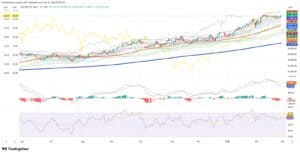
The MACD remains in positive territory with the signal at 1,066.71 and the MACD line at 913.59, though the histogram at −153.12 shows declining momentum — the bullish impulse is fading but not reversing. RSI reads 62.41/61.44, comfortably above the 50 midline but below the 70 overbought threshold, indicating room for further upside without triggering a technical sell signal.
Price sits well above the Ichimoku cloud, which provides dynamic support in the 68,000–69,000 range. The 200-day SMA at approximately 61,879 confirms the structural bull trend remains firmly intact. The rising blue trendline from mid-2025 continues to guide the advance, currently intersecting near 67,000.
Key Levels
| Level | IPC | Significance |
|---|---|---|
| Resistance 3 | 72,111 | 52-week / all-time high |
| Resistance 2 | 71,890 | Friday intraday high |
| Resistance 1 | 71,092 | Near-term ceiling |
| Last Close | 71,406 | — |
| Support 1 | 70,331 | Ichimoku cloud upper band |
| Support 2 | 68,026 | Cloud base / congestion zone |
| Support 3 | 61,879 | 200-day SMA |
Global Context
Wall Street closed February in the red. The S&P 500 fell 0.43% to 6,878.88 on Friday, the Dow dropped 1.05%, and the Nasdaq shed 0.92%. Hotter-than-expected PPI data — headline at +0.5% versus +0.3% expected, core at +0.8% versus +0.3% — cemented fears that tariff pass-through is stoking inflation, pushing Fed cut expectations further out. February was the worst monthly performance for the S&P 500 in a year, with the Nasdaq falling 3.4% and the S&P losing 0.9% for the month, though the Dow eked out a 0.2% gain.
The weekend saw a seismic geopolitical escalation: joint U.S.–Israeli military strikes killed Iran’s Supreme Leader Ayatollah Ali Khamenei. Brent crude surged over 13% to approximately $80/bbl in early Monday trading, WTI jumped to $73, and the Strait of Hormuz faces potential disruption. S&P 500 futures fell 1.3% and gold spiked 3.3–3.5%. Goldman Sachs warned that only a “severe and sustained oil disruption” would materially hurt global growth, but cyclical sectors and oil importers face outsized near-term pressure.
For Mexico, the calculus is mixed. Higher oil prices support Pemex revenues and government fiscal accounts, but Mexico is also a major refined product importer, so gasoline and diesel costs could rise. The risk-off impulse may test the super-peso’s resilience, particularly with the T-MEC review approaching and tariff threats from Washington still unresolved. The decoupling between Mexican equities (near all-time highs) and U.S. indices (in correction mode) has been a defining theme of 2026, driven by the peso carry trade and the relative attractiveness of Mexico-listed miners and telecoms.
Looking Ahead
The Iran crisis dominates the near term. Any escalation — Strait of Hormuz closure, Iranian retaliation against Gulf states, or further U.S. operations — could send oil above $90 and trigger broad EM capital flight. Conversely, a rapid de-escalation would deflate the oil premium and benefit risk assets.
Domestically, the March 26 Banxico decision is the key event. Four of five board members have signaled openness to resuming rate cuts, with Borja explicitly citing weak GDP (the economy decelerated for four consecutive years), strong peso, and contained inflation as justification. A 25 bps cut to 6.75% is the base case if inflation does not surprise sharply higher. The U.S. February jobs report on Friday (consensus: +60,000) will shape both Fed expectations and peso dynamics. Mexico’s arancels against Chinese imports (5–50%) continue to be monitored for second-round price effects, while the approaching FIFA World Cup 2026 is expected to provide a temporary boost to services inflation.
Verdict
Mexico enters March from a position of strength that stands in stark contrast to its Latin American peers. While Colombia’s COLCAP hemorrhaged 8% last week on election panic, the IPC sits within 1% of all-time highs after a 5.63% February surge. The peso has appreciated for four consecutive months and trades at levels not seen since mid-2024. The domestic narrative — dovish Banxico signals, strong remittances, falling dollar index — remains broadly supportive.
But Monday will test this resilience. The Iran shock is the biggest geopolitical event in decades, and no emerging market will be immune to the initial risk-off wave. Expect the IPC to gap lower at the open, with airlines (Volaris) and consumer discretionary names taking the brunt. The 70,331 Ichimoku cloud support is the first line of defense; the 68,000 congestion zone is where serious buying should emerge. The super-peso’s ability to hold below MXN 17.50 through the week will be the single best indicator of whether Mexico’s decoupling story survives the geopolitical storm.