

Key Points
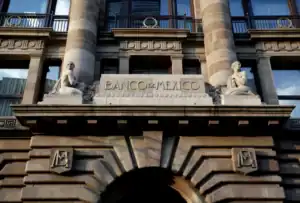
Mexico’s central bank sees the economy recovering, but not by much. In its fourth-quarter 2025 inflation report released Thursday, the Bank of Mexico raised its GDP growth forecast for this year to 1.6%, up from 1.1%. The upgrade reflects moderate improvement in private consumption and exports, but the overall picture remains one of an economy operating below potential and heavily dependent on what happens across the northern border.
The Upgrade in Context
The 1.6% forecast represents a meaningful revision from 1.1%, but it follows what Banxico itself acknowledged was a dismal 2025. The Mexican economy grew just 0.6% last year, its weakest performance since the pandemic, dragged down by a contraction in industrial activity linked to U.S. demand and compounded by federal budget austerity. Services sustained what growth there was.
For 2027, Banxico maintained its forecast at 2.0%. The central bank has cut its benchmark rate by more than four percentage points since early 2024, bringing it to 7.25% after eleven consecutive reductions, its lowest since mid-2022. Inflation forecasts were left untouched, with headline prices expected to reach the 3% target by the second quarter of 2027.
The USMCA Shadow
The report’s most important message was not the upgraded number but the warning that accompanied it. Banxico said the balance of risks for growth remains tilted to the downside, driven primarily by uncertainty surrounding the mandatory review of the U.S.-Mexico-Canada Agreement scheduled for July 2026.
The review is the first test of the trade pact since it replaced NAFTA in 2020, and the Trump administration has signaled it intends to treat the process as a renegotiation rather than a formality. Washington has flagged concerns over Chinese investment transiting through Mexico, automotive rules of origin, energy policy and labor enforcement. Commerce Secretary Howard Lutnick has confirmed the United States will seek structural reforms to the agreement. If the three parties fail to agree on an extension, the pact enters a decade of annual reviews that would erode the long-term certainty investors need.
Investment on Hold
Banxico noted that private investment would likely remain weak through the first half of 2026, a direct consequence of the trade uncertainty. Mexico attracted $40.9 billion in foreign direct investment in the first three quarters of 2025, a 14.5% increase year-on-year, but new commitments are slowing as companies wait for clarity on USMCA’s future. Banxico also warned that a U.S. economic slowdown, geopolitical disruptions to global trade, or the domestic effects of Washington’s own tariff policies could further erode Mexico’s external demand.
An economy that expanded 0.6% last year and is projected at 1.6% this year is not recovering — it is treading water, waiting for its largest trading partner to decide whether the rules of the relationship still apply.