

The Big Three
Oil Crashes −11%, Peso Rallies.
Brent crude plunged from near $120 to settle at $87.80 after U.S. Energy Secretary Wright falsely claimed the Navy escorted a tanker through the Strait of Hormuz. The post was deleted, the White House disavowed it, and Trump signaled the Iran war was “very complete.” The peso rallied as lower oil eased stagflation fears, with USD/MXN closing at 17.57.
Mexico Inflation Hits 4.02% in February.
INEGI reported annual CPI at 4.02% for February, up from 3.77% in January, with core inflation at a stubborn 4.50%. Banco Base noted the rise occurred before the Middle East war began, suggesting Banxico “should not cut rates.” The next Banxico decision is March 26, with analysts widely expecting rates to hold at 7.00%.
IPC Rebalance Takes Effect March 23.
The BMV announced its first 2026 rebalance of the S&P/BMV IPC, with Volaris (VOLAR) expected to replace Becle (CUERVO) in the index. The changes, announced March 6, enter into force on March 23. Analysts at BX+, Banorte, and Monex project the IPC could close 2026 between 73,000 and 73,500 points.
Market Snapshot
| Indicator | Value | Change |
| S&P/BMV IPC | 67,397.94 | +0.76% |
| FTSE-BIVA | 1,338.31 | +0.79% |
| USD/MXN (Close) | 17.57 | −0.15% |
| Banxico FIX | 17.5037 | Mar 10 determination |
| Banxico Policy Rate | 7.00% | Hold (Feb 5) |
| Annual CPI (Feb 2026) | 4.02% | Core: 4.50% |
| Brent Crude | $87.80 | −11.28% |
| WTI Crude | $83.45 | −11.94% |
| S&P 500 | 6,781.48 | −0.21% |
| VIX | 24.93 | −2.24% |
| Gold (XAU/USD) | $5,228.40 | +2.44% |
| IPC from ATH (72,111) | — | −6.53% |
Equities
The S&P/BMV IPC rose 0.76% to 67,397.94 on Monday, snapping a three-session losing streak as markets responded to easing geopolitical tensions. The FTSE-BIVA gained a slightly stronger 0.79% to 1,338.31. Both indexes found support from the sharp retreat in oil prices and Trump’s comments suggesting the Iran conflict could end soon.
The session opened at 67,111.64 and pushed to an intraday high of 67,866.65 before giving back some gains to close at 67,397.94. The high-to-close fade of nearly 469 points suggests some profit-taking into strength, though the overall tone was constructive after a brutal week that saw the IPC drop 1.52%.
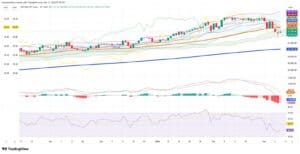
The index remains 6.53% below its all-time high of 72,111.41 reached on February 12, with the correction driven by a combination of Iran war fears, oil-driven inflation concerns, and pre-Fed caution. Analysts at BX+, Banorte, Kapital, and Monex continue to project a year-end target between 73,000 and 73,500 points, implying roughly 8–9% upside from current levels.
The first IPC rebalance of 2026, announced on March 6, is expected to see Volaris (VOLAR) replace Becle (CUERVO) when it takes effect on March 23. Banorte analysts noted that Becle dropped to position 36 in the liquidity ranking while Volaris rose to 35, triggering the swap. No other changes are anticipated beyond ponderación adjustments.
Currency
The peso extended gains for a second consecutive session, with USD/MXN closing at 17.57, down 0.15% on the day. The pair had opened at 17.54 (per Dow Jones) and traded in a range of 17.5137 to 17.6984 (per Banco Base). The Banxico FIX was determined at 17.5037 on March 10. This marked the third straight session of peso appreciation after the currency had briefly weakened past 18.00 per dollar during last week’s peak oil panic.
Grupo Financiero Actinver noted that “markets are calm after the change in sentiment driven by Trump’s assertion that the Iran war will end very soon.” Monex placed the peso as the thirteenth-best performer among emerging-market currencies on the day, a modest showing compared to the Colombian peso’s chart-topping rally, reflecting Mexico’s more complex relationship with oil prices—as both a producer and a consumer exposed to inflation passthrough.
Banxico holds its policy rate at 7.00% after pausing its cutting cycle unanimously on February 5. The February CPI release (4.02% annual, core 4.50%) reinforces the case for holding. Banco Base was blunt: the inflation uptick occurred before the Middle East war even started, meaning Banxico “should not cut.” The consensus view from HSBC, Santander, Crédit Agricole, and Wells Fargo is that rates will hold at 7.00% through year-end. Banorte is more dovish, expecting a 25-bps cut in March and a terminal rate of 6.50%.
Year-end USD/MXN forecasts range from 19.30 (Banorte) to 20.50 (Banxico survey), with nearshoring investment and FIFA World Cup 2026 inflows expected to provide structural support for the peso. The T-MEC renegotiation remains the key wildcard for currency direction in the second half.
Technical Analysis & Chart
The daily chart shows the IPC posted a green candle that opened near the prior close and pushed to test the 67,956 area (the 20-day moving average zone) before pulling back. The session high of 67,866.65 came close to but did not breach this key resistance level, leaving the immediate technical picture as a constructive bounce within a corrective downtrend.
The RSI reads 52.15 with its signal at 40.47, placing the oscillator just above the neutral 50 line—a marginal improvement that confirms early-stage recovery without yet signaling strong bullish momentum. The MACD histogram at 284.87 sits above its signal (−326.08) and trigger (−610.94), with the histogram positive for the first time in several sessions, suggesting the selling momentum has crested.
Bollinger Bands show the index bouncing from near the lower band and pushing toward the midline. The 200-day SMA at 62,235.62 sits well below, confirming the long-term uptrend remains intact. The price structure since the February 12 all-time high of 72,111.41 resembles a classic ABC correction, with the index now potentially entering a consolidation phase between 67,000 and 69,000.
The key level to watch is the 67,956 resistance (approximate 20-day SMA). A close above this level would confirm the bounce and open a path toward 68,575–68,713. Failure to clear it could mean more sideways consolidation between 67,000 and 68,000.
Key Levels
| Level | Price | Significance |
| Resistance 3 | 69,136.23 | Early March swing high |
| Resistance 2 | 68,713.93 | Upper Bollinger zone |
| Resistance 1 | 67,956.77 | 20-day SMA zone |
| Last Close | 67,397.94 | Session close |
| Support 1 | 67,164.30 | Recent session low area |
| Support 2 | 64,141.36 | 2026 YTD low |
| Support 3 | 62,235.62 | 200-day SMA |
Global Context
Monday was defined by the most dramatic oil reversal in years. Brent crude underwent a roughly $30 swing in less than 48 hours, touching nearly $120 before crashing to settle at $87.80—the largest single-day percentage drop since 2022. WTI fell 11.94% to $83.45. The catalyst was a cascade of de-escalatory signals from Washington: Trump called the Iran war “very complete,” floated taking over the Strait of Hormuz, and Energy Secretary Wright’s false (and quickly deleted) claim about a Navy tanker escort triggered a 17% intraday plunge before partial recovery.
Wall Street finished mixed despite the chaos. The S&P 500 slipped 0.21% to 6,781.48, the Dow fell 0.07%, while the Nasdaq eked out a 0.01% gain. The intraday swings were far more extreme: the Dow plummeted nearly 900 points before recovering to finish down just 33 points. The VIX eased to 24.93 from over 27. JPMorgan warned that a 10% S&P 500 correction remains probable if oil sustains triple-digit prices, while the IEA called an emergency meeting on strategic stockpile releases.
Gold surged 2.44% to $5,228.40, benefiting from dollar weakness and safe-haven demand. Silver jumped 6.25%. The dollar index weakened as risk appetite partially recovered, with the EUR/USD extending to 1.1645. U.S. gas prices hit $3.54 per gallon, the highest since mid-2024, underscoring the consumer-level impact of the energy shock.
For Mexico, the oil dynamic is nuanced. As a major producer, Pemex benefits from elevated crude—colocaciones de deuda en la BMV surged over 640% in early 2026. But as a net gasoline importer with an inflation rate already above target, high oil prices threaten the very rate cuts the economy needs. The $87.80 settlement represents a Goldilocks zone: high enough to support fiscal revenues, low enough to avoid a second-round inflation shock.
Looking Ahead
Today (March 11): U.S. CPI data for February is the week’s marquee release. A hot print would further dim rate-cut expectations and could pressure the peso. Markets will also process the full implications of Mexico’s February 4.02% inflation print released Sunday.
This week: U.S. initial jobless claims (March 12), GDP second estimate and University of Michigan inflation expectations (March 13). In Mexico, attention turns to whether the oil price retreat holds or reverses, given the direct implications for Pemex revenues and the fiscal outlook.
March 18: The Federal Reserve rate decision dominates global markets. Rates are expected to hold at 3.50–3.75%, but the statement will be scrutinized for any shift in inflation language driven by the energy shock.
March 23–26: The IPC rebalance takes effect on March 23 (Volaris in, Becle out). Three days later, Banxico announces its rate decision on March 26. The consensus overwhelmingly expects a hold at 7.00%, though Banorte remains an outlier calling for a 25-bps cut. T-MEC renegotiation talks and FIFA World Cup preparations continue to shape the medium-term investment thesis.
Verdict
Monday’s session was a relief valve for a market that had been under severe pressure. The IPC’s 0.76% gain was modest compared to some LatAm peers (Colombia’s COLCAP surged 2.11%), reflecting Mexico’s more complex positioning: the oil crash is a double-edged sword for an economy that needs both Pemex revenues and lower energy prices. The peso’s steady grind lower in USD/MXN from the 18.00 panic level to 17.57 is the more significant signal—it suggests markets are pricing out the worst-case oil scenario.
The February inflation print at 4.02% is the elephant in the room. With core still at 4.50%, Banxico has no room to cut, and the oil shock’s second-round effects haven’t even arrived yet. This makes Mexico an outlier in a region where most central banks are either cutting or paused at lower levels. The carry trade remains attractive at 7.00%, but it comes with the caveat that Mexico’s real rate premium could narrow quickly if inflation continues to climb.
Bias: Neutral with upside risk. The IPC is finding support near 67,000 and the technical picture is improving, but the index needs to clear the 67,956 resistance (20-day SMA) to confirm a trend reversal. The peso is the stronger story, benefiting from rate differential and nearshoring flows. Key risks: oil rebound above $100, U.S. CPI surprise, and T-MEC uncertainty. Support at 67,164; resistance at 67,957.