

— Germán Aguilar, known as Lobo Menor and second-in-command of Ecuador’s Los Lobos gang, was arrested in Mexico City’s upscale Polanco neighborhood carrying a fake Colombian passport — wanted for masterminding the 2023 assassination of presidential candidate Fernando Villavicencio
— The arrest illuminates a cocaine supply chain running from Colombian FARC dissident territories through Ecuadorian ports to Mexico’s Jalisco New Generation Cartel, which the Trump administration has formally linked to Los Lobos
— Colombia’s President Petro confirmed Lobo Menor was connected to FARC dissident leader Iván Mordisco — the country’s most wanted fugitive with a $1.3 million bounty — deepening the three-country criminal convergence
The Mexico Ecuador drug link that security analysts have tracked for over a decade was laid bare this week when Mexican authorities arrested Germán Aguilar — known as Lobo Menor — in the wealthy Polanco district of Mexico City. Ecuador’s Interior Minister confirmed Aguilar had an outstanding warrant for the 2023 assassination of Fernando Villavicencio, a presidential candidate gunned down after a campaign rally in Quito.
The Rio Times, the Latin American financial news outlet, examines how the arrest connects the criminal underworlds of three countries — and what it reveals about the cocaine corridor running from Colombia’s conflict zones through Ecuador’s ports to Mexican cartel distribution networks.
Who Is Lobo Menor
Aguilar is the stepson of Wilmer Chavarría, alias Pipo, the founder and leader of Los Lobos — one of Ecuador’s most powerful criminal organizations. When Pipo faked his own death during Ecuador’s brutal 2021 prison crisis and fled to Spain, where he was captured in November 2025, Aguilar took operational control of the gang.
Aguilar’s criminal record stretches back over a decade. In 2013, at age 22, he was sentenced to 20 years for the murder of the brother of Ecuador’s then-Interior Minister. He later obtained early release under virtual monitoring that authorities failed to enforce — and disappeared from the country entirely.
The Mexico Ecuador Drug Link in Practice
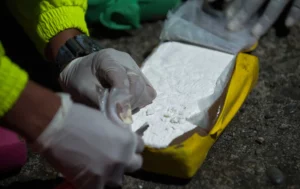
The supply chain works like this: cocaine produced in Colombia’s FARC dissident-controlled territories flows to Ecuadorian gangs who channel it through Pacific and Caribbean ports. From there, Mexican cartels — primarily the Jalisco New Generation Cartel (CJNG) — handle the final leg into the United States, the world’s largest consumer market.
The Trump administration has formally identified a link between Los Lobos and CJNG structures. Mexican military documents obtained by El País show Ecuador‘s government has known about the CJNG-Los Lobos connection for at least five years. The recent death of CJNG leader Nemesio Oseguera, known as Mencho, in a military confrontation in Jalisco has clouded the current shape of the Mexican-Ecuadorian criminal relationship.
Colombia’s FARC Dissident Connection
President Gustavo Petro celebrated the arrest and confirmed that Lobo Menor was linked to Iván Mordisco — the leader of the FARC dissident faction known as the Estado Mayor Central, which rejected the 2016 peace accord. Mordisco is Colombia’s most wanted fugitive, with a bounty of 5 billion pesos ($1.3 million).
The Mordisco connection adds a third country to the criminal web. Los Lobos grew rapidly after splitting from Los Choneros, Ecuador’s historically dominant gang, during the 2021 prison massacres that killed over 100 inmates. Their expansion was financed by narcotrafficking networks and CJNG support, eventually giving them control over more than half of Ecuador’s provinces.
The Villavicencio Assassination
Prosecutors say Aguilar did not merely order the killing — he planned it and ensured the operation remained secret. On August 9, 2023, Villavicencio was shot dead leaving a campaign event in northern Quito.
One of the seven hitmen died at the scene. The other six, all Colombian nationals, were arrested and then murdered inside Ecuadorian prisons days later — destroying a critical path to the truth.
The assassination marked a point of no return for Ecuador, which has experienced an extraordinary surge in homicides over the past six years. Whether Aguilar was hiding in Mexico City or conducting business there remains unclear. What is clear is that the arrest proves what security forces across three countries have long suspected: the cocaine trade has fused the criminal ecosystems of Colombia, Ecuador, and Mexico into a single, integrated, and increasingly violent network.