

For 80 days, María Corina Machado crisscrossed the corridors of power in Washington, met with Donald Trump in the Oval Office, and handed him her Nobel Peace Prize. On Sunday, she announced she is heading home.
In a video posted to social media, the opposition leader said she would return within weeks, joining hundreds of thousands of exiles eager to go back. She laid out a three-part roadmap: rebuild the citizen networks from the opposition’s primary campaign, forge a national consensus for a transitional government, and prepare for fresh elections.
From Clandestinity to the Oval Office
Machado left Venezuela in December 2025 in a cinematic extraction after more than a year underground. The disputed July 2024 election, in which the opposition says its candidate Edmundo González Urrutia won decisively, had triggered a repressive wave that drove her into hiding.
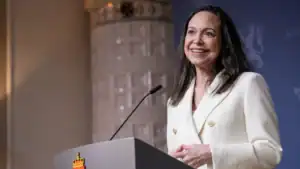
She flew to Oslo to collect the Nobel Peace Prize, then to the United States, where she met Secretary of State Marco Rubio, 17 senators, 27 members of Congress, ten foreign ministers, and several unnamed heads of state.
A Country Transformed
The Venezuela Machado left is not the one she would return to. On January 3, US forces captured Maduro and his wife Cilia Flores in a pre-dawn Caracas raid. Both face narcoterrorism charges in New York and have pleaded not guilty.
Delcy Rodríguez, Maduro’s former vice president, was sworn in as interim leader days later. She has consolidated power swiftly — signing a hydrocarbon reform opening the oil sector to foreign investment and pushing through an amnesty bill for political prisoners.
The Amnesty Trap
That amnesty law is precisely the obstacle that could block Machado’s homecoming. Signed on February 19, it has produced over 1,500 applications and freed hundreds of detainees. But it explicitly excludes anyone prosecuted for promoting foreign armed actions against Venezuela.
Rodríguez considers Machado to fall squarely within that exclusion. In a CBS interview, the interim president warned that the opposition leader would have to answer for allegedly requesting military intervention. Former attorney general Tarek William Saab has classified her as a fugitive from justice.
Caught Between Two Powers
Washington’s evolving stance complicates things further. Trump said he would like to involve Machado in the Venezuelan government but simultaneously praised Rodríguez’s leadership. A CIA assessment reportedly concluded that Machado lacks sufficient support to govern, and her relationship with the administration has frayed since she accepted the Nobel rather than deferring it to Trump.
The Road Ahead
In her video, Machado struck a tone of inevitability, arguing the regime had been defeated in stages — spiritually, politically, electorally, and finally militarily. She called on Venezuelans to prepare for a massive new electoral victory.
Whether she can convert that rhetoric into reality depends on variables outside her control: Washington’s willingness to press Rodríguez, the military’s tolerance for genuine opening, and whether a fractured Chavista elite will let the woman they call a fugitive walk through Caracas. Revolutions rarely follow a script.