

Key Points
- Dubai will expand DIFC with the Zabeel District, a AED 100 billion ($27.2 billion) project running through 2040.
- The plan targets a premium office bottleneck, with Grade A occupancy reported near 95.5% in late 2025.
- The bigger story is a three-way Gulf contest, measured against older global hubs and Switzerland’s wealth machine.
Dubai is expanding its flagship financial district because its success created a new problem: there is not enough room left for the next wave of firms.
The Dubai International Financial Centre, founded in 2004, will build a new precinct called DIFC Zabeel District across the road from the original site.
The expansion’s gross development value exceeds AED 100 billion ($27.2 billion). It will roll out in six phases, open to the public in 2030, and aim for completion in 2040.
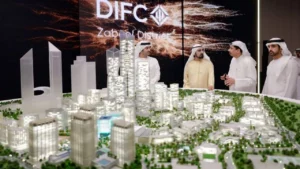
DIFC says the project covers a 7.1 million square foot site and adds 17.7 million square feet of gross floor area. DIFC’s growth has been fast enough to strain supply.
By late 2025, DIFC said it hosted more than 8,000 active registered companies. That rise matters to Dubai’s broader economy. DIFC-linked reporting has said the financial services sector captured 52% of all foreign direct investment flowing into Dubai.
Dubai Expands DIFC As Global Finance Hub
Another official estimate put DIFC’s 2021 contribution to Dubai’s nominal GDP at about 5%. Zabeel District is planned as mixed-use, not just more towers. The first phase is expected to include six office towers, two residential towers, a hotel, and an AI campus.
DIFC and Dubai’s media office have also pitched futuristic transport links, including connections to the proposed Dubai Loop, plus readiness for autonomous vehicles and flying taxis.
How big is DIFC in global terms already. The Global Financial Centres Index ranks cities, not countries. In its 38th edition, Dubai ranked 11th worldwide.
That puts it in the same conversation as Frankfurt and Paris, and within sight of Singapore, but far behind Switerland, which is a different kind of heavyweight.
The Gulf rivalry explains the timing. Abu Dhabi’s ADGM is scaling with sovereign backing. Riyadh is also pulling firms with deep state capital and incentives. Dubai’s answer is to add space, speed, and a stronger technology pitch.