

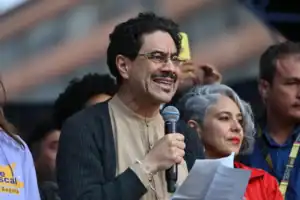
Nearly two hundred believers gathered in a Bogotá school auditorium on Tuesday to hear a leftist presidential candidate talk about God, peace, and Colombian politics. Muslims sat beside Catholic priests, Anglican clergy alongside indigenous spiritual leaders, convened by a grassroots group called “Con Iván Creemos” — With Iván We Believe.
It was a campaign rally for Iván Cepeda, the Pacto Histórico candidate who leads every major poll ahead of the May 31 presidential first round, and it signaled a deliberate shift: the Colombian left is taking the fight for religious voters to the right’s home turf.
Why Religion Matters in Colombian Elections
Around 80% of Colombians identify as believers. Evangelical and Pentecostal churches have grown rapidly, and their political influence has been overwhelmingly conservative. In 2016, evangelical leaders helped defeat the peace referendum with the FARC, framing the accords as a threat to family values. Parties like Colombia Justa Libres have since formalized the link between conservative Christianity and right-wing politics.
But religious communities also have deep roots in conflict zones. The National Center for Historical Memory documented nearly 600 religious leaders and communities victimized between 1982 and 2012, targeted not only for their faith but for their social engagement.
Peace, Not Theology
Cepeda’s pitch sidestepped the moral debates that conservative churches have traditionally placed at the center of politics. Attendees signed a declaration emphasizing dignity, environmental stewardship, and social justice. A Syriac Orthodox leader from working-class Bogotá neighborhoods framed it as practical: public policy shaped by religious communities should help people escape poverty.
Cepeda told the crowd that poverty was also a symptom of a broader moral crisis, and that religious communities were essential to reconciliation. He closed by invoking Martin Luther King Jr. alongside the guerrilla-priest Camilo Torres — a pairing that captures how Cepeda is trying to bridge liberation theology with mainstream religious sentiment.
Timing and Electoral Context
The rally came five days before Sunday’s legislative elections, when Colombians choose a new Congress and vote in presidential primary consultations. Cepeda‘s Pacto Histórico leads Senate polling with roughly 28% of voting intention, battling Álvaro Uribe’s Centro Democrático for the largest caucus.
Cepeda himself will not appear on Sunday’s ballot. The electoral tribunal barred him from the left’s interparty consultation in February, ruling his October primary victory counted as a consultation under the law. He will go directly to the May 31 first round, where polls show him leading with 31–37%, depending on the survey. His nearest rival, right-wing lawyer Abelardo de la Espriella, has closed the gap to roughly nine points, though Cepeda leads all simulated runoff scenarios by wide margins.
Can the Left Win the Faithful?
Whether two hundred believers in Teusaquillo translate into a meaningful electoral shift remains to be seen. The right’s infrastructure among evangelical congregations, built over a decade of organized engagement, dwarfs anything the left has assembled. But Cepeda’s gambit reflects a recognition that ceding the entire religious vote to the opposition is a luxury the left can no longer afford. With three months until Colombians choose their next president, the contest for their souls has become quite literal.