

- The Colombian government and the Clan del Golfo — the country’s largest armed criminal organization — confirmed Tuesday they have resumed peace negotiations, two weeks after the cartel walked out in protest
- The crisis erupted after President Petro visited the White House on February 3 and gave Trump a document pledging to capture three top drug lords within two months — including the Clan del Golfo’s own supreme commander, “Chiquito Malo”
- The episode exposes the central contradiction of Petro’s “Total Peace” policy: negotiating disarmament with armed groups while simultaneously promising Washington to hunt their leaders
There is a peculiar kind of diplomacy happening in Colombia right now. On February 3, President Gustavo Petro sat across from Donald Trump in the White House and handed him a document titled “Colombia: America’s #1 Ally Against Narcoterrorists.” It included photographs of three drug trafficking leaders, a promise of joint operations to capture them within 60 days, and a commitment to eradicate coca crops. One of the names was “Chiquito Malo” — the supreme commander of the Clan del Golfo, Colombia‘s largest criminal organization.
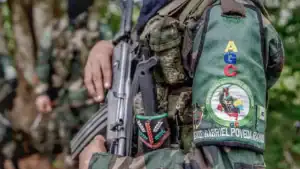
The problem: Petro’s government had been negotiating peace with that same organization since July 2024. A first formal round of talks was held in Doha, Qatar, in September 2025, mediated by Qatar, Spain, Norway, and Switzerland. The goal was disarmament in exchange for legal benefits — roughly the framework that ended the FARC insurgency in 2016. When news of the Trump document broke, the Clan del Golfo walked out, accusing Petro of prioritizing Washington over peace.
Both sides blink
Two weeks later, both parties have stepped back. The government’s defense ministry reportedly removed Chiquito Malo from its “high-value targets” list. The cartel agreed to resume talks after a meeting in Bogotá on February 9 organized by the international mediators and the Catholic Church. A joint statement said the suspension had been “overcome.”
The deeper question is whether any of this can hold. Petro’s “Total Peace” policy — simultaneous negotiations with at least ten armed groups — was the signature initiative of his presidency, but it has produced more fragmentation than resolution. Talks with the ELN collapsed after a devastating offensive in Catatumbo in January 2025 that killed over 80 people and displaced 64,000. FARC dissident factions have splintered further. Human Rights Watch called 2025 one of Colombia’s worst humanitarian years in a decade. With presidential elections in May 2026, Petro’s political capital is shrinking, and the armed groups know it. The Clan del Golfo returned to the table not because the contradiction was resolved, but because both sides need the process more than they trust it.