

Colombia’s coffee sector is having its worst start to a year in recent memory. February production fell 36% to 869,000 sixty-kilogram bags, the National Federation of Coffee Growers (Fedecafé) reported Thursday, following January’s 34% decline to 893,000 bags. Germán Bahamón, the federation’s general manager, attributed the collapse to reduced bean availability caused by adverse weather, warning that the figures confirm “an important adjustment in supply.”
Over the rolling 12 months through February, output stands at 12.72 million bags — down 14% from the same window a year earlier. The USDA had already forecast Colombian production at 12.5 million bags for the 2025/26 marketing year, a 5.3% decline from 13.2 million the previous season, but the pace of deterioration in early 2026 suggests even that reduced target may prove optimistic.
Rain and the Ripple Effect
Excess rainfall in Colombia’s Andean coffee belt since late 2025 has been the primary culprit. While coffee trees require regular precipitation, prolonged wet conditions disrupt flowering, complicate harvesting and hamper the drying process essential to bean quality. The pattern mirrors challenges that have plagued production in recent years, from El Niño droughts in 2024 to La Niña-driven excess moisture now. For the roughly 540,000 families that depend directly on coffee — 95% cultivating fewer than five hectares — the production swing translates directly into reduced income.
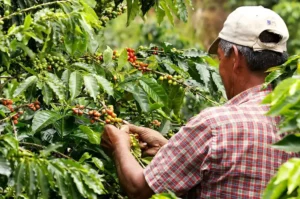
Exports are tracking the decline. Preliminary February shipments fell 32% to 807,000 bags. In the current coffee year running from October, Colombia has exported 5.06 million bags, down 14%. Imports of 116,000 bags in February, and 1.32 million over the trailing 12 months, are being used primarily to supplement industrial processing. Domestic consumption holds steady at 2.3 million bags annually, underscoring solid local demand even as the export pipeline thins.
A Shifting Price Landscape
The production decline arrives at a complicated moment for global coffee markets. Arabica futures, which peaked above $4.23 per pound in November 2025 — a record driven by drought fears in Brazil and tight global stocks — have retreated sharply to around $2.80–3.00 per pound. The correction was triggered by Conab’s forecast of a record 66.2 million bags for Brazil’s 2026/27 harvest, up 17.2% year on year, and by Rabobank’s projection of 180 million bags in global output for the same period. The World Bank expects arabica prices to fall 13–15% in 2026.
For Colombian growers, the timing creates a double bind. Higher prices in 2025 had partially cushioned the impact of lower volumes, with farmgate prices reaching a record 3.12 million pesos per 125-kilogram bag in February of that year. But as international prices soften while production continues to disappoint, the margin protection erodes. Input costs — fertilizer, labor — remain elevated, and the federation’s price stabilization mechanism has not been activated because prices, while falling, still exceed the trigger threshold.
What Comes Next
Bahamón urged countercyclical measures, specifically increased fertilization and the renewal of aging plantations to consolidate the next productive cycle. Colombia has modernized significantly: 87% of coffee area is now planted with rust-resistant varieties, up from 35% in 2010, and planting density has reached a record 5,340 trees per hectare. A new cultivar, Castillo 2.0, was released in late 2024 for improved climate resilience.
The broader picture for the world’s second-largest arabica producer remains one of structural vulnerability. Global consumption continues to grow, expected to reach 170 million bags in the current season, and Colombia exports more than 93% of its output. But with weather increasingly erratic and margins under pressure, the country that gave the world Juan Valdez is finding it harder to keep up with the demand its reputation generates.