

Late on a Monday night in Bogotá, Colombia’s Defense Minister Pedro Sánchez raced across the city for another emergency meeting. Two congressional candidates had been kidnapped that day. With elections five days away, security had stopped being one campaign issue among many and become the only one that mattered.
Colombians will vote on March 8 to elect 102 senators and 186 lower house members, and participate in three interparty presidential consultations. They will do so under the heaviest security deployment in recent memory, in the shadow of a political assassination that has haunted the campaign from the start.
The Uribe Turbay Effect
What distinguishes this electoral cycle is a single event. On June 7, 2025, Senator Miguel Uribe Turbay was shot at point-blank range during a campaign rally in Bogotá. He died two months later, becoming the first high-profile political assassination in Colombia in decades. The 38-year-old Centro Democrático senator and presidential pre-candidate was the son of journalist Diana Turbay, killed during a botched rescue from Pablo Escobar’s kidnappers in 1991.
The killing reshaped the political landscape. Uribe Turbay had been leading presidential polls at the time of his death, and his father took up the family banner as a pre-candidate. Nine people have been detained; authorities point to the Segunda Marquetalia, a FARC splinter group. But the intellectual authors remain unidentified.
A Cascade of Threats
Since then, every alert triggers emergency protocols. This week, Medellín’s mayor and Antioquia’s governor cancelled a visit to the country’s largest hydroelectric dam after a FARC dissident drone attack warning. The army confirmed the group’s capability but denied knowledge of the specific threat.
Two congressional candidates disappeared in remote regions last week; both were released. Their kidnappings followed Senator Aída Quilcué’s abduction in Cauca on February 10. The Defensoría del Pueblo now lists 69 municipalities at critical alert, with 457 death threats registered against political leaders during the campaign.
The Violence You Cannot See
But the most insidious threat is the quietest. Javier Flórez of the Fundación Ideas para la Paz estimates that 1.5 to 2 million voters, roughly 10% of the effective electorate, face armed pressure on their vote. In hundreds of municipalities under armed group control, campaigns are permitted but the outcome is already decided by whoever holds the guns.
The UN recorded 18 homicides and 126 attacks against political leaders in Colombia in 2025. In Cauca, candidates report armed checkpoints blocking campaign travel. Analysts note that not all incidents are genuine — some candidates may exaggerate threats for publicity, complicating the government’s task of separating real dangers from manufactured ones.
Deployment and Defiance
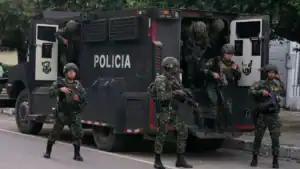
The government’s response is massive presence. Defense Minister Sánchez announced 246,000 uniformed personnel guarding more than 12,000 polling stations, with drone-jamming systems. The ELN guerrilla declared a ceasefire from March 7 to 10, though Sánchez dismissed it, citing broken promises in December when soldiers were killed despite a similar pledge.
The stakes extend beyond March 8. Presidential elections follow on May 31 and a potential runoff on June 22. For young Colombian politicians who grew up believing the worst was history, Uribe Turbay’s death was a brutal correction — they now feel what older generations felt during the assassinations of the 1980s.