

BCS / S&P IPSA Daily Report · March 4, 2026 · Covering March 3 Session
The Big Three
IPSA breaches 10,000 intraday for the first time since October as 5.9% plunge shocks Santiago. The index crashed to 9,931.28 at 11:14 AM local time — an intraday magnitude not seen since December 20, 2021, when markets reacted to Gabriel Boric’s presidential victory. A partial recovery pulled the close to 10,248.96 (−2.85%), but the four-session cumulative loss of 7.9% has wiped out all 2026 gains, leaving the IPSA at −2.2% YTD.
Chile’s oil import dependency makes it the most vulnerable LatAm market to Hormuz disruption. Unlike Mexico and Argentina, Chile imports virtually all its petroleum. The Brent surge directly threatens the inflation path and complicates the BCCh’s rate-cutting calculus. Betterplan’s Maximiliano Gré warned the central bank may now hold the TPM at its March meeting rather than cutting, despite January’s economic contraction.
Airlines and banks lead the carnage: Latam −5.3%, ILC −5.6%, Banco Santander −4.5%. Latam Airlines was crushed by the combination of surging jet fuel costs and Middle East airspace closures forcing longer routing. Financial heavyweights BCI (−4.0%), Banco de Chile (−3.2%), and Itaucórp (−3.0%) dragged the index lower as rate-cut expectations evaporated.
01 Session Data
| Metric | Value | Change |
| S&P IPSA Close | 10,248.96 | −2.85% |
| Session High | 10,549.28 | at open |
| Session Low | 9,931.28 | −5.9% intraday |
| USD/CLP | CLP 890 | +0.9% |
| Copper (LME) | $4.38/lb | −1.2% |
| BCCh TPM | 4.75% | unchanged |
| S&P 500 | 6,816.63 | −0.94% |
| Brent Crude | $81.40 | +4.71% |
| VIX | 23.57 | +9.93% |
| IPSA YTD | −2.2% | turned negative |
02 Key Movers
| Ticker | Close (CLP) | Change |
| ILC | 18,600 | −5.58% |
| LTM (Latam Airlines) | 21.98 | −5.30% |
| ECL (Enel Chile) | 1,365 | −4.94% |
| BSANTANDER | 68.58 | −4.48% |
| BCI | 54,642 | −3.97% |
| CENCOSUD | 2,600 | −3.70% |
03 Market Commentary
The Santiago exchange suffered its most violent session since April 2025’s “Liberation Day” tariff shock, with the IPSA crashing to 9,931.28 at mid-morning — a 5.9% intraday plunge that briefly wiped out the index’s entire 2026 rally. That magnitude of intraday loss had not been seen since December 20, 2021, when markets convulsed after Boric’s presidential election. A partial afternoon recovery, aided by Trump’s tanker escort announcement and Wall Street’s own reversal, pulled the close to 10,248.96 (−2.85%), but the damage was severe: four consecutive sessions of losses totaling 7.9%, and the IPSA’s YTD performance has turned negative at −2.2%.
Chile’s structural vulnerability to the Hormuz disruption is worse than any other major Latin American market. As Betterplan’s Maximiliano Gré explained, Chile imports virtually all its petroleum, making higher oil a direct inflation threat. Unlike Brazil with its large domestic economy, or Mexico and Argentina with meaningful oil production, Chile absorbs the full impact of higher energy costs through its trade balance. The January economic contraction had raised hopes for a TPM cut at the March meeting, but Gré warned the central bank may now hold at 4.75% to assess inflationary risks.
The airline and banking sectors bore the worst of the selling. Latam Airlines, the index’s most heavily-traded name, plunged 5.3% on a toxic combination of surging jet fuel costs and Middle East airspace closures forcing longer, more expensive routing. ILC dropped 5.6%, while ECL (Enel Chile) fell 4.9%. The banking sector was hammered across the board: Banco Santander Chile lost 4.5%, BCI fell 4.0%, Banco de Chile dropped 3.2%, and Itaucórp Chile declined 3.0%. Banchile Corredores’ Javier Pizarro noted that higher oil directly impacts growth projections for oil-importing countries and raises inflation estimates.
The peso weakened to approximately CLP 890 per dollar, opening at 889.58 against the previous close of 882. Four consecutive sessions of depreciation have accumulated a 3.3% weekly loss. Copper — Chile’s economic backbone — fell on global demand fears despite the broader commodities rally, creating a uniquely hostile environment for Chilean assets: higher oil costs with lower copper revenue. The IPSA and Colombia’s COLCAP (−3.4%) were the worst performers in Latin America, while Brazil’s Bovespa (+0.2%) and Peru Select (+0.9%) managed to close positive.
04 Technical Analysis
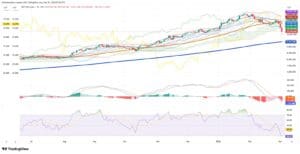
The IPSA’s technical picture has deteriorated sharply. The close at 10,248.96 sits below the Tenkan-sen (10,248.96 — effectively on the line), well beneath the Kijun-sen (10,458.80) and decisively below both Senkou spans (A: 10,540.46 / B: 10,683.39). The index has been below the cloud since late February, and the gap is widening. The cloud top at 10,826 represents a 5.6% recovery target — a meaningful distance that underscores the severity of the correction from the January 28 all-time high of 11,721.38.
The MACD remains deeply negative with the line at −45.64, signal at −73.95, and histogram at −119.59. All components are below zero and trending lower, showing no signs of momentum reversal. The histogram’s continued deterioration suggests the selloff has further to run before any bullish divergence emerges. The RSI tells a similar story: the fast line at 42.66 with the slow at 28.72, the latter now in deeply oversold territory. This is the lowest RSI reading since the September 2025 correction.
The Bollinger Bands have expanded significantly, reflecting spiking volatility. The lower band at 9,414.59 was not violated — the intraday low of 9,931.28 bounced approximately 500 points above it — but the bands’ width signals the potential for continued large swings. The midline at approximately 10,249 coincides almost exactly with the close, making this a critical juncture: a hold above would suggest the midline is acting as support, while a break below re-exposes the 9,931 intraday low and ultimately the lower band near 9,415.
| Level | Points | Reference |
| R3 | 11,721 | ATH (Jan 28) |
| R2 | 10,826 | Cloud top / upper BB |
| R1 | 10,459 | Kijun-sen |
| S1 | 10,249 | Mar 3 close / BB mid |
| S2 | 9,931 | Mar 3 intraday low |
| S3 | 9,415 | Lower Bollinger Band |
05 Forward Look
BCCh March Meeting:
The central bank faces a dilemma. January’s economic contraction and 8.3% unemployment argued for a rate cut, but the oil shock has introduced a competing inflation risk that did not exist two weeks ago. With the TPM at 4.75% and inflation targeting convergence to 3% by Q3 2026, the BCCh must now weigh short-term growth support against the medium-term price stability risk of imported energy inflation. Market pricing has shifted decisively toward a hold.
Copper vs. Oil Divergence:
Chile’s terms of trade are under acute pressure. Copper prices are falling on global recession fears while oil prices surge on supply disruption — the worst possible combination for an economy that exports copper and imports oil. If this divergence persists, the peso will face sustained depreciation pressure, further complicating the inflation outlook and eroding the FX-adjusted returns that attracted foreign investors in 2025.
Kast Government Transition:
The incoming administration’s pro-business reform agenda had been a key driver of the IPSA‘s rally from 7,136 to 11,721. That structural narrative remains intact, but the war has delivered an exogenous shock that the new government cannot control. The transition period creates an additional layer of policy uncertainty — will the new economic team pursue countercyclical stimulus if the downturn deepens, or maintain fiscal discipline? The market needs clarity, and until it gets it, risk premiums will remain elevated.
Verdict
The IPSA’s breach of 10,000 intraday is a watershed moment. Even though the close recovered above that level, the message is clear: the January–February rally has been completely unwound, and the index is now testing levels not seen since December 2025. The 13% drawdown from the all-time high, adjusted for FX depreciation, represents a genuine bear-market-magnitude correction for the Santiago exchange.
Chile’s unique vulnerability — oil importer, copper exporter, small open economy — makes it the most structurally exposed LatAm market to a sustained Hormuz disruption. The RSI’s slow line at 28.72 is deeply oversold, which could support a technical bounce, but the fundamental picture argues against bottom-calling. The copper-oil terms of trade divergence, the BCCh’s policy paralysis between growth support and inflation risk, and the evaporation of rate-cut expectations form a trifecta of headwinds.
Bias: BEARISH — the most bearish of our four LatAm markets. Below the cloud, RSI oversold, MACD deteriorating, and the worst structural exposure to the oil shock. The 9,931 intraday low is now the critical support; below that, the lower Bollinger Band at 9,415 is the next target. A reclaim of 10,459 (Kijun-sen) is needed to stabilize.
This report is for informational purposes only and does not constitute investment advice. Past performance is not indicative of future results. All data sourced from BCS, TradingView, Diario Financiero, BioBioChile, LarrainVial, Investing.com, Banco Central de Chile, Infobae. Chart: TradingView (riotimesonline). Report by The Rio Times. Verify all figures independently before making investment decisions.