

Seven hours. That is how long it took Fitch Ratings on Monday to downgrade Raízen twice — first from investment-grade BBB- to B at sunrise, then from B to CCC by evening — after the Brazilian biofuel giant announced it was hiring financial advisers to figure out how to stay solvent.
S&P Global followed with its own cut to CCC+. By the time São Paulo’s market closed, the company that was supposed to prove Brazil could lead the world’s energy transition had been stripped of every shred of investment-grade credibility it ever held.
The numbers behind the collapse are staggering. Raízen’s net debt hit R$53.4 billion in the second quarter of its 2025/26 crop year — up nearly 50 percent from a year earlier.
It has R$10.5 billion in obligations coming due within 18 months, at a time when Brazil’s benchmark interest rate makes refinancing ruinously expensive. Its leverage ratio has ballooned to more than five times earnings, and S&P expects it could reach six times by 2027.
The company posted a loss of over R$2.3 billion last quarter alone. Its stock, trading below R$1 since October, has been formally warned by the B3 exchange to get above the minimum price threshold or face sanctions by May.
What makes the story extraordinary is not just the debt — it is the silence of the two shareholders who built this company. Raízen is a joint venture between Shell, the European oil major, and Cosan, the Brazilian conglomerate controlled by billionaire Rubens Ometto.
Both have spent months publicly pledging to fix the balance sheet. Neither has written a check. Cosan raised R$10 billion in fresh capital in September — then explicitly told investors that none of it would go to Raízen.
Shell, for its part, is reluctant to inject enough money to push its stake above 50 percent, because that would force Raízen’s massive debt onto Shell’s own consolidated balance sheet. The result is a standoff that credit agencies have lost patience with.
Fitch cited the “failure of shareholders to execute a material capital injection” as the primary trigger for Monday’s downgrade.
Behind closed doors, the options being discussed are grim. Bloomberg reported last week that Raízen and its advisers — Citigroup for the company, Itaú BBA for Cosan, Lazard for Shell — have talked through scenarios including a debt haircut, a carve-out of part of the business, an equity offering, and a possible stake sale to Japan’s Mitsubishi.
Debt crunch derails Brazil biofuel champion
The company’s dollar bonds have been in freefall: the 2032 notes crashed 12 cents on the dollar in a single day earlier this month, with yields jumping above 14 percent from 6.5 percent at issuance. Institutional investors who are only allowed to hold investment-grade paper are now forced sellers, accelerating the spiral.
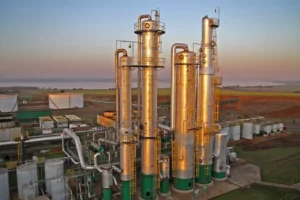
The tragedy is that Raízen’s underlying business was supposed to be the future. The company operates 24 sugarcane mills, runs the Shell-branded fuel distribution network across Brazil, and pioneered second-generation cellulosic ethanol — a biofuel made from sugarcane waste that produces 97 percent fewer greenhouse emissions than gasoline.
It had plans to build 20 E2G plants with R$24 billion in investment, targeting 1.6 billion liters of annual capacity. European buyers had already signed long-term contracts.
A Harvard Business School case study asked whether Raízen could “help decarbonize the world.” The answer, it turns out, depended on whether anyone could first decarbonize the balance sheet.
What went wrong is a familiar emerging-market story with a Brazilian accent. Raízen bet aggressively on expansion — new plants, new technology, acquisitions — just as the era of cheap global capital ended.
Brazil’s interest rates soared. Sugar prices weakened. Droughts and wildfires destroyed seven percent of the cane crop in 2024. Working capital demands in the seasonal harvest cycle devoured cash.
By the time management began selling assets and cutting investment, leverage had already crossed the point where operational fixes alone could restore confidence.
For international investors, the implications extend well beyond one ticker symbol. Raízen is the world’s largest sugarcane ethanol producer and one of the most prominent vehicles for the idea that Brazil’s agricultural powerhouse can underpin a profitable green energy transition.
If a company backed by Shell and one of Brazil’s wealthiest families cannot make the math work, the signal to every other emerging-market biofuel bet is unmistakable: ambition without capital discipline is just debt with better marketing. The next earnings report drops Tuesday. The restructuring advisers are already in the building.