

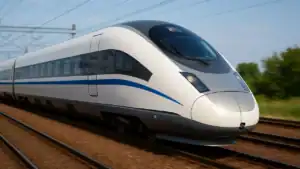
After three decades of studies, false starts, and shifting political priorities, Brazil’s first medium-speed intercity train finally has a face. The concession holder TIC Trens unveiled the exterior design of the Trem Intercidades this week: a streamlined composition in navy blue, red, and orange with an elongated aerodynamic nose, built to cover 101 kilometers between Sao Paulo and Campinas in 64 minutes flat.
Construction is set to begin in May. If the project holds to its timeline, commercial operations would start by 2031, giving Latin America’s largest economy something it has conspicuously lacked: a modern passenger rail link between major cities.
Two Services, One Corridor
The project actually comprises two distinct services along the same corridor. The express Trem Intercidades will run nonstop from Sao Paulo’s Agua Branca station to Campinas with a single stop in Jundiai, reaching speeds of 140 km/h and carrying up to 860 passengers per trip. Tickets are priced at R$64 ($11).
A second, slower service called the Trem Intermetropolitano will connect Jundiai to Campinas over 44 kilometers in 33 minutes, making stops at Louveira, Vinhedo, and Valinhos. That service will carry up to 2,048 passengers per trip at R$14 ($2.40). The intermetropolitan service is expected to begin operations first, by 2029.
Engineering at the Heart of the Challenge
The hardest part is not building new track. It is rebuilding existing infrastructure without shutting it down. Between Jundiai and Sao Paulo, the express train will share the corridor of the existing Linha 7-Rubi commuter line, which currently moves 400,000 passengers daily and shares its tracks with freight trains operated by MRS Logistica.
The solution requires constructing dedicated tracks for each service: one for the express, one for commuters, and a third for freight. That means rerouting existing rails while keeping the commuter line running, building a 600-meter tunnel near Francisco Morato, and installing 17 passing sidings along the route. CEO Pedro Moro has called this the project’s most complex phase, with work on this stretch set to begin in April 2027.
The Flood Factor
Several stations sit in flood-prone areas, particularly in Franco da Rocha and Francisco Morato. While the stations themselves have been elevated, surrounding streets can become impassable during Sao Paulo’s intense rainy season. Moro acknowledged that drainage and flood mitigation would be critical components of the civil works.
Chinese Trains, Brazilian Ambition
The consortium behind TIC Trens pairs CRRC, the world’s largest rolling stock manufacturer, with Brazilian holding company Grupo Comporte. CRRC holds 40% of the venture and is building a manufacturing facility in Araraquara, in Sao Paulo’s interior, repurposing the former Hyundai Rotem plant. Seven of nine maintenance vehicles have already arrived from China through the Port of Santos.
The 30-year concession contract, signed in February 2024, carries a total investment of R$16.85 billion ($2.8 billion), of which R$9.5 billion ($1.6 billion) comes from the Sao Paulo state government. The project expects to serve up to 45,000 passengers daily and is designed to be competitive with both bus services and private cars for a commute that currently takes at least two hours by road during peak traffic.
For a country that has talked about intercity rail since the 1990s, the unveiling of a train design and a confirmed construction date marks a tangible shift. Whether it becomes the template for three additional intercity lines Sao Paulo has planned depends on whether TIC Trens can deliver on time and on budget. Brazil’s rail ambitions have failed that test before.