

Key Points
Nearly eight years after a drive-by shooting silenced one of Rio de Janeiro’s most prominent voices against political violence, Brazil’s highest court has convicted the men who ordered the killing. The verdict draws a direct line from an elected official’s murder to the paramilitary structures that have quietly shaped politics in Brazil’s second-largest city for decades.
The Verdict
On Wednesday, a four-justice panel of the Supreme Federal Court unanimously convicted Domingos Brazão, a counselor on Rio’s state audit court, and his brother Chiquinho Brazão, a former federal congressman, of ordering the murders of councilwoman Marielle Franco and her driver Anderson Gomes on the night of March 14, 2018. Each received 76 years and three months in prison.
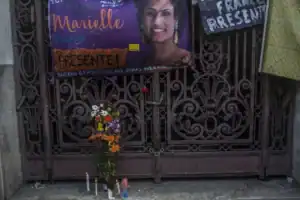
Three co-defendants were also found guilty. Former military police major Ronald Paulo Alves Pereira received 56 years for tracking Franco’s movements. Former Rio police chief Rivaldo Barbosa got 18 years for corruption and obstructing the investigation. Robson Calixto Fonseca, an assistant to Domingos Brazão, received nine years. The court ordered R$7 million ($1.2 million) in compensation to the victims’ families.
Why They Killed Her
Franco, 38, was a Black, gay, favela-born councilwoman from the Socialism and Liberty Party (PSOL) who had become a powerful critic of militia expansion in Rio’s western neighborhoods. The Brazão brothers had built a financial empire through illegal land grabs on public territory in these areas, using militia networks to control access and extort residents.
Justice Alexandre de Moraes, who oversaw the trial, said the brothers believed they could eliminate Franco without consequences. He described how political motivation combined with what he called misogyny, racism, and discrimination. Justice Cármen Lúcia closed her vote with a question that hung over the courtroom: how many more Marielles will Brazil allow to be murdered?
The Long Road to Accountability
For years, the investigation stalled. Barbosa, appointed police chief the day before Franco’s assassination, was supposed to lead the inquiry but instead derailed it. The breakthrough came in 2024 when triggerman Ronnie Lessa, sentenced to 78 years, named the Brazão brothers as part of a plea deal. His accomplice Élcio de Queiroz received 59 years.
The case exposed what analysts call Rio’s parallel state: militia groups that began as vigilante units against drug gangs but evolved into criminal enterprises controlling territory, extorting communities, and operating under political protection. The Brazão brothers, the court concluded, were not merely connected to this system. They were integral to it.
Franco’s widow, Mônica Benício, now a Rio councilwoman herself, called the conviction a landmark for Brazilian democracy. Her sister Anielle Franco, Brazil’s Minister of Racial Equality, called it a historical milestone. But the family’s grief sits alongside a stubborn fact: Domingos Brazão has continued drawing his R$56,000-per-month government salary from prison, collecting over R$726,000 ($125,000) since his arrest. In Brazil, convicting the powerful and stripping them of power remain two different things.