

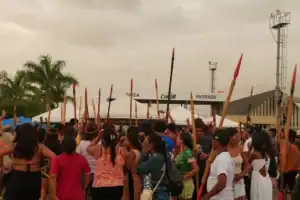
For 33 days, hundreds of Indigenous protesters from 14 peoples of the lower Tapajós basin occupied a Cargill grain terminal in Santarém, deep in the Brazilian Amazon. On Monday, the government blinked. Ministers Guilherme Boulos and Sônia Guajajara announced the revocation of Decree 12,600, which had included stretches of the Tapajós, Madeira and Tocantins rivers in Brazil’s National Privatization Program, opening the door to private concessions for dredging, navigation management and waterway maintenance.
What the Decree Proposed
Signed in August 2025, the decree was a preliminary step — not an automatic authorization of works, as the government repeatedly stressed. It aimed to improve navigability on Amazonian waterways that already move about 41 million metric tons of cargo annually. In December, authorities announced R$ 74.8 million ($14 million) for dredging 250 kilometers of the Tapajós between Itaituba and Santarém, designed to accommodate larger barges carrying soy and corn to northern export ports.
Brazil is the world’s largest soybean producer, shipping 171.5 million metric tons in the 2024–25 season. Northern ports are strategic for reaching Asian markets, and cargo movement in the region rose over 10% last year to 163.3 million metric tons. The Ministry of Ports argues that waterborne transport emits roughly 70% less greenhouse gas per ton than road haulage — a point that proponents say makes river concessions a greener alternative to cutting new highways through the forest.
Why Indigenous Groups Resisted
The Tapajós and Arapiuns Indigenous Council argued the decree was advanced without Free, Prior and Informed Consent, a right guaranteed under ILO Convention 169 to which Brazil is a signatory. Leaders warned that industrial dredging would threaten fisheries, water quality and sites of cultural significance. Munduruku leader Alessandra Korap, a Goldman Environmental Prize laureate, celebrated the revocation as proof that resistance works.
The protest escalated sharply. On February 21, demonstrators entered Cargill’s offices and suspended operations at a terminal that handles roughly 5.5 million metric tons of grain annually — about 70% of the region’s exports. A judge ordered the site cleared, putting the government in a bind: deploy police against Indigenous families or negotiate.
Two Narratives, One Reversal
Boulos cast the decision as evidence that Lula’s government “has the capacity to listen.” For the environmental left and Indigenous movements, the episode vindicated organized pressure and reaffirmed that Amazonian rivers cannot be treated as mere export corridors. Amazon Watch called it a major victory and urged that consultation must come “before, not after, decisions are made.”
The right saw it differently. Lawmaker Pedro Lupion, president of the powerful Parliamentary Agricultural Front, called the Cargill occupation illegal and warned that Brazil’s legal framework does not authorize the invasion of private property or forced interruption of operations. Conservative commentators accused the government of rewarding vandalism, arguing that the reversal signals that public policy can be undone by whoever shouts loudest, undermining the legal certainty investors need.
The Wider Contradiction
The standoff lays bare a tension at the heart of Lula’s presidency as he seeks reelection. His government styles itself as a global climate leader, yet it needs the infrastructure that agribusiness demands to keep Brazil’s trade surplus flowing. An interministerial working group has been created to guide future dialogue and review land demarcation demands in the Tapajós basin. Whether that produces a durable framework or merely delays the next confrontation will say much about whether Brazil can reconcile its export ambitions with the rights of the people who live along the rivers that carry its grain.