

The S&P Merval tumbled 1.6% to 2,754,419 on Thursday — touching its lowest level since late November — as banking stocks cratered in lockstep with a sharp Nasdaq selloff triggered by Nvidia’s tepid guidance. Banco Macro led the carnage with a 6.1% plunge, followed by Banco Supervielle (−3.5%). ADRs fared even worse in New York, with Banco Macro shedding 7.3%, Supervielle 6.8%, and Galicia 4.8%. The index is now 16.4% below its January 28 all-time high of 3,296,502.
Country risk surged 15 points to 554 basis points — the highest since January 21 — as sovereign bonds fell 0.4% on average following the Tesoro’s Bonar 2027 placement. The Secretaría de Finanzas placed USD 100 million on Thursday and USD 150 million the prior day in its new dollar-denominated bond, part of a plan to raise USD 2 billion by mid-year to cover the July sovereign maturity. Bond market weakness reflected broader EM risk-off sentiment compounded by local concerns over Argentina’s earnings season outlook.
The dollar rose for the third consecutive session, with the mayorista closing at ARS 1,408 (+0.6%) — back above 1,400 for the first time since February 11 — while the BCRA still managed to buy USD 41 million in the MULC. Reserves fell USD 749 million to USD 46,156 million on technical end-of-month bank movements and debt payments, after touching a six-year high of USD 46,905 million the day before. The blue dollar dropped ARS 20 to ARS 1,425, matching the official retail price.
Key Indicators — February 26, 2026
| Indicator | Close | Change |
|---|---|---|
| S&P Merval | 2,754,419 | −1.62% |
| Merval Weekly | — | −3.11% |
| Merval YTD | — | −9.89% (1M) |
| Distance from ATH (3,296,502) | — | −16.4% |
| USD/ARS Mayorista | 1,408.00 | +0.6% |
| USD/ARS Official (BNA Venta) | 1,425.00 | +0.7% |
| Dólar Blue | 1,425.00 | −1.4% |
| Dólar MEP | 1,435.40 | +0.85% |
| Dólar CCL | 1,480.10 | +0.53% |
| Country Risk (EMBI+) | 554 bps | +15 bps |
| BCRA Reserves | USD 46,156M | −749M |
| BCRA Rate (Monetary Policy) | — | — |
| Inflation (Jan 2026) | 2.9% m/m | 32.4% YoY |
| S&P 500 | 6,908.86 | −0.54% |
| Banda Superior BCRA | 1,605.40 | 14% above spot |
Banks Lead Selloff as Argentina Posts Worst Global Equity Performance of 2026
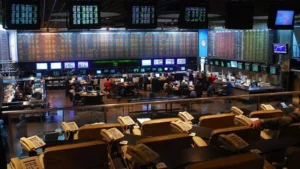
The session was overwhelmingly driven by the financial sector. Banco Macro collapsed 6.1% domestically and 7.3% in its New York ADR, making it the worst-performing large-cap in the BYMA session. Banco Supervielle shed 3.5% at home and 6.8% in its ADR, while Grupo Financiero Galicia lost 4.8% in New York. The sell-through from Wall Street’s tech rout was amplified by Argentina’s idiosyncratic weakness.
Ignacio Morales, CIO of Wise Capital, framed the context bluntly: Argentina has the worst-performing equity market in the world so far in 2026. He noted that the upcoming earnings season will be crucial, as companies need to demonstrate they can sustain margins and generate cash in an environment of contractionary monetary policy, high real rates, and significant peso appreciation.
The Merval in dollar terms touched its lowest level since November 21, extending a drawdown that has erased the post-legislative-election euphoria. The Bovespa slipped just 0.1% and COLCAP dropped 4.4%, but Argentina’s underperformance relative to regional peers has become a persistent theme — raising questions about whether the market has fully priced in the macro stabilization under Milei or if structural headwinds are being underestimated.
Earnings season kicks off in earnest this week. Grupo Financiero Galicia reported on Wednesday (Feb 26), with YPF, TGS, and Transener scheduled for Thursday (Feb 27). Banco Macro and Vista Energy reported the day prior. Pampa Energía and Grupo Supervielle follow on March 2, BBVA on March 4, and BYMA and Edenor on March 6. The results will test whether current valuations — a P/E of approximately 17.4x according to IEB — are justified.
Dollar Reclaims 1,400 as Carry Trade Unwinds, BCRA Still Buying
The dollar mayorista advanced ARS 9 (+0.6%) to close at ARS 1,408, breaching the psychologically important 1,400 level for the first time since February 11. Volume collapsed to USD 213.1 million — less than half of the prior session’s USD 495.9 million — suggesting the move was driven more by demand concentration than panic. The band ceiling set by the BCRA stands at ARS 1,605.40, leaving the spot price 14% below the intervention threshold.
The BCRA extended its buying streak to 37 consecutive sessions, purchasing USD 41 million (19.2% of spot turnover) and bringing the 2026 total above USD 2,600 million — surpassing 26% of its annual target. The “phase 4” accumulation program has now totaled USD 2,681 million. Despite this, reserves fell sharply on the day due to end-of-month bank movements, a USD 30 million payment to international organizations, and the servicing of a provincial bond.
The blue dollar surprised by falling ARS 20 (−1.4%) to ARS 1,425, matching the official retail price at Banco Nación — an unusual convergence. The MEP closed at ARS 1,435.40 and the CCL at ARS 1,480.10, keeping the CCL-mayorista spread at approximately 5.1%. The dollar futures curve rose 0.5–0.7%, with the February contract (expiring Friday) settling at ARS 1,407.50, roughly ARS 100 below the band ceiling.
January inflation came in at 2.9% monthly (32.4% interannual), the highest reading since March 2025, driven by food and beverages (+4.7%) and restaurants (+4.1%). The REM survey from the BCRA projects inflation gradually declining to below 2% by April, but the persistence of above-target readings has kept real rates elevated and complicated the monetary easing timeline. The government postponed the planned IPC methodology update until mid-year.
Bearish Consolidation Deepens as RSI Approaches Oversold Territory
Thursday’s session produced a decisive red candle with OHLC of 2,799,876 / 2,825,680 / 2,720,686 / 2,754,419 (−45,457, −1.62%). The index closed near the lower Bollinger Band at approximately 2,754,419 — a level that coincides with the band’s lower boundary, signaling price is pressing against the floor of its volatility envelope. The candle body shows clear distribution, with the close well below the session open and near the low.
The RSI dual readings of 40.55 and 38.16 confirm that momentum is approaching oversold territory but has not yet reached the 30-level capitulation zone. This is the lowest RSI reading since the post-election correction in late 2025. MACD remains deeply negative with the signal line at −19,598, the MACD line at −53,615, and histogram at −73,213 — all three trending lower, indicating that bearish momentum is accelerating rather than exhausting.
The 200-day SMA at approximately 2,443,870 sits 11.3% below the current price, providing a structural floor for the secular uptrend. The Ichimoku cloud on the daily timeframe has been breached, and the Bollinger midline (around 2,881,381) now acts as first resistance. The index has been in a clear downtrend since the January 28 ATH, with lower highs and lower lows establishing a descending channel.
| Level | Price | Notes |
|---|---|---|
| Resistance 3 | 3,018,201 | Upper Bollinger Band |
| Resistance 2 | 2,881,381 | Bollinger midline / Ichimoku cloud |
| Resistance 1 | 2,803,689 | Near-term horizontal resistance |
| Current Close | 2,754,419 | Feb 26 close |
| Support 1 | 2,720,686 | Session low |
| Support 2 | 2,641,336 | Prior swing low zone |
| Support 3 | 2,443,870 | 200-day SMA |
Nvidia Sell-the-News Hammers Tech, EM Sentiment Weakens
The S&P 500 fell 0.54% to 6,908.86 as Nvidia dropped 5.7% despite beating estimates on both EPS ($1.62 vs. $1.53) and revenue ($68.13B vs. $66.21B). The market’s sell-the-news reaction reflected lingering concerns about the pace of AI spending returns. The Nasdaq shed 1.18% to 22,878.38, while the Dow barely held flat at 49,499.20 (+0.03%).
Oil slid as US-Iran nuclear negotiations advanced. Brent fell 1.54% to $70.85 and WTI settled at $65.25. Gold retreated to $5,173 as the DXY firmed to 97.80 (+0.18%). Treasury yields held steady with the 10-year near 4.05%. For Argentina, the global risk-off in tech amplified the existing domestic malaise, but the local story — high real rates choking activity, rising country risk, and a weak earnings outlook — remains the dominant driver.
Earnings Season and FX Dynamics to Set Near-Term Direction
The most immediate catalyst is Friday’s earnings slate: YPF, TGS, and Transener all report February 27. YPF’s results will be closely watched for Vaca Muerta production growth and the impact of asset sales under its 4×4 plan. Next week brings Pampa Energía and Supervielle (March 2), BBVA (March 4), and BYMA/Edenor (March 6). The earnings season is the market’s best chance to establish a floor.
On the macro front, the BCRA’s reserve accumulation trajectory remains the anchor for peso stability. The central bank has purchased over USD 2,600 million in 2026, but net reserves remain deeply negative at approximately −USD 9,856 million under the IMF methodology (per Eco Go). FMI negotiations continue in Buenos Aires, with the team reportedly “very happy.” The February inflation data (due March 10) and any signals on monetary easing will also shape sentiment.
Argentina’s equity market is caught in a vicious feedback loop: high real rates crush economic activity and corporate earnings, falling equities widen the country risk premium, and rising risk makes future easing harder to justify. Thursday’s 1.6% Merval drop and 15-point surge in country risk to 554 bps are symptoms of a market that has lost its post-election narrative without finding a new one.
The BCRA’s reserve accumulation provides a structural floor for the currency — 37 consecutive days of purchases and USD 2,681 million accumulated is genuinely impressive. But the paradox is clear: the same peso strength that enables reserve building is compressing corporate margins and making Argentine equities the worst-performing in the world in 2026.
Technically, the Merval is pressing against the lower Bollinger Band with RSI nearing oversold at 38–40. Earnings season is the make-or-break moment. If companies demonstrate they can survive the strong-peso environment, the 16% drawdown from the ATH will look like a buying opportunity. If not, the next stop is the 2,641,000 zone — and the 200-day SMA at 2,443,870 is not as far away as bulls would like.