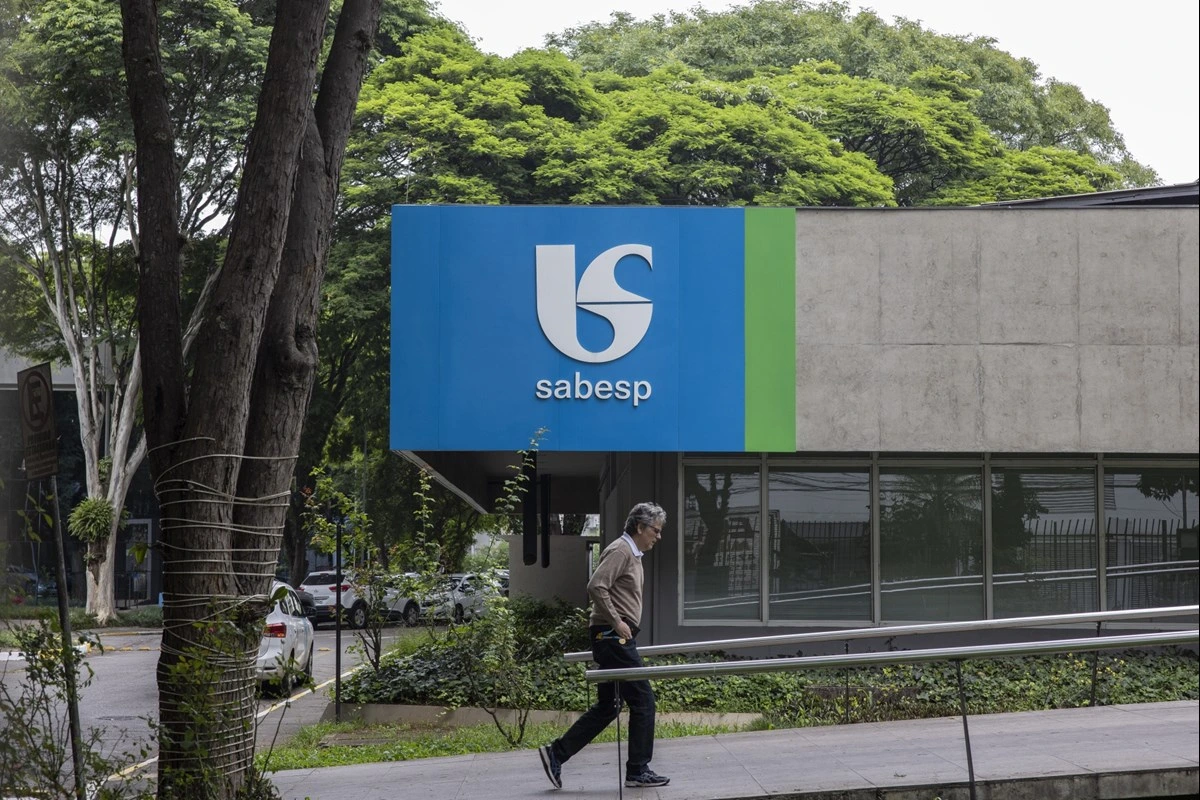
Sabesp (B3: SBSP3, NYSE: SBS), the São Paulo state water and sewage utility privatised by Equatorial Energia in July 2024 at R$67 per share, reported Q1 2026 adjusted net income of R$1.55 billion ($307M), up 32.2 percent year-on-year, according to the CVM filing released Thursday May 7.
EBITDA reached R$3.8 billion (+26%), slightly missing the R$3.99 billion analyst estimate, on adjusted revenue of approximately R$6 billion (+11%), per the filing. The result is the company’s first full-year quarterly report under private management, delivered two weeks after a 1-for-5 stock split took effect on April 29 (reducing the share price from approximately R$167 to R$33.40).
Sabesp ended March with net debt of R$32.5 billion, cash of R$19.2 billion, and a R$84 billion capex plan for 2026–2030 aimed at achieving universal water and sewage coverage in São Paulo by 2029.
The company has captured approximately 15 percent efficiency gains since privatisation through technology, digitalisation, and headcount optimisation, per CFO Daniel Szlak’s statements.
Key Points
What Sabesp Did in Q1 2026
Sabesp (Companhia de Saneamento Básico do Estado de São Paulo) is Brazil’s largest water and sewage utility, serving 28.4 million people across 375 municipalities in São Paulo state — approximately one-eighth of Brazil’s population. The company was privatised in July 2024 when Equatorial Energia acquired a controlling stake at R$67 per share, ending decades of state management. Since privatisation, Sabesp has undergone rapid transformation: headcount rationalisation, digitalisation of metering and operations centres, migration of energy procurement from regulated to free-market contracts (reducing one of its largest cost lines), and acceleration of capital investment from the historical R$3–4 billion annual pace to a projected R$20 billion in 2026 alone, according to CFO Daniel Szlak’s January 2026 interview with Money Times.
The Q1 profit growth of 32.2 percent was driven by lower provisions, energy cost savings, and the beginning of regulatory asset base (RAB) revaluation effects. The BAR (Base de Ativos Regulatórios) of R$88 billion approved for 2024 provides the foundation for tariff calculations that allow Sabesp to earn a regulated return on the invested capital base — a mechanism that becomes more valuable as the capex programme expands the asset base through 2030. Santander projects revenue of R$25.1 billion in 2026 rising to R$30.4 billion in 2027, with NI of R$6.5 billion and R$10.2 billion respectively, per their April research note. The EBITDA slight miss versus consensus (R$3.8B vs R$3.99B estimate) reflects the early-stage nature of the efficiency programme — the full impact of headcount reductions, system modernisation, and procurement savings will build through 2026-2027.
Live Company IntelligenceCompanhia de Saneamento Básico do Estado de São Paulo – SABESP — the full investor dossier
Valuation & profitability
Price & risk
$23.0152-wk high
$35.32
Revenue trend · 6y
Ownership
Dividend
Why Sabesp’s Q1 Matters
Sabesp is the second major Brazilian privatisation success story alongside Axia (ex-Eletrobras). The 32 percent profit growth, combined with the R$84 billion capex commitment, demonstrates that private management can simultaneously improve profitability and increase investment — resolving the state-management paradox where neither profitability nor investment reached adequate levels. The 1-for-5 stock split (effective April 29) was designed to increase retail investor accessibility and liquidity, reducing the per-share price from ~R$167 to ~R$33.40. CFO Szlak stated the company aims to achieve universal water and sewage coverage in São Paulo by 2029 — six years ahead of the 2035 national regulatory deadline — financing the expansion through a combination of operating cash flow, domestic debt (R$19 billion raised in 2025 alone), international bonds (first US dollar issuance in 12 years), and multilateral lending from the World Bank. The dividend payout ratio is scheduled to increase from 25 percent (2024-2025) to 50 percent (2026-2027) and up to 100 percent from 2030, creating a phased income growth story, per Genial Investimentos’ post-privatisation model.
Sabesp Q1 2026 Snapshot
| Indicator | Q1 2026 | Chg YoY |
|---|---|---|
| Adj. Net Income | R$1.55B ($307M) | +32.2% |
| EBITDA | R$3.8B ($752M) | +26% (missed R$3.99B est) |
| Adj. Revenue | ~R$6B ($1.19B) | +11% |
| Population Served | 28.4M across 375 municipalities | — |
| Capex Plan 2026-2030 | R$84B (~R$20B in 2026) | — |
| ND | Cash | R$32.5B | R$19.2B | — |
| Stock Split | 1:5 effective Apr 29 (R$167→R$33.40) | — |
| Santander TP (post-split) | R$35.22 (Outperform) | — |
What Happens Next for Sabesp
Capex ramp: R$20 billion in 2026 investment means R$5B per quarter — a pace that will test Sabesp’s project execution capacity. The company has returned to World Bank and multilateral lending after 12 years, per CFO Szlak.
Copasa acquisition: CFO Szlak confirmed Sabesp has adopted “a more active posture in analysing growth opportunities” post-privatisation, with Copasa (CSMG3, the Minas Gerais water utility) widely seen as the next target.
Dividend trajectory: Payout rises from 25% to 50% in 2026-2027, then to 75% in 2028-2029 and potentially 100% from 2030 as capex intensity moderates.
UniversalizaSP: The programme to achieve universal water/sewage by 2029 could position Sabesp for new concession bids across Brazil, extending the franchise beyond São Paulo.
Why did Sabesp’s share price drop from R$167 to R$33?
Sabesp executed a 1-for-5 stock split effective April 29, 2026. Each shareholder received four additional shares for every share held, reducing the per-share price proportionally without changing the total market value. The split was designed to increase retail investor accessibility and trading liquidity. Santander adjusted its target to R$35.22 post-split from R$176.39 pre-split.
How has privatisation changed Sabesp?
Equatorial Energia acquired control in July 2024 at R$67 per share. Since then, Sabesp has captured approximately 15 percent in efficiency gains through headcount optimisation, digitalisation, and free-market energy procurement. Investment has accelerated from R$3-4 billion historically to a projected R$20 billion in 2026 alone, funded by operating cash flow, domestic debt, and international bonds.
What is Sabesp’s capex plan?
Sabesp plans R$84 billion in capital investment from 2026 to 2030, targeting universal water and sewage coverage in São Paulo by 2029, six years ahead of the national regulatory deadline. Approximately R$40-50 billion will be financed through debt, with the remainder from operational cash flow. The company has AAA domestic credit rating and above-sovereign global rating.
Updated: 2026-05-08T15:00:00-03:00 by Rio Times Editorial Desk
Sabesp Q1 2026 | SBSP3 earnings | Brazil sanitation privatisation Equatorial | Latin American financial news | The Rio Times
This article was produced by The Rio Times’ automated newsroom system. How we use AI · Report an error · Editorial responsibility: Matthias Camenzind, Editor-in-Chief
LatAm Markets: Live Signals → — real-time movers, turnover leaders and FX across Latin America.
Read More from The Rio Times