Petrobras CEO Sees Oil Falling to $70 by Year End
Key Facts
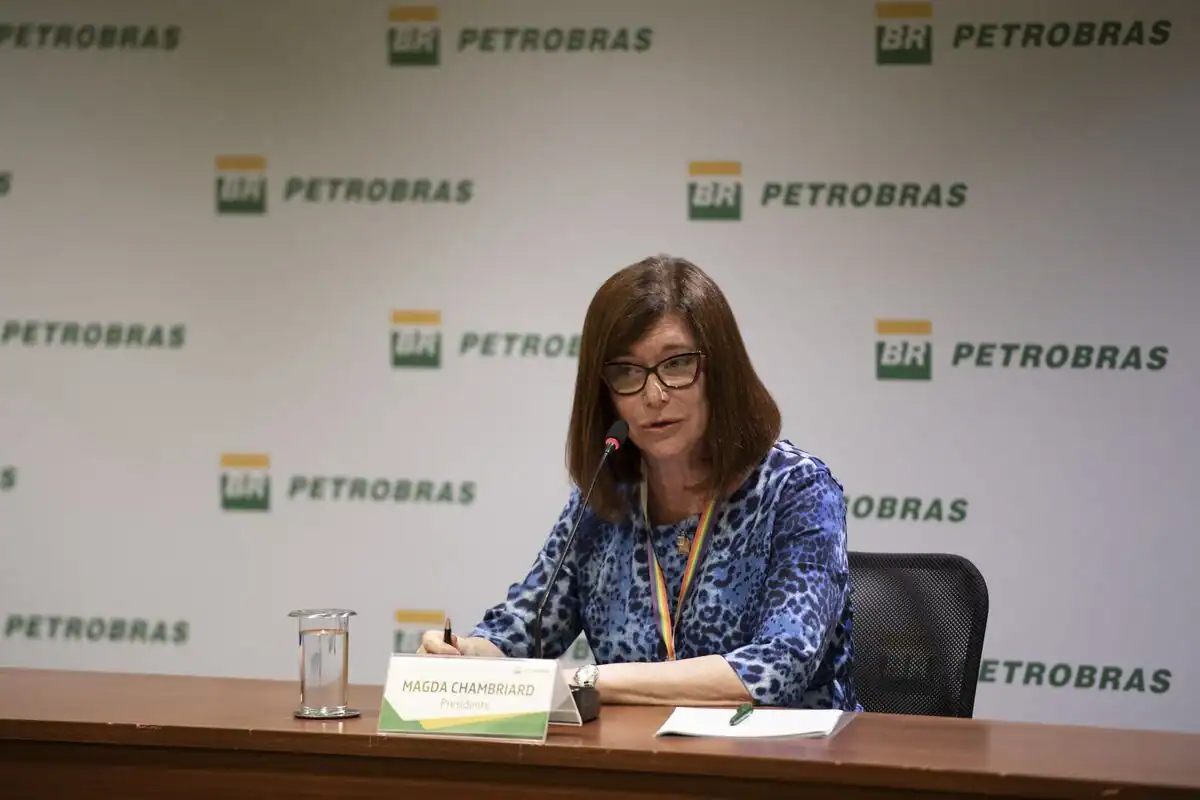
— — Petrobras CEO Magda Chambriard publicly stated Tuesday April 28 that the company’s Petrobras oil forecast targets Brent crude at approximately US$70 per barrel by year-end 2026 — a structural counterpoint to current Brent levels above US$110 driven by the Iran-Hormuz war that began February 28. Chambriard spoke at an event in Duque de Caxias, Rio de Janeiro state. Quote: “We prepare ourselves for low prices. Our projects must be resilient at low prices. We must be capable of dealing with that.”
— — Forecast context: Brent at US$111 Tuesday — up over 50 percent year-to-date due to Iran-Hormuz disruption. Chambriard’s US$70 year-end target implies a 37 percent decline over the remaining 8 months of 2026. World Bank’s April 2026 Commodity Markets Outlook projects Brent baseline US$86 with US$115 downside scenario; Chambriard’s view is more dovish than World Bank’s central case.
— — Petrobras pricing strategy: company abandoned Import Parity Pricing (PPI) in May 2023, replacing it with a margin-flexibility framework based on willingness-to-pay versus willingness-to-accept. PETR4 up 55 percent year-to-date despite war disruption. CEO comments: “If you ask me whether we are pressured by international parity, we are not pressured by price.” No diesel/gasoline imports needed for April-May. Government subsidy receipts arriving. Lula proposes PIS-Cofins gasoline tax cut to absorb pricing pressure.
The Petrobras oil forecast Chambriard delivered Tuesday — Brent at US$70 by year-end despite the Iran war driving current prices above US$110 — is the most explicit Latin American oil-major counter-narrative to the consensus shock pricing the World Bank, Goldman, and JP Morgan have been signaling.
Latin America’s largest oil producer just delivered the most contrarian commodity-shock forecast of the cycle. The Rio Times, the Latin American financial news outlet, reports that the Petrobras oil forecast publicly delivered by CEO Magda Chambriard Tuesday April 28 sees Brent crude reaching approximately US$70 per barrel by year-end 2026 — implying a 37 percent decline from current US$111 levels and a more dovish outlook than the World Bank’s April 2026 baseline projection of US$86 (with US$115 downside scenario).
“We prepare ourselves for low prices,” Chambriard told reporters at an event in Duque de Caxias in Rio de Janeiro state. “Our projects must be resilient at low prices. We must be capable of dealing with that.” The framing is deliberate strategic communication: Petrobras is signaling to investors that the company’s capital-allocation framework assumes mean reversion to historical price ranges, not the structural-shock pricing currently visible in spot markets.
The Petrobras Oil Forecast Math
Brent closed Tuesday at approximately US$111 per barrel. Chambriard’s US$70 year-end target implies a 37 percent decline over the remaining 8 months of 2026. The forecast assumes some combination of Iran-Hormuz resolution, OPEC+ supply normalization (post-UAE-exit), and demand-side weakness from Chinese economic deceleration through Q3-Q4 2026.
The World Bank Commodity Markets Outlook released last week projected Brent at US$86 baseline for 2026 with US$115 in the downside (continued-war) scenario; Chambriard’s US$70 forecast sits below the World Bank baseline. Goldman Sachs’s April 2026 outlook had Brent at US$94 baseline, JP Morgan at US$98. The Petrobras CEO’s view is structurally more bearish than every major Wall Street commodity-research desk.
Two interpretations of the forecast divergence: either Petrobras has access to ground-level supply-chain data that suggests faster-than-consensus normalization, or the forecast is a strategic communication tool to discipline Brazilian government expectations and reduce political pressure for Petrobras dividend increases. Both interpretations are credible — Petrobras’s Iran-war-period production resilience supports the first; the politicized 2026 election context supports the second.
The Pricing-Strategy Context
Petrobras abandoned Import Parity Pricing (PPI) in May 2023, replacing the international-pricing-anchor model with a more flexible margin framework based on the maximum customer willingness-to-pay versus the minimum company willingness-to-accept. The new framework deliberately decouples Brazilian retail fuel prices from international Brent oscillations.
“If you ask me whether we are pressured by international parity, we are not pressured by price,” Chambriard said. The structural read: Petrobras‘s domestic-pricing model has decoupled successfully through the Iran-Hormuz period, with retail gasoline prices rising only 8 percent versus the 50+ percent rise in Brent. The decoupling has been Petrobras’s most consequential operational achievement of the war period.
Lula’s government is currently pushing a PIS-Cofins gasoline tax cut to absorb additional retail-price pressure ahead of October 2026 elections. Chambriard signaled the tax cut would be sufficient to avoid further Petrobras price increases. The implicit framework: government tax relief absorbs marginal cost-push, Petrobras maintains margin discipline, retail consumers see only modest fuel-cost increases through the election period.
Live Company IntelligencePetroleo Brasileiro Petrobras SA ADR — the full investor dossier
Wall Street view
Valuation & profitability
Price & risk
$10.7852-wk high
$26.12
Revenue trend · 6y
Ownership
Dividend
What This Means for Petrobras Shareholders
For PETR4 shareholders, Chambriard’s US$70 year-end forecast implies the current 55 percent year-to-date stock outperformance is structurally vulnerable to mean reversion through Q3-Q4 2026. If Brent does fall to US$70 by December, Petrobras’s 2026 EBITDA framework will compress meaningfully versus current expectations, even with continued operational discipline.
The forecast also frames Petrobras’s capital-allocation discipline. By signaling preparation for US$70 oil, Chambriard is justifying conservative dividend policy and continued Capex investment in pre-salt expansion (where breakeven costs remain below US$35 per barrel). The Argonauta acquisition announced last week reflects this framework — pre-salt consolidation makes economic sense at any oil price above US$45.
For international investors holding the PBR ADR, Chambriard’s forecast supports continued long-term exposure but increases short-term volatility risk. The 2026 election cycle adds binary outcome risk to oil-price mean-reversion risk. Strategic positioning: incremental long PBR via covered-call strategies that monetize current high implied volatility.
The Latin American Oil-Producer Comparison
Among Latin American oil majors, Petrobras’s structural breakeven advantage is decisive: pre-salt fields produce profitably below US$35 per barrel, Mexico’s Pemex breakeven hovers around US$50, Colombia’s Ecopetrol around US$45, and Argentina’s YPF Vaca Muerta operations around US$40. Venezuela’s PDVSA effective breakeven (excluding sanctions complexity) is around US$30 but with massive infrastructure deficit.
If Chambriard is right and Brent reaches US$70 by December, every Latin American oil producer remains profitable but with varying margin compression. Petrobras’s 100 percent of pre-salt production stays comfortably profitable while Ecopetrol and YPF face moderate margin pressure. Pemex’s operational leverage to high prices means significant Q4 2026 EBITDA compression versus a US$110 environment.
The structural read: Chambriard’s forecast is more credible than Wall Street’s because Petrobras has the most operationally-relevant data about Brazilian and global supply-demand dynamics. Whether the US$70 target materializes by December depends primarily on Iran-Hormuz resolution timing and Chinese demand recovery — two variables Petrobras cannot directly observe but can infer from logistics, freight, and customer-order pattern data that flow through its commercial operations.
More: Brazil news in English, every day from The Rio Times.
This article was produced by The Rio Times’ automated newsroom system. How we use AI · Report an error · Editorial responsibility: Matthias Camenzind, Editor-in-Chief