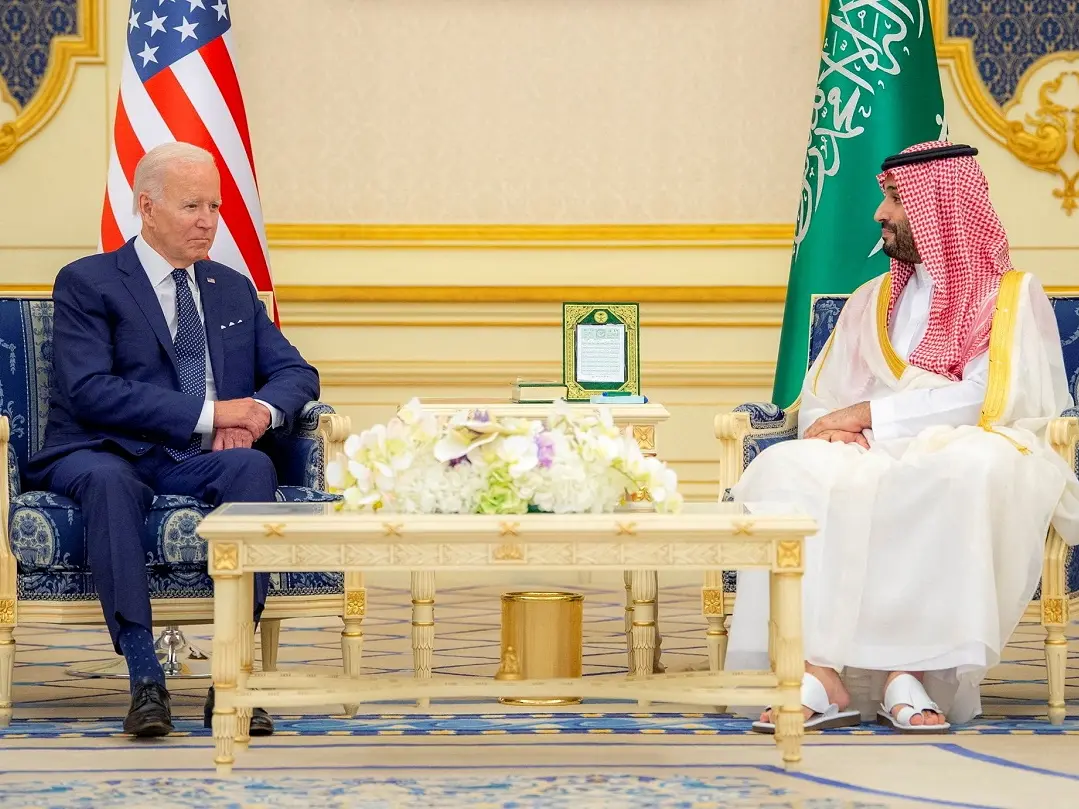
Reports indicate that the United States and Saudi Arabia are on the brink of finalizing a major security agreement.
This pact is poised to not only strengthen bilateral ties but also pave the way for Saudi Arabia to establish formal diplomatic relations with Israel.
This initiative is aligned with the broader American strategy aimed at enhancing its influence across the Middle East and countering the Chinese presence in the region.
Free daily brief — no card needed
Get every Middle East story in one morning email
We build you a personalized brief around the topics you follow — free for 7 days. Love it? Your first month after that is US$1.
The agreement stipulates that Saudi Arabia would reduce its use of certain Chinese technologies.
Rio Times membership
Read everything we publish for US$1 in the first month.
A pivotal element of this agreement is the establishment of diplomatic relations between Saudi Arabia and Israel.
This is contingent on progress towards a peaceful resolution between Israel and the Palestinians.
The success of these diplomatic efforts hinges on the creation of a feasible peace pathway for Palestinians. This echoes Saudi Arabia’s endorsement of the Arab Peace Initiative.
Moreover, ratification of the US-Saudi security pact by the U.S. Senate could face obstacles.
This is due to the complex political landscape of the Middle East and recent scrutiny of Saudi Arabia’s human rights practices.
The agreement, which mirrors the commitments of NATO, would commit the U.S. to defend Saudi Arabia in cases of military aggression.
Netanyahu Optimistic on Israeli-Saudi Peace Deal
Israeli Prime Minister Benjamin Netanyahu has expressed optimism about achieving a peace deal with Saudi Arabia.
He believes such an agreement could significantly move forward the peace process in the region and foster greater understanding between the Islamic world and Israel.
This initiative builds on the groundwork laid by the Abrahamic Accords, facilitated by the prior US administration. These accords sought to integrate Israel into regional diplomatic efforts.
However, these developments signify a strategic realignment in Middle East geopolitics.
Evolving alliances and the strategic recalibrations of significant global powers like the U.S. and Saudi Arabia drive them.
The outcome of these negotiations could herald a new era of cooperation and stability in the region.
This article was produced by The Rio Times’ automated AI newsroom. Editorial responsibility: Matthias Camenzind, Publisher and Editor-in-Chief. The Rio Times also runs Ask Rio Times, which answers from 100,000+ of our own articles, the daily Latin America Power Map, and prediction-market odds on elections and markets.. How we use AI · Report an error